Learning goals
- Relate pitch to source frequency.
- Compare periods and frequencies on equal-time traces.
- Separate a frequency change from an amplitude or scale change.
Frequency determines pitch
A faster repeating source vibration produces pressureThe normal force exerted per unit area, measured in pascals. changes more frequently. The arriving frequencyThe number of complete oscillations or wave cycles per second, measured in hertz. is associated with the pitchThe perceived highness or lowness of a sound, determined mainly by its frequency. heard: higher frequency means higher pitch, while lower frequency means lower pitch.
This comparison applies to steady tones. Real soundA mechanical wave produced by vibrations and transmitted through a material medium. can produce more complicated repeating traces; use matching points on successive cycles to find their periodThe time taken for one complete oscillation or repeating cycle..
Compare two traces
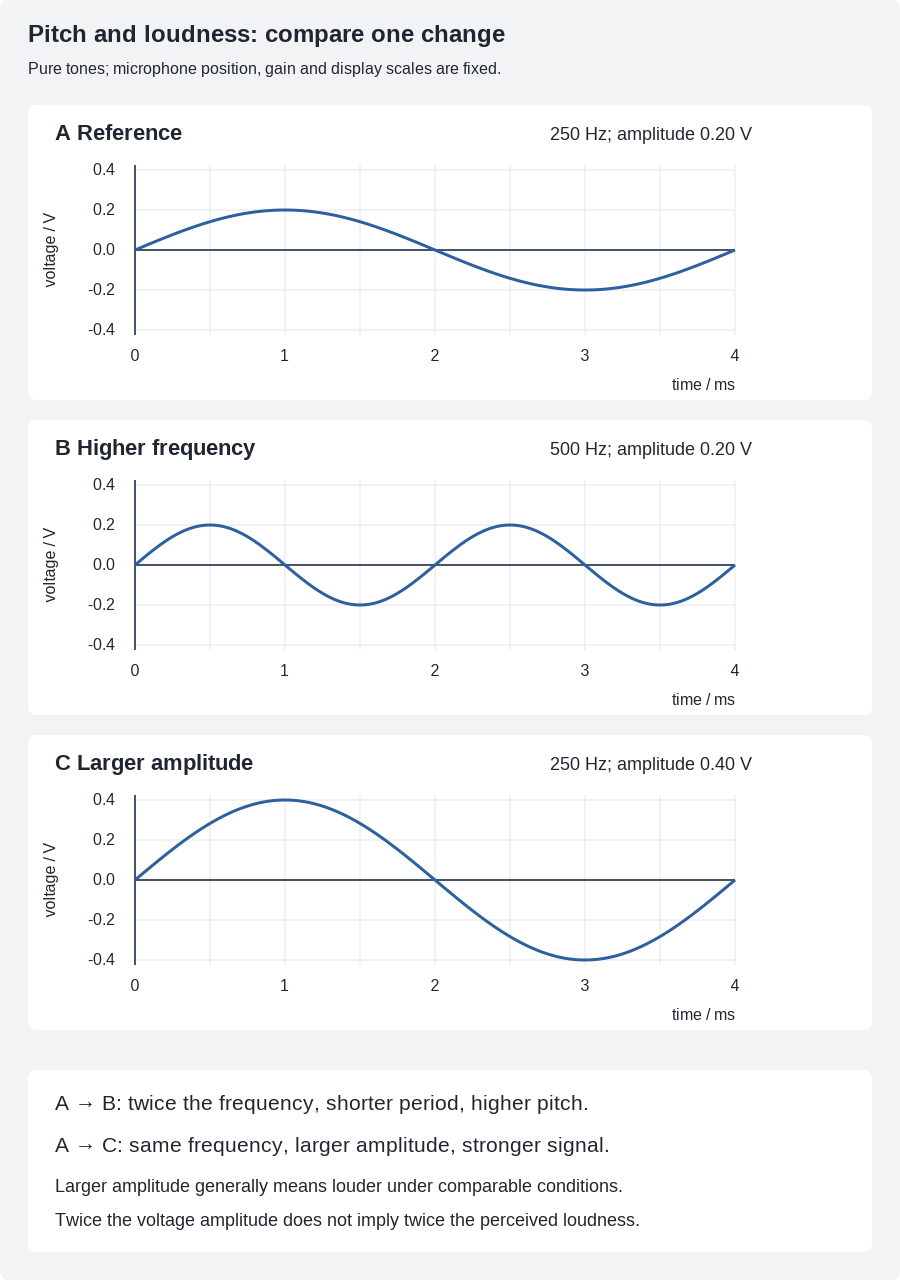
Trace A in the figure completes one cycle in 4.0 ms. Its frequencyThe number of complete oscillations or wave cycles per second, measured in hertz. is 1/0.0040 = 250 Hz. Trace B completes two cycles in the same 4.0 ms, so its periodThe time taken for one complete oscillation or repeating cycle. is 2.0 ms and frequency is 500 Hz. B represents the higher-pitched tone.
Both have the same model potential differenceThe energy transferred per unit charge between two points, measured in volts. amplitudeThe maximum displacement from the equilibrium position in an oscillation., 0.20 V. Their difference is the repetition rate. Counting more cycles across a screen indicates a higher frequency only if the timebase and total displayed duration are the same.
Predict a controlled change
Increase a signal generatorAn electronic device producing a varying voltage with a chosen frequency and waveform. from 250 to 500 Hz while using the same loudspeaker, microphone position and display timebase. The periodThe time taken for one complete oscillation or repeating cycle. halves and the trace fits twice as many cycles into the same time interval. This changes pitchThe perceived highness or lowness of a sound, determined mainly by its frequency.; it does not require the source displacementThe straight-line change in position from a starting point, with a specified direction. amplitudeThe maximum displacement from the equilibrium position in an oscillation. to increase.
To compare loudnessThe perceived strength of a sound, related to its intensity and the listener’s hearing response. separately, keep frequencyThe number of complete oscillations or wave cycles per second, measured in hertz. fixed and vary source amplitude, as on 5.29P. Equal microphone potential differenceThe energy transferred per unit charge between two points, measured in volts. at different frequencies do not guarantee equal perceived loudness because equipment and hearing sensitivity vary.
Equations
- f = 1/T; doubling f halves T.
Common misconceptions
- A taller trace does not by itself mean higher pitch.
- More cycles across the screen imply higher frequency only with a known common timebase.
- Pitch and loudness are different properties.