Learning goals
- Relate source vibration amplitude to sound loudness.
- Compare amplitudes using a common voltage scale.
- Identify controls needed for a fair loudness comparison.
Amplitude and stronger pressure changes
A source vibrating through a larger displacementThe straight-line change in position from a starting point, with a specified direction. pushes and pulls the surrounding air more strongly, producing larger pressureThe normal force exerted per unit area, measured in pascals. variations. Under comparable conditions this transfers more soundA mechanical wave produced by vibrations and transmitted through a material medium. energyA conserved quantity transferred between stores by working, heating, electrical processes or radiation, measured in joules. to the listener and is perceived as a louder sound.
frequencyThe number of complete oscillations or wave cycles per second, measured in hertz. describes how often the motion repeats; amplitudeThe maximum displacement from the equilibrium position in an oscillation. describes its size. A loudspeaker can keep the same frequency while the vibration amplitude increases, so a louder tone need not have a higher pitchThe perceived highness or lowness of a sound, determined mainly by its frequency..
Read the controlled comparison
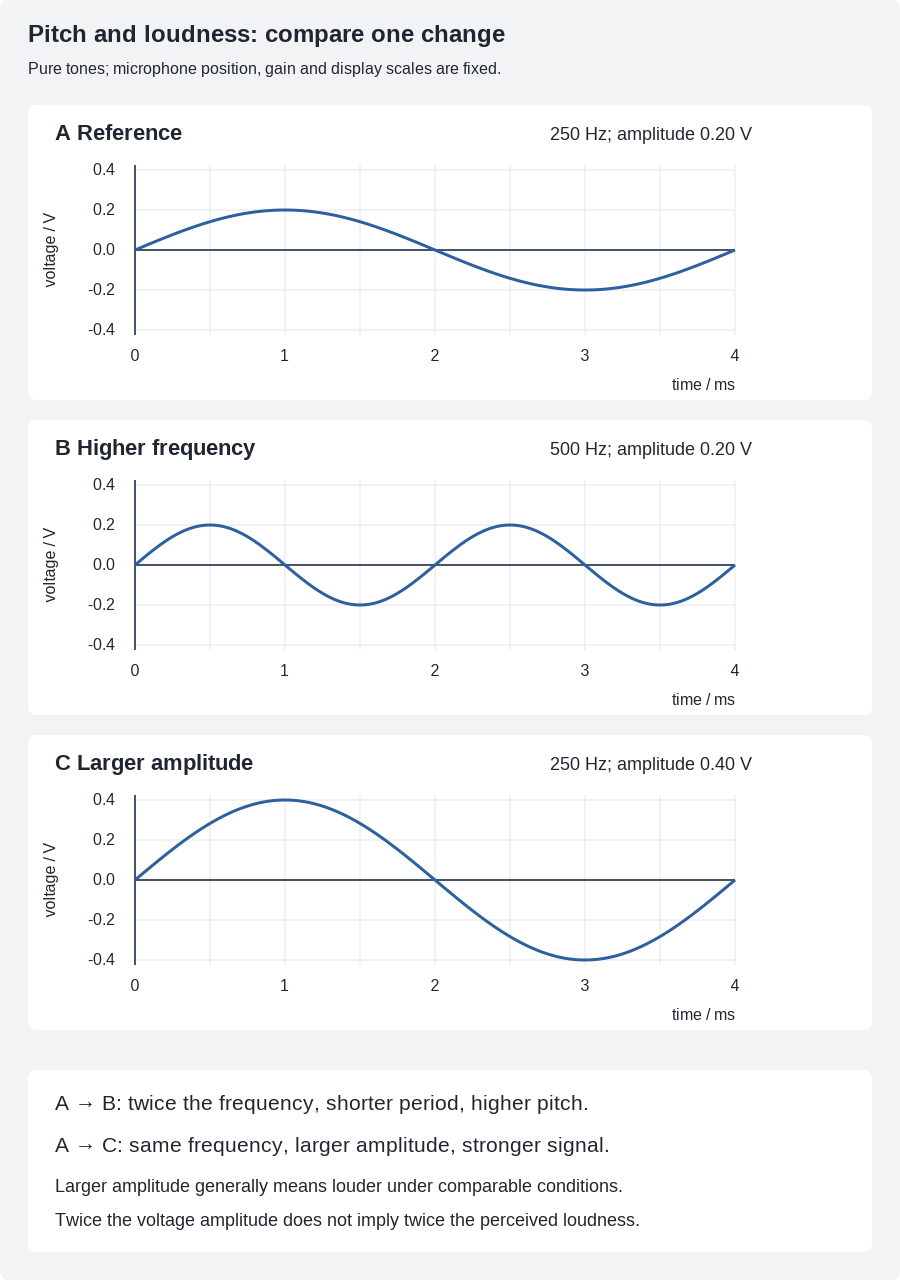
Trace A has model potential differenceThe energy transferred per unit charge between two points, measured in volts. amplitudeThe maximum displacement from the equilibrium position in an oscillation. 0.20 V and frequencyThe number of complete oscillations or wave cycles per second, measured in hertz. 250 Hz. Trace C has amplitude 0.40 V but the same 250 Hz frequency. On the shared vertical scale, C is twice as tall from zero to crestA point of maximum positive displacement on a transverse wave. while both complete one cycle in 4.0 ms.
With microphone position, sensitivity and gain fixed, the larger voltage represents stronger pressureThe normal force exerted per unit area, measured in pascals. variations reaching the microphone. It is evidence of a stronger signal; perceived loudnessThe perceived strength of a sound, related to its intensity and the listener’s hearing response. also depends on frequency and hearing sensitivity.
Make a fair practical comparison
Keep the source frequencyThe number of complete oscillations or wave cycles per second, measured in hertz., microphone distanceThe length of a path travelled, without regard to direction. and direction, amplifier gain and oscilloscopeAn instrument displaying how an input voltage changes with time. scales unchanged. Increase the drive amplitudeThe maximum displacement from the equilibrium position in an oscillation. moderately and compare the potential differenceThe energy transferred per unit charge between two points, measured in volts. amplitudes without allowing clipping. Keep all soundA mechanical wave produced by vibrations and transmitted through a material medium. at a comfortable level.
Moving the microphone closer or increasing gain can also enlarge the trace without changing the source vibration. Changing volts per division changes screen height even if the voltage remains the same. Record these controls before drawing a conclusion.
Limits of the simple relationship
Perceived loudnessThe perceived strength of a sound, related to its intensity and the listener’s hearing response. also depends on frequencyThe number of complete oscillations or wave cycles per second, measured in hertz., hearing sensitivity and the listening environment. The GCSE relationship identifies the effect of increasing amplitudeThe maximum displacement from the equilibrium position in an oscillation. with other conditions comparable; it does not provide a linear formula for subjective loudness.
Do not infer that doubling amplitude doubles perceived loudness. Use the separate frequency comparison on 5.28P to identify pitchThe perceived highness or lowness of a sound, determined mainly by its frequency. changes.
Equations
- Amplitude is measured from the equilibrium or zero level to an extreme, not from trough to crest.
Common misconceptions
- Twice the amplitude does not justify saying twice as loud.
- Frequency may remain constant while loudness changes.
- Microphone gain, position and display scale can change the trace without changing source amplitude.