Learning goals
- Explain the wave-speed relationship before using it.
- Rearrange v = fλ for any of its quantities.
- Predict wavelength changes when speed or frequency is held constant.
Why frequency multiplied by wavelength gives speed
Follow one crestA point of maximum positive displacement on a transverse wave.. In one complete oscillationOne complete repeated motion about an equilibrium position. of the source, the crest moves forward by one wavelengthThe shortest distance between two successive points in phase on a wave. λ. That cycle takes a periodThe time taken for one complete oscillation or repeating cycle. T, so speedThe distance travelled per unit time, without specifying direction. = distanceThe length of a path travelled, without regard to direction./time = λ/T. Since frequencyThe number of complete oscillations or wave cycles per second, measured in hertz. f = 1/T, this becomes v = fλ.
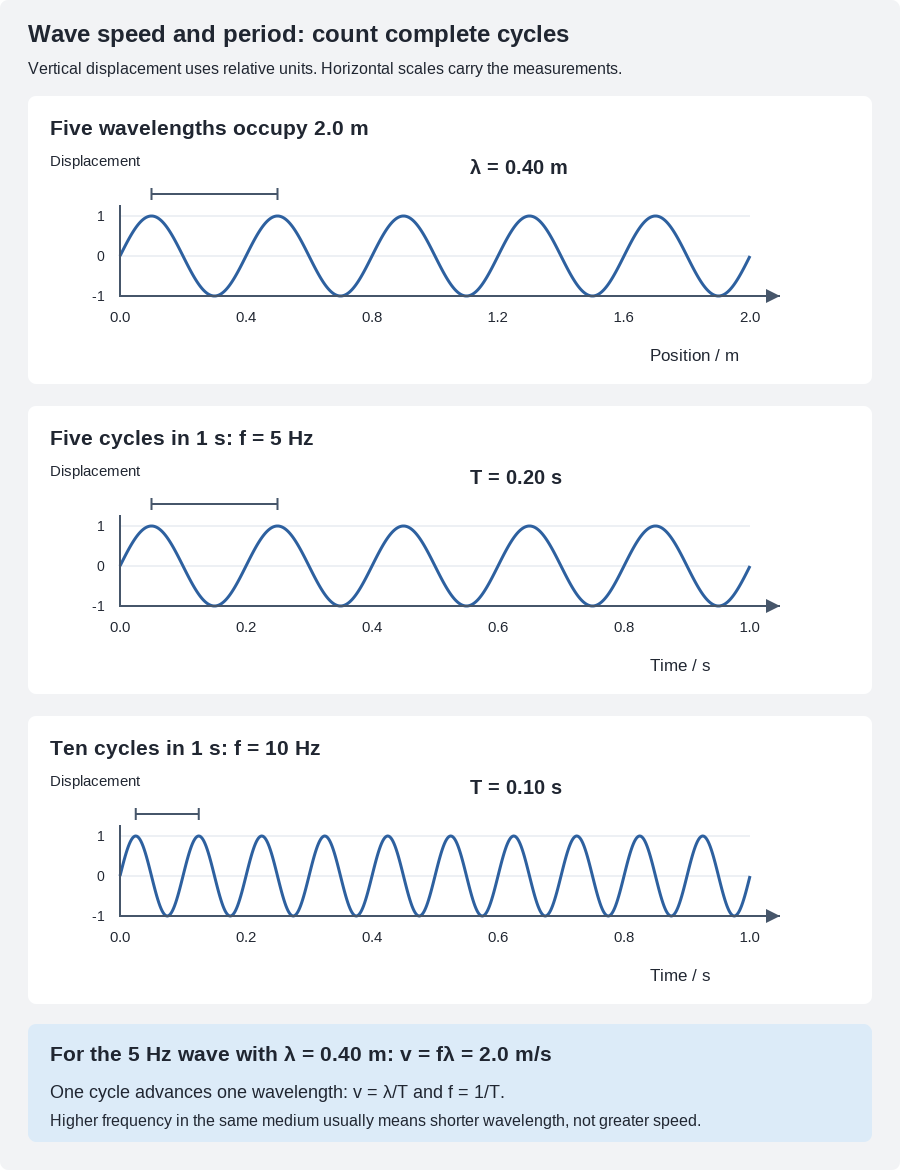
Equivalently, if five wavelengths pass a fixed point each second and each wavelength is 0.40 m long, the pattern advances 5 × 0.40 = 2.0 m each second. The speed is 2.0 m/s. This is the speed of the disturbance, not the local velocityThe rate of change of displacement, including the direction of motion. of a particle in the medium.
Worked calculation and rearrangements
For f = 5.0 Hz and λ = 0.40 m, v = 5.0 × 0.40 = 2.0 m/s. The spatial figure shows five wavelengthThe shortest distance between two successive points in phase on a wave. in 2.0 m, and its time record shows five complete cycles in 1.0 s. Both views agree.
Divide v = fλ by λ to find f = v/λ. A waveA travelling disturbance that transfers energy without an overall transfer of matter. travelling at 12 m/s with wavelength 3.0 m has f = 12/3.0 = 4.0 Hz. Divide by f instead to find λ = v/f. For v = 12 m/s and f = 6.0 Hz, λ = 12/6.0 = 2.0 m.
Change one quantity at a time
In a medium where the speedThe distance travelled per unit time, without specifying direction. is approximately fixed for the frequencyThe number of complete oscillations or wave cycles per second, measured in hertz. considered, increasing frequency decreases wavelengthThe shortest distance between two successive points in phase on a wave.. At v = 2.0 m/s, increasing f from 5 to 10 Hz reduces λ from 0.40 to 0.20 m. The waveA travelling disturbance that transfers energy without an overall transfer of matter. does not necessarily travel faster just because its source oscillates more often.
At a stationary boundary, the source sets the transmitted frequency. If the wave enters a slower region, its wavelength decreases in the same proportion. Some media have frequency-dependent speeds, so fixed speed is an assumption appropriate to the stated context, not a universal property of every wave.
Units and checks
Use wavelengthThe shortest distance between two successive points in phase on a wave. in metres and frequencyThe number of complete oscillations or wave cycles per second, measured in hertz. in hertz for a speedThe distance travelled per unit time, without specifying direction. in m/s. Convert 40 cm to 0.40 m before multiplying. Check dimensions: Hz × m means cycles per second × metres per cycle, leaving metres per second.
Check that an inverse relationship behaves sensibly: at fixed speed, twice the frequency should give half the wavelength. Retain intermediate precisionThe closeness of repeated measured values to one another. and round the final numerical answer appropriately.
Equations
- v = fλ; f = v/λ; λ = v/f
- v = λ/T
Common misconceptions
- Wave speed is not the speed at which a rope particle moves up and down.
- Increasing frequency alone does not establish an increase in wave speed.
Connect a wave snapshot to a local time trace
Change amplitude, frequency and wavelength while distinguishing wave propagation from local oscillation.
What you see
- Labelled diagrams and numerical outputs describe the same selected state.
How to use it
- Change one control at a time, predict the outcome, then compare the readouts. All controls have keyboard-accessible sliders and step buttons.
- Reset restores every model control to its initial value. Nothing is saved.
What it shows
- Wave speed=fλ and period=1/f. A snapshot plots displacement against position; the lower graph records one fixed point against time. The pattern and energy travel right while each marker oscillates locally. Amplitude changes the size of displacement, not the speed or period in this model.
Limits of the model
- An ideal smooth repeating transverse wave travels right without loss of amplitude. The black marker remains at position 2 m while moving transversely.
- The controls define a geometric wave, not a mechanical calculation for a particular rope or fixed medium. In a medium of fixed wave speed, frequency and wavelength cannot change independently. At zero amplitude the entered frequency and wavelength cannot be measured from the flat trace.
Controls
Predict, change and explain
At amplitude 0.5 m, frequency 1 Hz and wavelength 2 m, predict speed and period. Scrub time and follow the black marker. Then compare frequency 2 Hz with wavelength 1 m: what stays the same and what changes?
Connect the outcome to the Physics
Wave speed=fλ and period=1/f. A snapshot plots displacement against position; the lower graph records one fixed point against time. The pattern and energy travel right while each marker oscillates locally. Amplitude changes the size of displacement, not the speed or period in this model.