Reasoning about energy transfers
Account for energy, explain a transfer mechanism and state the conditions behind an energy prediction.
Specification 3.2, 3.3, 3.4, 3.5, 3.6, 3.7, 3.8, 3.9, 3.10, 3.11, 3.12, 3.13, 3.14, 3.15, 3.16, 3.17, 3.18P, 3.19P
Ratings, marks and Maths and Logic completion stay in this browser on this device. Written answers are temporary and are never recorded or transmitted. Reset clears only Physics practice progress, including Maths and Logic completion.
Answers and choices are temporary. Only started/completed flags are saved on this device. Practice can be retried or revealed; the check counts each question’s first answer. These are original practice tasks, not official exam questions.
Starting here
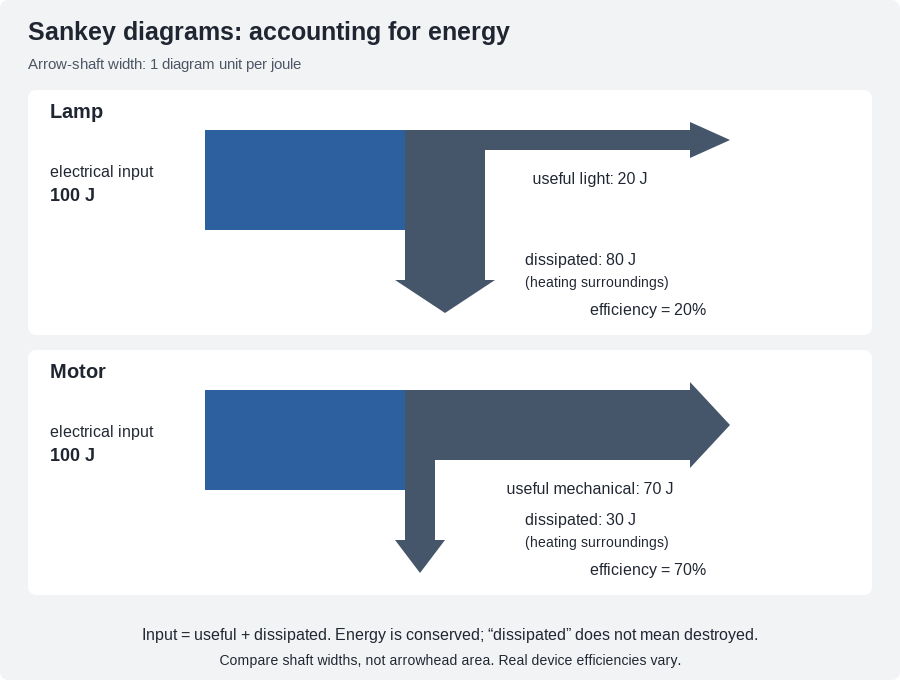
An energy explanation identifies the system, the stores that change and the pathways of transfer. Useful and unwanted outputs both belong in the account. The Sankey figure shows that a small useful fraction can coexist with conservation of energy.
For a prediction, name the quantity held constant and the relationship being applied. A larger energy transfer is not automatically greater power or efficiency. A thermal explanation also needs a mechanism: conduction, convection or radiation.
Key ideas
- Energy is conserved; dissipation spreads energy into less useful stores rather than destroying it.
- Power concerns transfer per time. Efficiency concerns the useful fraction of a complete output account.
- A model can neglect resistance or energy losses only when that approximation is stated and appropriate.
Worked example
The lamp in the figure receives 100 J and transfers 20 J as useful light and 80 J by heating, with no net accumulation. A student says its 20% efficiency breaks conservation because 80% is missing. Assess the claim.
- Account. Both outputs sum to 20+80=100 J.
- Distinction. Efficiency selects the useful light output, while conservation includes the heating transfer too.
- Conclusion. The device conserves energy even though most of its output is unwanted for illumination.
Answer: The 80 J is transferred by heating, not lost from the energy account. Low efficiency and energy conservation are compatible.
Activities
Opens when you finish the stage above.
Build the skill
Opens when you finish the stage above.
Check
Opens when you finish the stage above.