Learning goals
- Define a watt as one joule per second.
- Compare equal work completed in different times.
- Separate power, total energy and efficiency.
Rate rather than amount
powerThe energy transferred or work done per unit time, measured in watts. tells you how much energyA conserved quantity transferred between stores by working, heating, electrical processes or radiation, measured in joules. is transferred each second. One watt equals one joule per second. A motor can do the same total work as another motor yet have greater average power if it finishes sooner.
Average power over an interval is total energy transferred divided by elapsed time. If the rate changes during the interval, this average need not equal the power at every instant. Identify whether a stated power is electrical input or useful mechanical output.
Compare the two motors
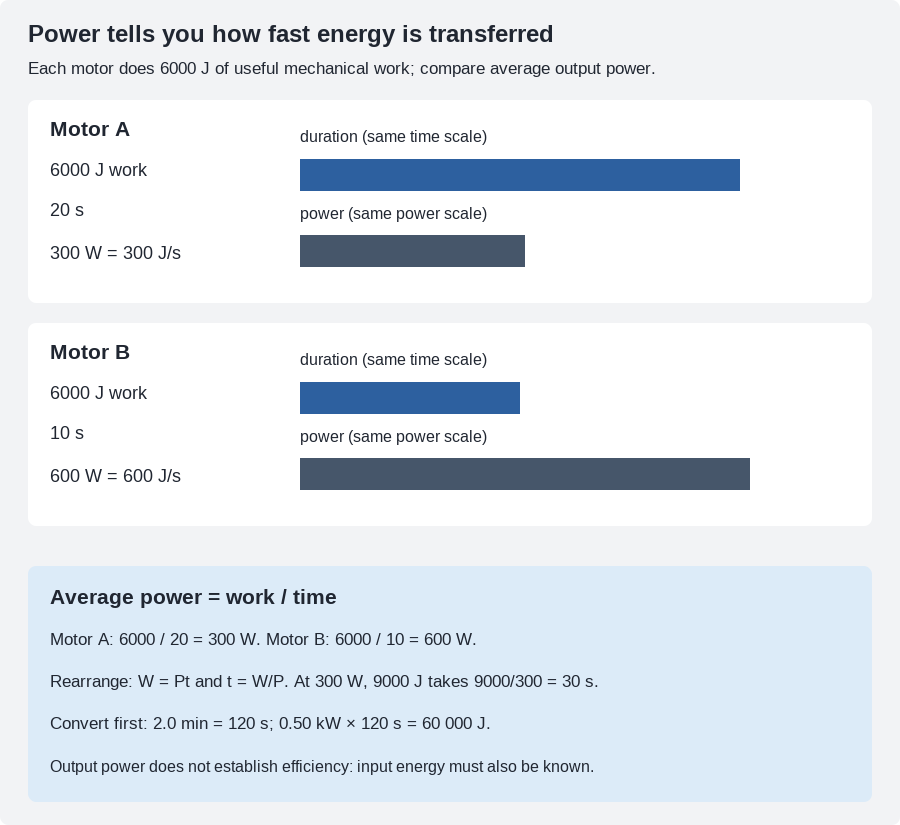
Motor A does 6000 J of useful work in 20 s: average output powerThe energy transferred or work done per unit time, measured in watts. = 6000/20 = 300 W. Motor B does the same work in 10 s: average output power = 600 W.
The shorter time bar and longer power bar describe the same energyA conserved quantity transferred between stores by working, heating, electrical processes or radiation, measured in joules. total. At constant power, energy equals power multiplied by time. A larger power rating does not by itself establish how much energy is used; operating duration also matters.
Connect power and efficiency correctly
Output powerThe energy transferred or work done per unit time, measured in watts. alone does not show efficiencyThe fraction of total energy input transferred usefully, also equal to useful power output divided by total power input.. If motor A receives 400 W electrically while delivering 300 W mechanically in steady operation, efficiency = 300/400 = 0.75 or 75%. The remaining 100 W is transferred in other ways, mainly increasing thermal stores.
A higher-power motor may be useful for completing a lift sooner, while a more efficient motor needs less input for the same useful work. These are separate comparisons; a device can be high-powered but inefficient.
Equations
- average power = energy transferred ÷ time
- 1 W = 1 J/s
Common misconceptions
- Power is a rate; it is not the energy stored in a device or the percentage transferred usefully.
Separate lifting work from lifting power
Change mass, vertical lift height and duration to compare work, energy gain and average useful power.
What you see
- Labelled diagrams and numerical outputs describe the same selected state.
How to use it
- Change one control at a time, predict the outcome, then compare the readouts. All controls have keyboard-accessible sliders and step buttons.
- Reset restores every model control to its initial value. Nothing is saved.
What it shows
- Work=force×distance moved in the force direction. Here force=mg, so useful work equals the gravitational potential energy gain mgh. Average useful power=work÷time; doing the same work faster needs greater average useful power.
Limits of the model
- An ideal vertical lift with g=10 N/kg and no friction; starting and finishing kinetic energy are equal.
- The force shown balances weight during steady motion. Starting and stopping intervals are neglected. Output power is the average useful power, not electrical input power or motor efficiency.
Controls
Work=200×3=600 J. Average useful power=600÷6=100 W. At zero lift height the work and useful power are zero; supporting a stationary load still requires force.
Predict, change and explain
Lift 20 kg through 3 m in 6 s. Predict work and average useful power. Halve only the time: explain which quantities change. Then double only height and compare work and power.
Connect the outcome to the Physics
Work=force×distance moved in the force direction. Here force=mg, so useful work equals the gravitational potential energy gain mgh. Average useful power=work÷time; doing the same work faster needs greater average useful power.