Learning goals
- Select and rearrange the power equation.
- Convert time and power units before substitution.
- Check calculations against physical expectations.
Identify the quantities
In P = W/t, P is average powerThe energy transferred or work done per unit time, measured in watts. in watts, W is work doneThe energy transferred by a force acting through a distance in its direction. in joules and t is elapsed time in seconds. W as a quantity symbol means work; W as a unit after a number means watt. energyA conserved quantity transferred between stores by working, heating, electrical processes or radiation, measured in joules. E can replace work W when the transfer is not mechanical.
Rearranging gives W = Pt and t = W/P. Use the input quantities together or the output quantities together: do not divide useful work by an input power without accounting for efficiencyThe fraction of total energy input transferred usefully, also equal to useful power output divided by total power input..
Model the method
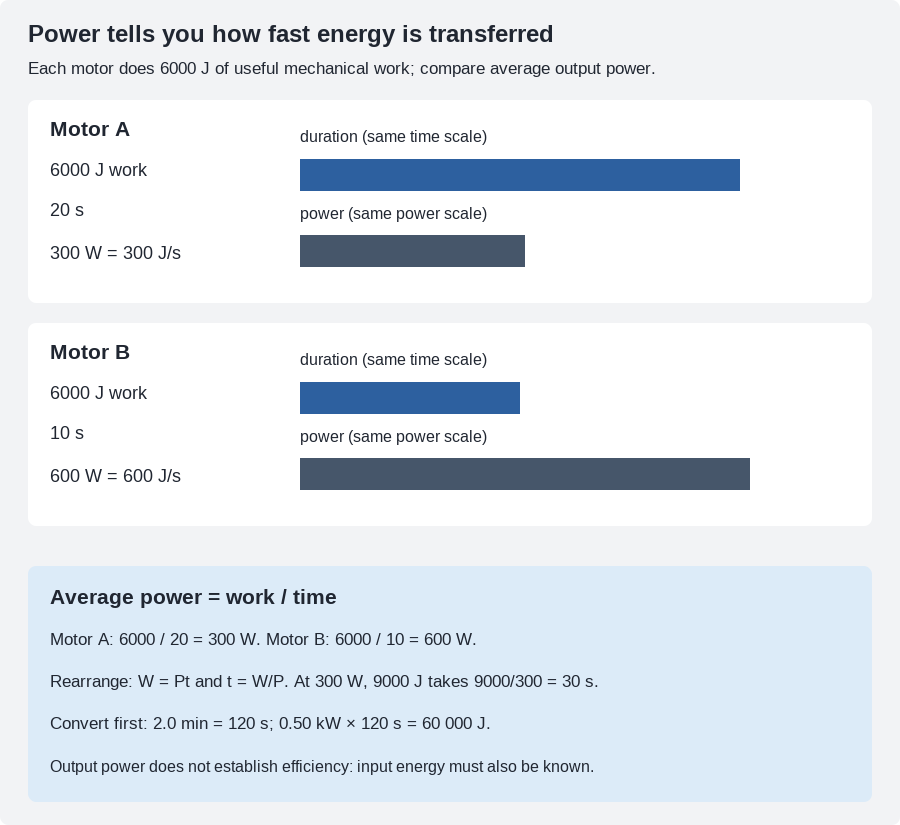
A motor does 6000 J work in 20 s. Substitute: P = 6000 J/20 s = 300 W. If the same work takes 10 s, powerThe energy transferred or work done per unit time, measured in watts. is 600 W. Halving time doubles power when the energyA conserved quantity transferred between stores by working, heating, electrical processes or radiation, measured in joules. transfer is fixed.
At 300 W output, transferring 9000 J takes t = 9000/300 = 30 s. Check by multiplying: 300 J/s × 30 s = 9000 J. The units of seconds cancel in the check.
Convert before calculating
A constant 0.50 kW transfer continues for 2.0 min. Convert to 500 W and 120 s. energyA conserved quantity transferred between stores by working, heating, electrical processes or radiation, measured in joules. = 500 × 120 = 60 000 J, or 6.0 × 10⁴ J to two significant figures.
Keeping powerThe energy transferred or work done per unit time, measured in watts. in kW and time in hours would instead give an answer in kWh: 0.50 × (2/60) ≈ 0.0167 kWh. This agrees with 60 000 J because 1 kWh = 3.6 × 10⁶ J. Do not label a kW-minute product as joules.
Check the magnitude as well as arithmetic: longer operation at the same power means greater energy; a longer time for the same work means smaller average power.
Equations
- P = W/t
- W = Pt
- t = W/P
Common misconceptions
- Convert minutes to seconds when using joules and watts; a kilowatt-hour is an energy unit, not power.
Separate lifting work from lifting power
Change mass, vertical lift height and duration to compare work, energy gain and average useful power.
What you see
- Labelled diagrams and numerical outputs describe the same selected state.
How to use it
- Change one control at a time, predict the outcome, then compare the readouts. All controls have keyboard-accessible sliders and step buttons.
- Reset restores every model control to its initial value. Nothing is saved.
What it shows
- Work=force×distance moved in the force direction. Here force=mg, so useful work equals the gravitational potential energy gain mgh. Average useful power=work÷time; doing the same work faster needs greater average useful power.
Limits of the model
- An ideal vertical lift with g=10 N/kg and no friction; starting and finishing kinetic energy are equal.
- The force shown balances weight during steady motion. Starting and stopping intervals are neglected. Output power is the average useful power, not electrical input power or motor efficiency.
Controls
Work=200×3=600 J. Average useful power=600÷6=100 W. At zero lift height the work and useful power are zero; supporting a stationary load still requires force.
Predict, change and explain
Lift 20 kg through 3 m in 6 s. Predict work and average useful power. Halve only the time: explain which quantities change. Then double only height and compare work and power.
Connect the outcome to the Physics
Work=force×distance moved in the force direction. Here force=mg, so useful work equals the gravitational potential energy gain mgh. Average useful power=work÷time; doing the same work faster needs greater average useful power.