Learning goals
- Compare renewable and non-renewable sources.
- Explain practical advantages and limitations.
- Make a justified choice for a stated location and demand.
Use the terms carefully
A renewable resource is replenished by natural processes on human timescales. Wind, sunlight and the water cycle continually provide energyA conserved quantity transferred between stores by working, heating, electrical processes or radiation, measured in joules., while geothermal resources can be replenished if managed appropriately. fossil fuelCoal, oil or natural gas formed from ancient organisms and burned to transfer chemical energy. and uranium are finite and are classed as non-renewable.
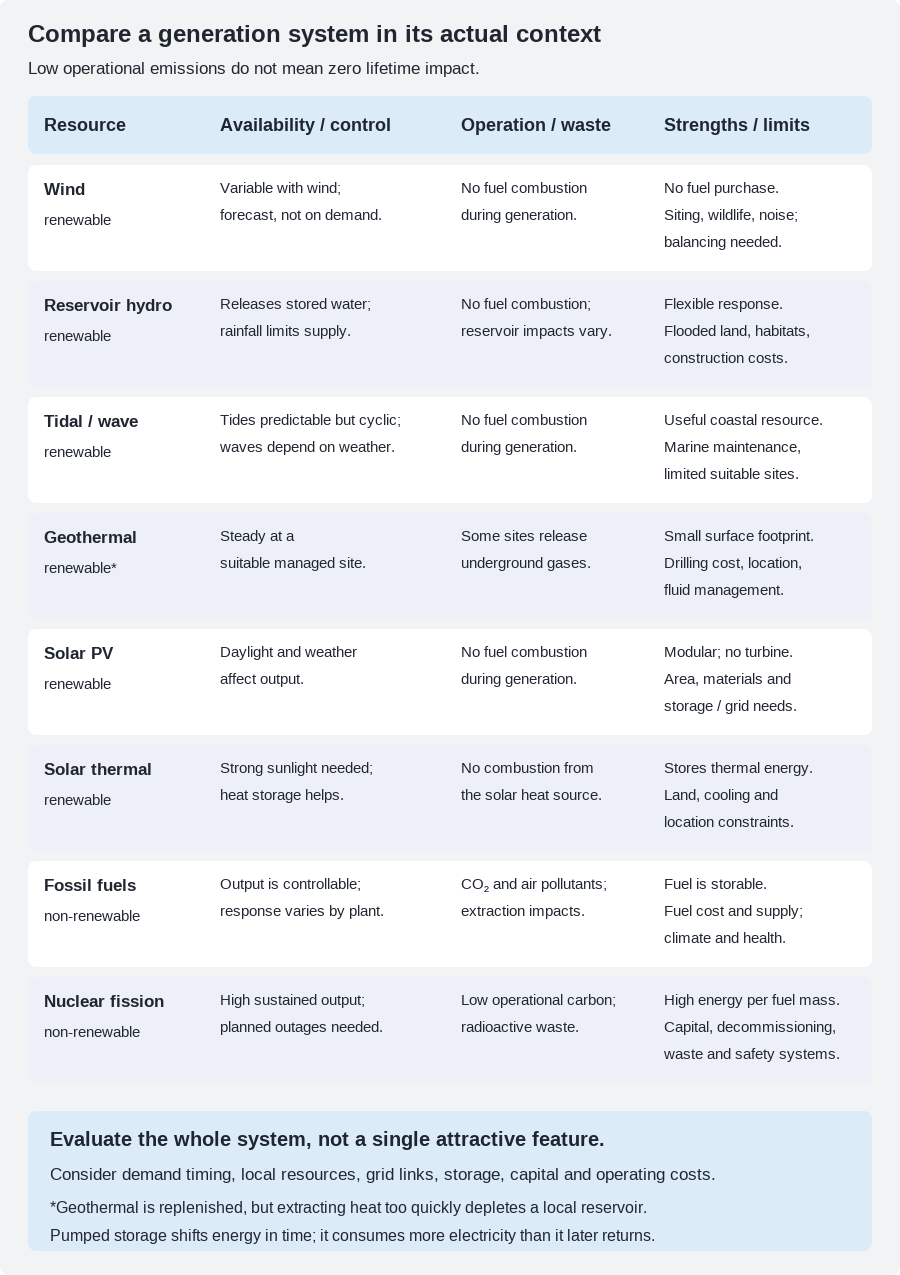
Renewable does not mean available whenever demand occurs. Distinguish variability, predictability and controllability. Wind can be forecast but varies; tides are predictable but cyclic; a reservoir can store water and release it when needed. Every plant also needs maintenance.
Wind, hydro, tides and waves
wind turbineA device transferring kinetic energy from moving air to rotational energy to drive a generator. need no fuel purchase and produce no combustion exhaust during generation. Output varies with wind, so the electricity system must balance demand using other generation, storage or connections. Siting must consider landscape, noise and wildlife as well as wind strength.
Reservoir hydro can respond flexibly by releasing stored water, but rainfall, storage capacity and competing water needs constrain output. Dams can flood land, displace people and change river habitats. Decomposing vegetation in some reservoirs releases greenhouse gasA state of matter whose widely separated particles move randomly, filling the available container., so no fuel combustion is not the same as no emissions.
Tidal output is predictable but changes through the cycle; waveA travelling disturbance that transfers energy without an overall transfer of matter. output varies with weather. Both need suitable coastal sites and equipment resistant to corrosion and storms. Marine habitats, navigation, maintenance and connection costs matter.
Geothermal and solar
Geothermal can provide steady output at suitable sites with relatively little surface land, but drilling and exploration are costly. Underground fluids may contain gasA state of matter whose widely separated particles move randomly, filling the available container. or dissolved minerals requiring management. Extracting heat too rapidly can deplete a local reservoir despite the renewable classification.
Solar PV has no rotating generatorA device transferring mechanical energy to electrical energy by electromagnetic induction., can be installed in modules and requires no combustion during operation. Output depends on daylight, weather and season. Material extraction, manufacturing, land use and end-of-life treatment still have impacts.
Solar thermal generation suits strong direct sunlight and can use thermal storage, but land, cooling and capital requirements matter. Domestic solar water heating can reduce electricity or fuel demand even though it is not itself electricity generation. Storage and grid connections can help match solar supply to demand but add costs and losses.
Fossil fuels and nuclear fission
fossil fuelCoal, oil or natural gas formed from ancient organisms and burned to transfer chemical energy. can be stored and used to control output, though start-up and response differ between plant types. Burning them releases carbon dioxide and often air pollutants. Extraction, transport, finite supply and changing fuel prices are further disadvantages.
Nuclear fuel provides a large amount of energyA conserved quantity transferred between stores by working, heating, electrical processes or radiation, measured in joules. per unit massThe quantity measuring an object’s inertia, expressed in kilograms. and supports sustained output with low direct carbon emissions. The fuel is finite. Construction, decommissioning, cooling, radioactive wasteUnwanted material containing radioactive isotopes that requires controlled storage or disposal. management and robust safety systems are significant requirements.
Low emissions during operation do not erase impacts from mining, manufacture, construction or waste treatment. Compare the same boundaries when judging sources; avoid equating a cooling-tower water-vapour plume with combustion smoke.
Build an evidence-based judgement
For a region with suitable water storage and sharp evening demand peaks, reservoir hydro offers controllability, but land and ecological costs may rule out a proposed site. A sunny region may favour solar, while still needing a plan for night-time demand. Support the choice with the stated context rather than a universal ranking.
Consider capital expenditure, operating and fuel costs, lifetime, reliability and grid requirements. Pumped storage uses electricity to raise water and returns less electricity later; its value is shifting energyA conserved quantity transferred between stores by working, heating, electrical processes or radiation, measured in joules. in time, not creating a new primary energy source.
Equations
Common misconceptions
- Renewable, predictable, controllable and low-carbon are different descriptions; no single one settles the choice.