Learning goals
- Trace all seven specified generation routes.
- Distinguish solar thermal and photovoltaic systems.
- Identify the source stores, mechanical stages and dissipative transfers.
Separate a turbine from a generator
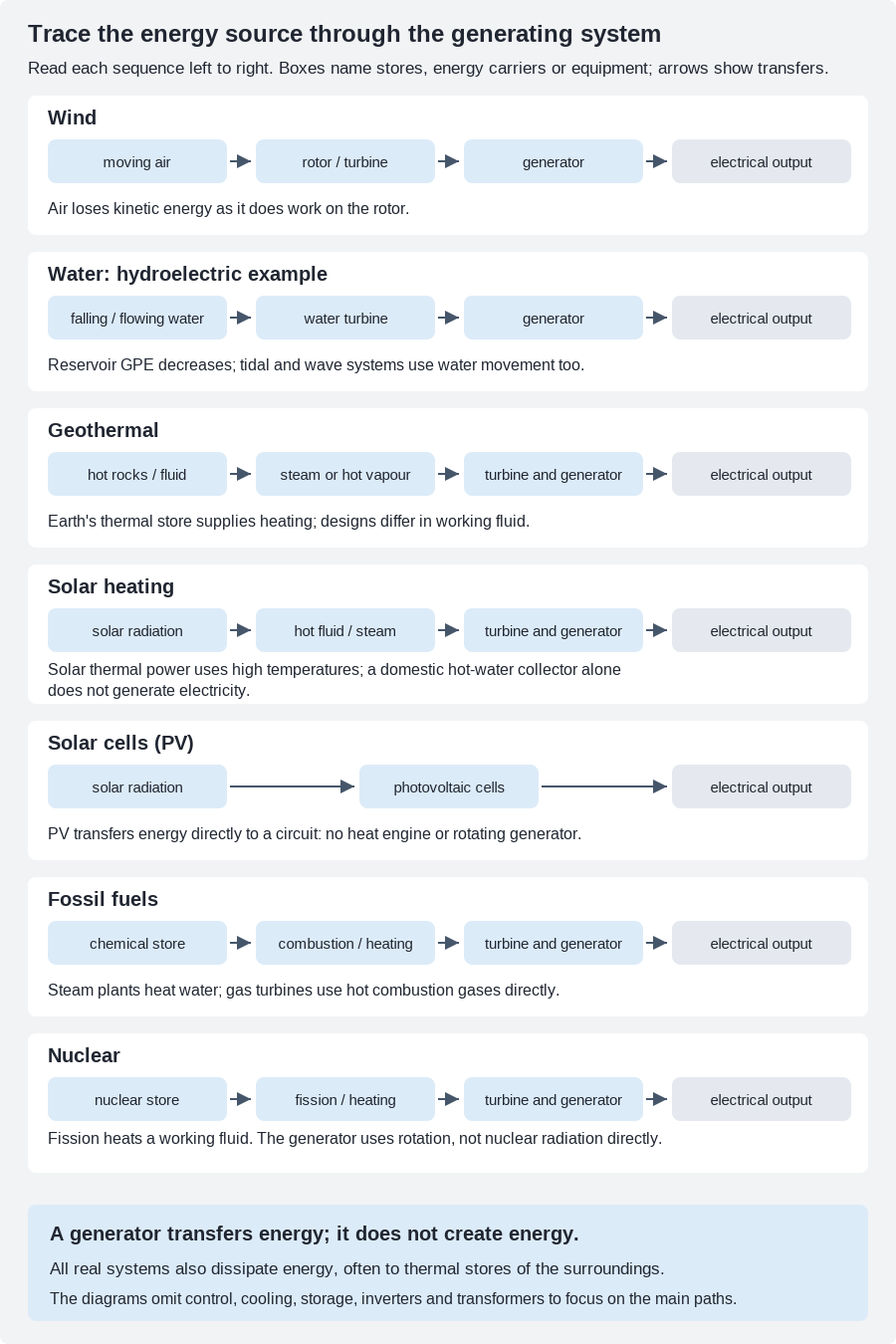
A turbine is turned by a moving fluid such as air, water or steam. It transfers energyA conserved quantity transferred between stores by working, heating, electrical processes or radiation, measured in joules. mechanically to a generatorA device transferring mechanical energy to electrical energy by electromagnetic induction., which transfers energy electrically to a circuit. The generator does not create energy or directly convert fuel into electricity.
The figure shows main routes and omits cooling, controls and grid equipment. Real systems transfer some energy to thermal stores and soundA mechanical wave produced by vibrations and transmitted through a material medium., so electrical output is less than the resource energy captured.
Wind and water
Wind has kinetic energyThe energy associated with motion, equal to half the mass multiplied by speed squared for a moving object.. Air exerts forceA push or pull arising from an interaction between objects, measured in newtons. on a rotor, doing work and turning the generatorA device transferring mechanical energy to electrical energy by electromagnetic induction.; the air leaving the rotor has less kinetic energy than it would without the turbine.
In reservoir hydroelectricity, water at height has gravitational potential energyThe energy stored by the position of masses in a gravitational field, increasing when an object is raised.. Descending water gains kinetic energy and drives a turbine connected to a generator. River-flow systems use moving water without necessarily having a large reservoir.
Tidal systems exploit water movement or height differences associated with tides. waveA travelling disturbance that transfers energy without an overall transfer of matter. devices use wave-driven motion; designs may use moving floats, hydraulic machinery or airflow through a turbine. They do not all follow the exact water-turbine layout shown for hydroelectricity.
Thermal sources: geothermal, fossil and nuclear
Geothermal systems transfer energyA conserved quantity transferred between stores by working, heating, electrical processes or radiation, measured in joules. from hot underground rocks or fluids. Steam, or a separate fluid heated by the geothermal source, can drive a turbine and generatorA device transferring mechanical energy to electrical energy by electromagnetic induction.. The energy supply comes from Earth's thermal store; a suitable temperatureA measure of how hot a system is, related to the average kinetic energy of its particles. and geology are needed.
Burning fossil fuelCoal, oil or natural gas formed from ancient organisms and burned to transfer chemical energy. decreases a chemical store and heats a working fluid. In a steam powerThe energy transferred or work done per unit time, measured in watts. station, heated water becomes steam that drives a turbine. gasA state of matter whose widely separated particles move randomly, filling the available container. turbines instead use hot combustion gases directly; combined-cycle plants also recover exhaust energy for a steam stage.
nuclear fissionSplitting a heavy nucleus into smaller nuclei, usually releasing neutrons and energy. releases energy from nuclear stores and heats a coolant. This heat is used to produce steam for a turbine and generator. Commercial nuclear stations use fission, not the fusion process powering the Sun. Topic 8 explains the nuclear reactions.
Two different uses of solar radiation
A solar heating collector absorbs radiation and raises a fluid's thermal energyThe part of internal energy associated with the random motion and interactions of particles.. In a solar thermal powerThe energy transferred or work done per unit time, measured in watts. plant, concentrating reflectors can provide sufficiently high temperatureA measure of how hot a system is, related to the average kinetic energy of its particles. to run a heat engine, often a steam turbine and generatorA device transferring mechanical energy to electrical energy by electromagnetic induction.. Thermal storage can allow some generation after collection stops.
A domestic solar hot-water collector mainly provides useful heating; without the further conversion machinery it does not generate electricity. Do not confuse this with a solar cellA device that directly converts energy transferred by light into electrical energy..
Photovoltaic solar cells transfer energyA conserved quantity transferred between stores by working, heating, electrical processes or radiation, measured in joules. from incident light directly to an electrical circuit through a semiconductor process. They do not require a rotating turbine or a steam stage. Arrays produce a direct-current output, with additional equipment used where alternating currentA flow of electric charge that repeatedly reverses direction. is required.
Equations
Common misconceptions
- Solar thermal collectors and solar cells have different mechanisms; not every electricity source first boils water.