Learning goals
- Explain the particle mechanisms of conduction and convection.
- Explain why radiation needs no medium.
- Identify more than one pathway in everyday situations.
Conduction: local interactions
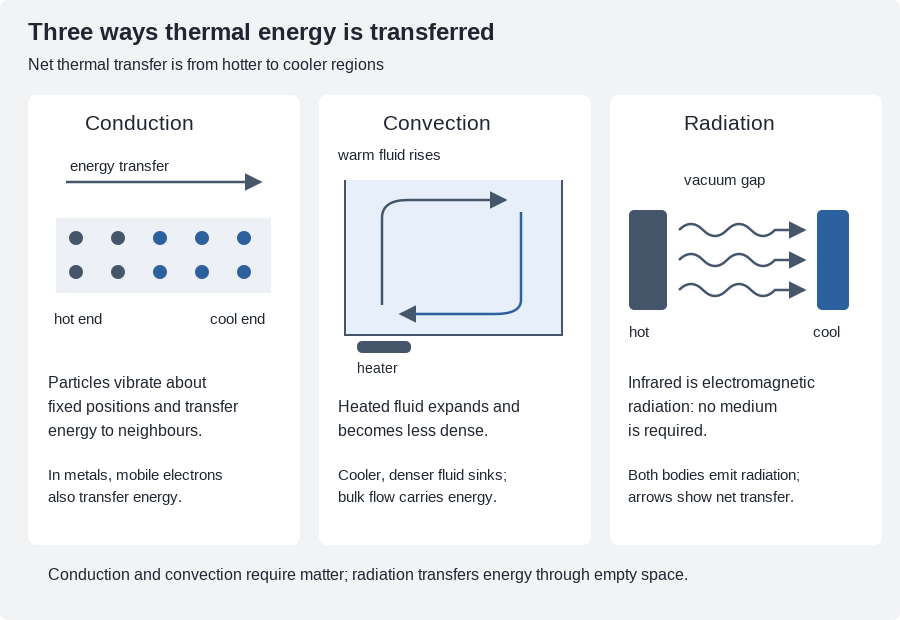
In a solidA state of matter whose closely packed particles vibrate around fixed positions, giving a fixed shape and volume., particles near a hotter region vibrate more vigorously. Interactions with neighbouring particles transfer energyA conserved quantity transferred between stores by working, heating, electrical processes or radiation, measured in joules. towards cooler regions. The particles vibrate around their positions rather than travelling along the solid from hot end to cold end.
Metals also contain mobile electronA negatively charged subatomic particle found outside an atom’s nucleus. that carry energy through the material and exchange it with the lattice. This helps explain why metals generally conduct thermal energyThe part of internal energy associated with the random motion and interactions of particles. better than plastics. conductionEnergy transfer through a material by particle interactions and, in metals, mobile electrons, without bulk flow of the material. also occurs in fluids, but movement of the fluid can provide a much faster additional transfer.
Convection: the fluid itself moves
In liquidA state of matter with closely spaced particles moving past one another, giving a fixed volume but no fixed shape. and gasA state of matter whose widely separated particles move randomly, filling the available container., heated regions often expand and become less dense than their surroundings. Buoyancy can make that fluid rise, while cooler, denser fluid replaces it. The bulk movement transports energyA conserved quantity transferred between stores by working, heating, electrical processes or radiation, measured in joules. and may form a circulating convection currentA circulating fluid flow produced when warmer, less dense fluid rises and cooler, denser fluid replaces it..
A solidA state of matter whose closely packed particles vibrate around fixed positions, giving a fixed shape and volume. cannot circulate this way because its particles are not free to flow through the bulk material. A fan or pump can also drive fluid flow: that is forced convectionEnergy transfer by bulk movement of a fluid, commonly driven by density differences within it., rather than a flow generated solely by temperature-related densityThe mass of material per unit volume, measured in kilograms per cubic metre in SI units. differences.
Radiation: transfer without matter
Objects emit electromagnetic radiation, including infrared. Radiation can cross a vacuum, so it transfers energyA conserved quantity transferred between stores by working, heating, electrical processes or radiation, measured in joules. from the Sun through space. Ordinary warm objects need not glow visibly to emit infrared.
Both hot and cool bodies emit and absorb. Under ordinary conditions the net radiative exchange is from the hotter body to the cooler one. The figure's arrows represent that net result; the cooler body also emits radiation.
Combine pathways in a real example
Heating a saucepan involves conductionEnergy transfer through a material by particle interactions and, in metals, mobile electrons, without bulk flow of the material. through its base, convectionEnergy transfer by bulk movement of a fluid, commonly driven by density differences within it. in the water and radiation from hot surfaces. The mechanisms can operate simultaneously. Identify the region being discussed before naming the dominant mechanism.
A metal and a wooden surface at the same room temperatureA measure of how hot a system is, related to the average kinetic energy of its particles. may feel different because the metal transfers energyA conserved quantity transferred between stores by working, heating, electrical processes or radiation, measured in joules. from your warmer hand faster. Feeling colder does not establish a lower initial temperature.
Equations
Common misconceptions
- Convection is movement of a fluid, while radiation can cross a vacuum; neither is a flow of a material called heat.