Learning goals
- Explain the expansion–density–buoyancy chain.
- Apply convection to rooms, water and coastal air.
- Distinguish natural and forced convection.
Explain why warmer fluid rises
A region of air heated at roughly the same pressureThe normal force exerted per unit area, measured in pascals. as its surroundings expands. Its massThe quantity measuring an object’s inertia, expressed in kilograms. is distributed through a larger volume, so its densityThe mass of material per unit volume, measured in kilograms per cubic metre in SI units. decreases. The surrounding denser fluid produces an upward buoyancy forceA push or pull arising from an interaction between objects, measured in newtons.; if this exceeds the region's weightThe gravitational force acting on an object, equal to its mass multiplied by gravitational field strength., the warm fluid rises.
The phrase heat rises is incomplete: the air or liquidA state of matter with closely spaced particles moving past one another, giving a fixed volume but no fixed shape. rises and carries energyA conserved quantity transferred between stores by working, heating, electrical processes or radiation, measured in joules. with it. thermal energyThe part of internal energy associated with the random motion and interactions of particles. also transfers sideways or downwards by conductionEnergy transfer through a material by particle interactions and, in metals, mobile electrons, without bulk flow of the material. or radiation. Heating does not always cause expansion, so the simple account assumes an ordinary range where the fluid expands on warming.
Read the room diagram
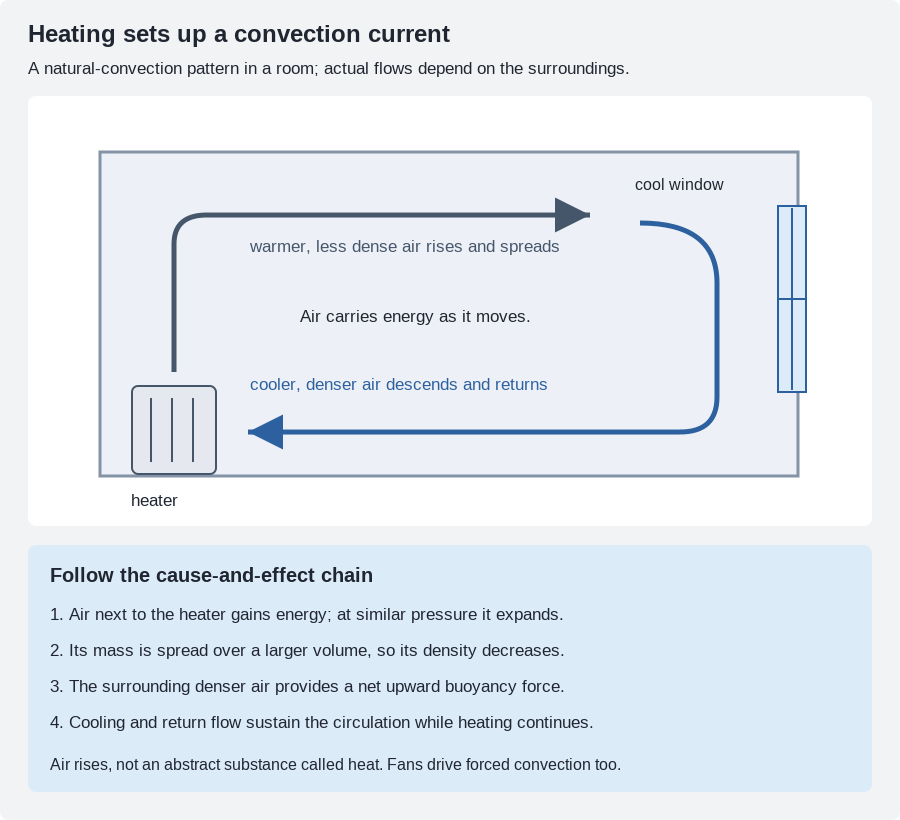
Air beside a heater warms, rises and spreads across the upper room. Near a cooler window or wall it loses energyA conserved quantity transferred between stores by working, heating, electrical processes or radiation, measured in joules., becomes denser and may descend. Return flow along the lower room replaces the rising air and can maintain a circulation while heating continues.
Real rooms rarely contain one perfectly neat loop. Furniture, doors, ventilation, heater position and changing temperatureA measure of how hot a system is, related to the average kinetic energy of its particles. affect the flow. The arrows show an idealised bulk pattern, not the paths of individual molecules.
Apply the same reasoning
Water heated locally near the bottom of a beaker can form a rising plume, with cooler water moving down elsewhere. A small dye tracer makes the motion visible. Heating the water only at the top tends to create a stable warm layer and much weaker natural circulation.
On a sunny day, land may warm the air above it more strongly than the nearby sea does. Rising air over the land and return flow aloft can produce a sea breeze at the surface. Large-scale winds can modify this sea-breeze pattern.
Fans and pumps move fluids mechanically. They can increase heat transfer even when natural buoyancy would produce little flow, so do not explain every observed electric currentThe amount of electric charge passing a point per unit time, measured in amperes. by warmer fluid rising.
Equations
- density = mass ÷ volume
Common misconceptions
- Individual particles do not become less dense; the bulk fluid density changes as its particle spacing and volume change.