Learning goals
- Compare matte black and polished metal surfaces.
- Explain emission and absorption at equal temperature.
- Distinguish emitted power from net energy transfer.
Absorb, reflect or transmit
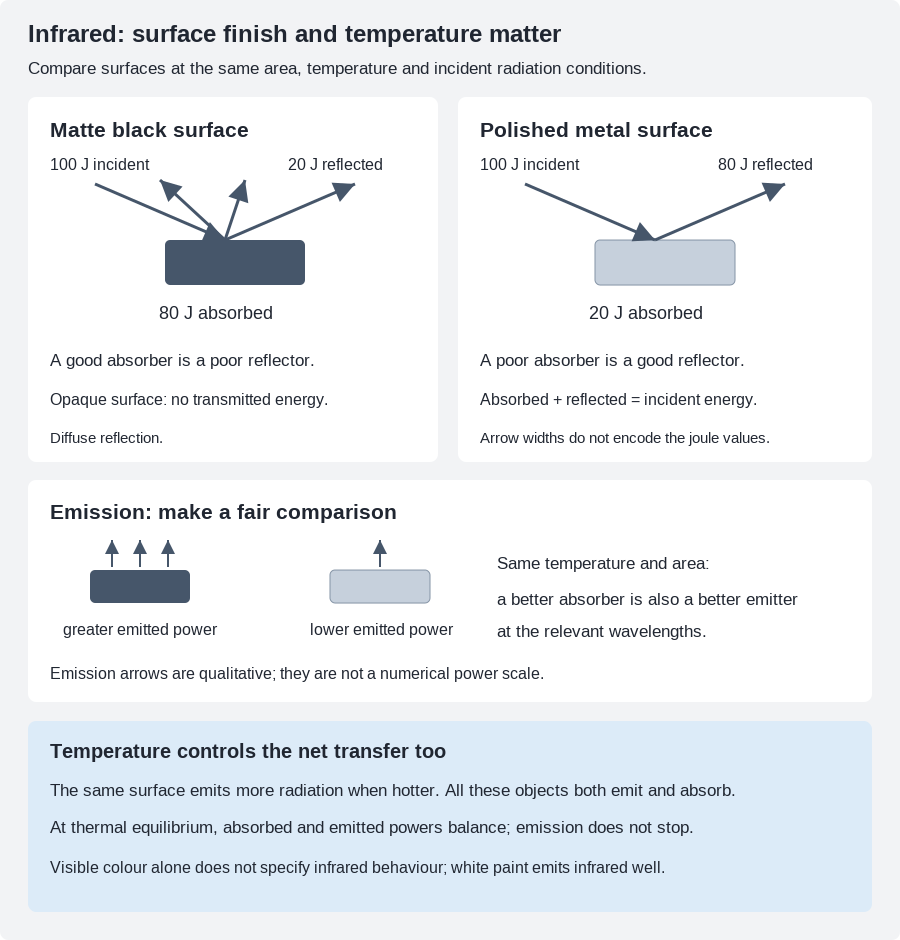
When radiation meets a surface it may be absorbed, reflected or transmitted. For an opaque surface, transmission is negligible, so the incident energyA conserved quantity transferred between stores by working, heating, electrical processes or radiation, measured in joules. divides between absorption and reflectionThe return of a wave into its original medium after meeting a boundary.. A good absorber is therefore a poor reflector under the same conditions.
In the usual classroom comparison, a matte black surface is a good absorber of infrared while polished metal is a poor absorber and good reflector. The figure's 80/20 and 20/80 J divisions are examples illustrating energy accounting, not universal material properties.
Compare emission fairly
At the same temperatureA measure of how hot a system is, related to the average kinetic energy of its particles. and exposed area, a surface that absorbs well at a particular wavelengthThe shortest distance between two successive points in phase on a wave. also emits well there. A matte black surface is generally a better infrared emitter than a polished metal surface under those matched conditions.
Visible colour alone is not enough to specify infrared behaviour. Some white paints emit infrared well, despite reflecting much visible lightElectromagnetic radiation with wavelengths detected by the human eye, from violet to red.. Use the stated surface finish and wavelength range rather than assuming every light-coloured object is a poor infrared emitter.
Temperature and net exchange
For the same surface and area, raising temperatureA measure of how hot a system is, related to the average kinetic energy of its particles. increases its emitted radiative powerThe energy transferred or work done per unit time, measured in watts.. Even a relatively cool object emits infrared; becoming hotter is not a switch that turns emission on.
An object also absorbs radiation from its surroundings. At thermal equilibriumA state in which both the resultant force and the resultant moment on an object are zero. the emitted and absorbed powers balance, although both processes continue. An object warmer than its surroundings normally loses energyA conserved quantity transferred between stores by working, heating, electrical processes or radiation, measured in joules. by net radiation; one cooler than its surroundings can gain it.
To compare surface effects, keep temperature, area and viewing geometry the same. A hotter shiny object may emit more overall than a colder matte object, so surface finish alone cannot determine the result if temperatures differ.
Equations
- incident energy = absorbed + reflected energy (opaque surface)
Common misconceptions
- A good absorber is also a good emitter under matched conditions; it does not necessarily retain energy longer.