Learning goals
- Calculate and interpret efficiency.
- Account for dissipated energy.
- Distinguish efficiency from energy output and power.
Define the useful output first
An efficient device transfers a large fraction of its energyA conserved quantity transferred between stores by working, heating, electrical processes or radiation, measured in joules. usefully for its purpose. For a lifting motor, useful output increases gravitational potential energyThe energy stored by the position of masses in a gravitational field, increasing when an object is raised.. For a lamp, useful output is visible lightElectromagnetic radiation with wavelengths detected by the human eye, from violet to red.; warming the room is normally not the intended purpose.
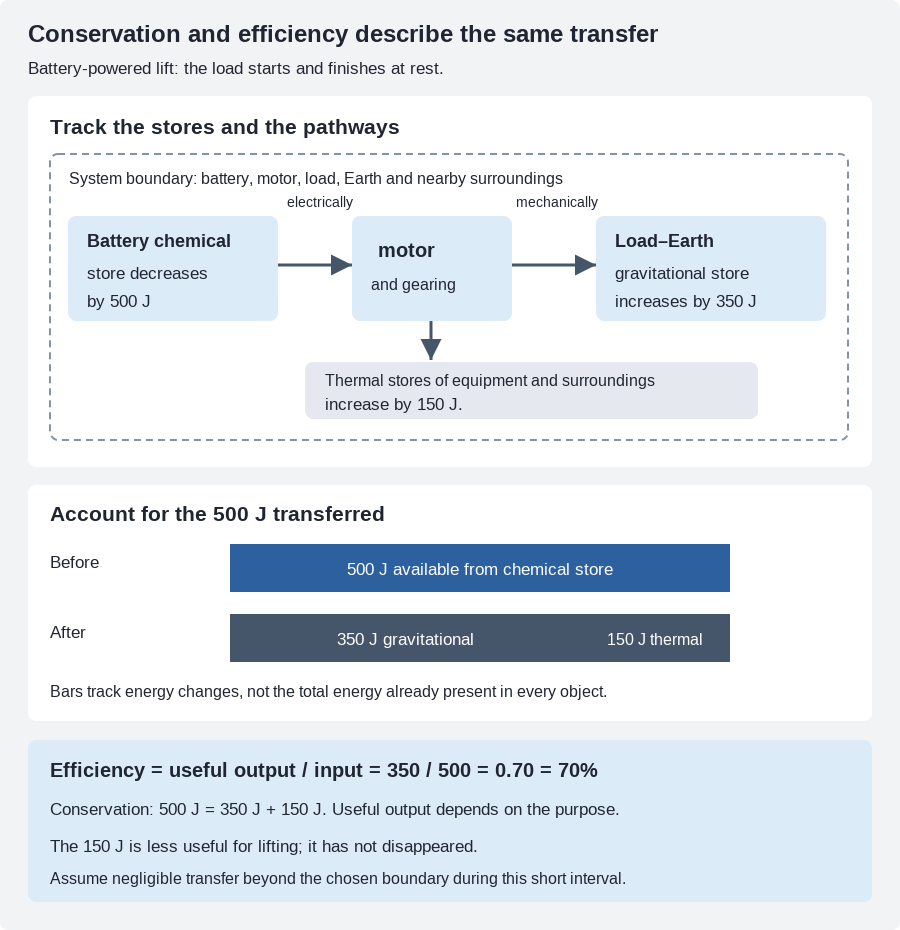
efficiencyThe fraction of total energy input transferred usefully, also equal to useful power output divided by total power input. = useful energy output ÷ total energy output. In a device calculation with no net energy accumulation, total output equals total input, so the familiar useful-output/input form is equivalent. Use the same time interval and include all relevant transfers.
Worked example and reverse calculation
The illustrated lift receives 500 J and transfers 350 J usefully. efficiencyThe fraction of total energy input transferred usefully, also equal to useful power output divided by total power input. = 350/500 = 0.70. As a percentage, 0.70 × 100% = 70%. The remaining 500 − 350 = 150 J is dissipated; 30% of the input was not useful for lifting.
For the same 70% efficiency, 800 J input would give 0.70 × 800 = 560 J useful output. To obtain 350 J useful output at 50% efficiency, required input = 350/0.50 = 700 J. Convert a percentage to a decimal before using it as a multiplier or divisor.
Interpret the answer
For the same useful task, improved efficiencyThe fraction of total energy input transferred usefully, also equal to useful power output divided by total power input. reduces the required input. It does not guarantee lower total consumption if the device is then used more often or does more work. powerThe energy transferred or work done per unit time, measured in watts. measures transfer per second, so a powerful device can be inefficient and a low-power device efficient.
An energyA conserved quantity transferred between stores by working, heating, electrical processes or radiation, measured in joules. efficiency above 100% indicates missing inputs, inconsistent intervals or another accounting error. Check that every source of energy has been included before comparing useful and total output. Use the same system boundary and time interval in both quantities.
Equations
- efficiency = useful energy output ÷ total energy output
- percentage efficiency = (useful energy output ÷ total energy output) × 100%
Common misconceptions
- Multiply a decimal efficiency by 100 only when converting it to a percentage; 70% means 0.70, not 70.
Keep every joule in the energy account
Change input energy and efficiency, then compare useful and unwanted transfers on a Sankey diagram.
What you see
- Labelled diagrams and numerical outputs describe the same selected state.
How to use it
- Change one control at a time, predict the outcome, then compare the readouts. All controls have keyboard-accessible sliders and step buttons.
- Reset restores every model control to its initial value. Nothing is saved.
What it shows
- Useful output=efficiency×input, with efficiency expressed as a fraction. The remaining energy is transferred in unwanted ways, often to thermal stores. Improving efficiency changes the distribution; it does not create energy or destroy the unwanted energy.
Limits of the model
- One transfer interval with no energy accumulating in the device; input equals the two output transfers.
- Arrow-shaft width is proportional to energy: 10 J per drawing unit. Efficiency is a chosen operating value, not a prediction about a particular real device.
Controls
Predict, change and explain
At 500 J input and 40% efficiency, predict both outputs. Double input at the same efficiency. Then restore input and improve efficiency: explain why the total output stays equal to the input.
Connect the outcome to the Physics
Useful output=efficiency×input, with efficiency expressed as a fraction. The remaining energy is transferred in unwanted ways, often to thermal stores. Improving efficiency changes the distribution; it does not create energy or destroy the unwanted energy.