Learning goals
- State conservation of energy accurately.
- Account for useful and dissipated transfers.
- Define a system boundary for an energy calculation.
Choose the system
energyA conserved quantity transferred between stores by working, heating, electrical processes or radiation, measured in joules. cannot be created or destroyed; it can be transferred between stores. For an isolated system with no energy crossing its boundary, total energy remains constant. If energy does cross a chosen boundary, include that transfer in the accounting.
State explicitly which objects are included and whether energy entering or leaving is negligible. A boundary drawn around a device does not by itself prevent energy transfer across that boundary.
Follow the battery-powered lift
The figure includes the battery, motor, load, Earth and nearby surroundings. During the chosen short interval, assume negligible energyA conserved quantity transferred between stores by working, heating, electrical processes or radiation, measured in joules. transfer beyond this boundary. The load starts and finishes at rest, so it has no net kinetic-energy change. Assume battery and wire losses are negligible for this calculation.
A 500 J decrease in the battery's chemical store matches a 350 J increase in the gravitational store and a 150 J increase in thermal stores. Check: −500 + 350 + 150 = 0 J. The before and after bars track these changes, not all the pre-existing energy in the battery, Earth or room.
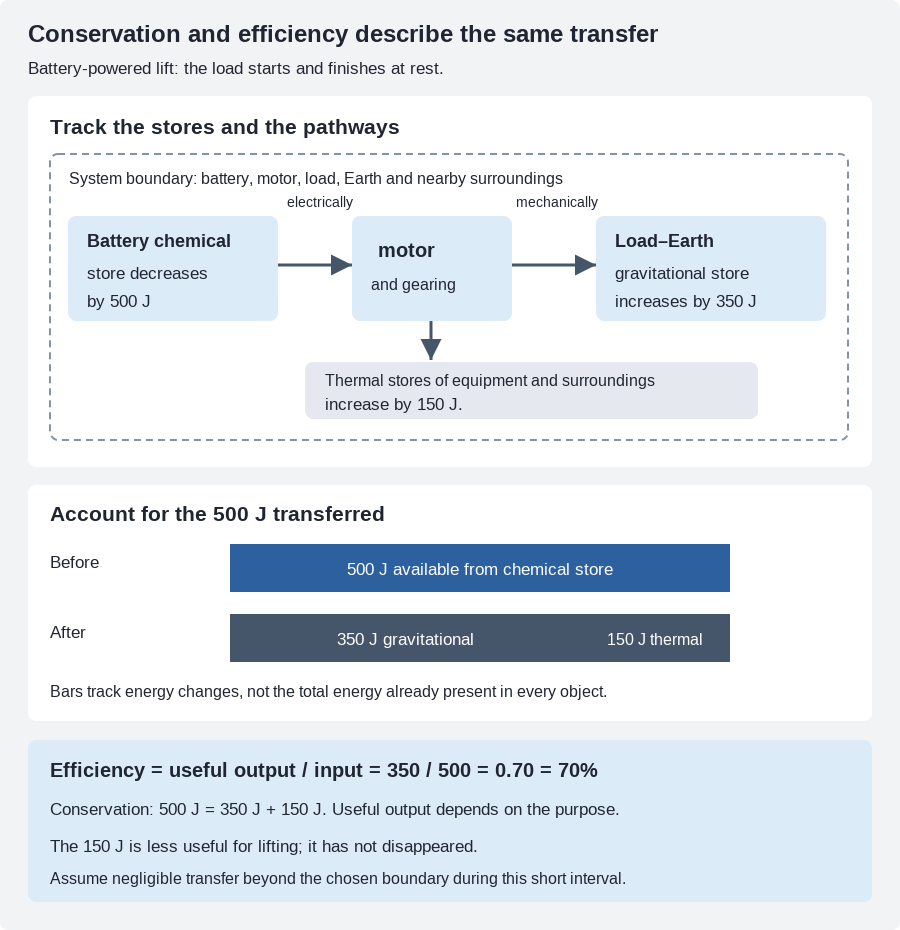
Where the apparently missing energy goes
If you measured only the useful lifting transfer, 150 J would seem missing. frictionA force opposing relative sliding or the tendency to slide between contacting surfaces. and electrical resistanceThe ratio of potential difference across a component to the current through it, measured in ohms. account for increases in the equipment's thermal store; energyA conserved quantity transferred between stores by working, heating, electrical processes or radiation, measured in joules. then spreads to the surroundings. soundA mechanical wave produced by vibrations and transmitted through a material medium. can also carry energy outward and eventually be absorbed.
Dissipated energy is distributed in ways that make it less useful for the intended task. It has not vanished. A real investigation must consider unmeasured transfers, temporary storage and measurement uncertaintyThe estimated range around a measured value within which the true value is expected to lie. before claiming that energy accounting has failed.
Equations
- energy entering − energy leaving = change in total energy within the boundary
Common misconceptions
- Energy output need not equal input during a charging or warming interval if energy is accumulating inside the device.
Keep every joule in the energy account
Change input energy and efficiency, then compare useful and unwanted transfers on a Sankey diagram.
What you see
- Labelled diagrams and numerical outputs describe the same selected state.
How to use it
- Change one control at a time, predict the outcome, then compare the readouts. All controls have keyboard-accessible sliders and step buttons.
- Reset restores every model control to its initial value. Nothing is saved.
What it shows
- Useful output=efficiency×input, with efficiency expressed as a fraction. The remaining energy is transferred in unwanted ways, often to thermal stores. Improving efficiency changes the distribution; it does not create energy or destroy the unwanted energy.
Limits of the model
- One transfer interval with no energy accumulating in the device; input equals the two output transfers.
- Arrow-shaft width is proportional to energy: 10 J per drawing unit. Efficiency is a chosen operating value, not a prediction about a particular real device.
Controls
Predict, change and explain
At 500 J input and 40% efficiency, predict both outputs. Double input at the same efficiency. Then restore input and improve efficiency: explain why the total output stays equal to the input.
Connect the outcome to the Physics
Useful output=efficiency×input, with efficiency expressed as a fraction. The remaining energy is transferred in unwanted ways, often to thermal stores. Improving efficiency changes the distribution; it does not create energy or destroy the unwanted energy.
Follow energy as an object falls
Connect height lost, gravitational potential energy and kinetic energy during an ideal fall.
What you see
- Labelled diagrams and numerical outputs describe the same selected state.
How to use it
- Change one control at a time, predict the outcome, then compare the readouts. All controls have keyboard-accessible sliders and step buttons.
- Reset restores every model control to its initial value. Nothing is saved.
What it shows
- Lost gravitational potential energy mgh becomes kinetic energy ½mv². The total stays constant before impact. At the same release and observation heights, a larger mass has proportionally larger energy stores but the same speed in this no-resistance model.
Limits of the model
- An object is released from rest, with negligible air resistance and g=10 N/kg. The ground defines zero gravitational potential energy.
- The slider selects a fraction of the height fallen, not a fraction of the falling time. The model ends just before impact and does not model the collision.
Controls
The bars always use the same scale within one state. At zero release height, both stores and the speed are zero. Impact transfers energy to other stores and is outside this model.
Predict, change and explain
Release 2 kg from 10 m. Predict the two energy stores after half the height has been lost. Double mass and compare energy and speed at the same height. Explain why half the height fallen does not mean half the final speed.
Connect the outcome to the Physics
Lost gravitational potential energy mgh becomes kinetic energy ½mv². The total stays constant before impact. At the same release and observation heights, a larger mass has proportionally larger energy stores but the same speed in this no-resistance model.