Learning goals
- Identify all eight specified energy stores.
- Distinguish stores from transfer pathways.
- Trace changes through familiar devices.
Eight energy stores
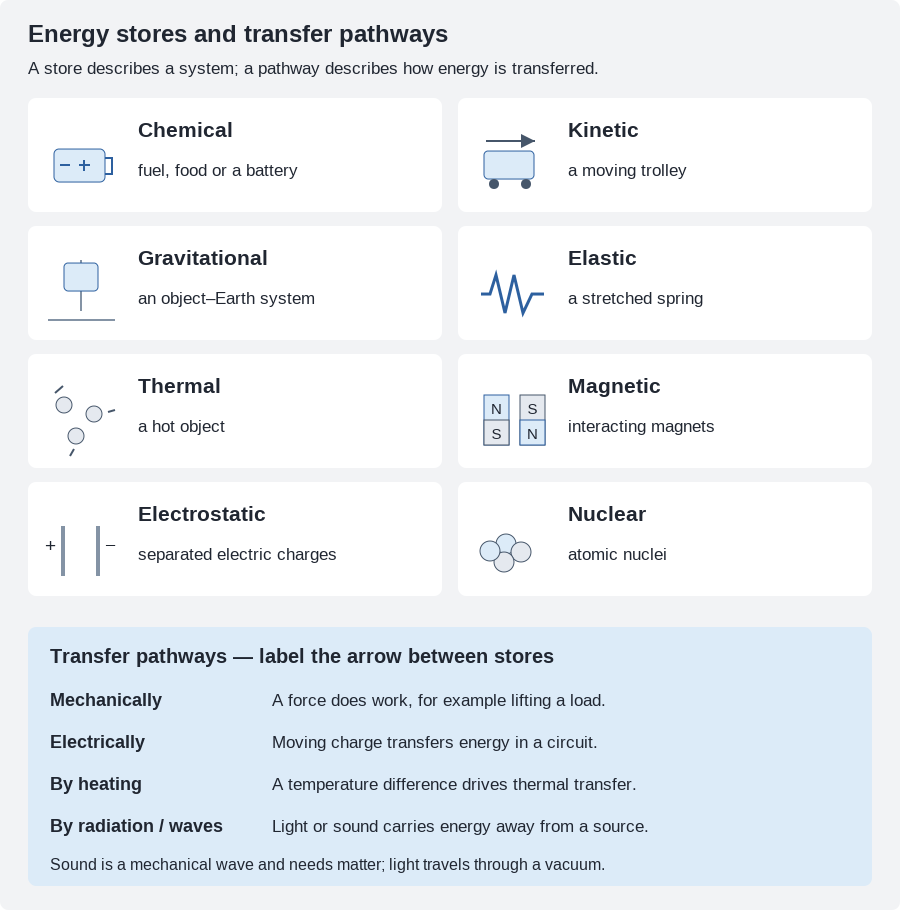
Chemical stores are associated with fuels, food and batteries; kinetic stores with moving objects; gravitational stores with interacting massThe quantity measuring an object’s inertia, expressed in kilograms. such as an object and Earth; elastic stores with stretched or compressed objects. Thermal stores depend on the microscopic motion and interactions of particles.
Magnetic stores are associated with magnetic interactions, electrostatic stores with electric chargeA property of particles responsible for electrical interactions, measured in coulombs. and their arrangement, and nuclear stores with atomic nucleusThe dense central region of an atom containing protons and neutrons, except hydrogen-1 which has no neutron.. The figure gives an example of each. A store belongs to a physical system: lifting an object changes the object–Earth gravitational store.
How energy is transferred
Mechanical transfer occurs when a forceA push or pull arising from an interaction between objects, measured in newtons. does work. Electrical transfer occurs when electric chargeA property of particles responsible for electrical interactions, measured in coulombs. moves through a potential differenceThe energy transferred per unit charge between two points, measured in volts.. Heating transfers energyA conserved quantity transferred between stores by working, heating, electrical processes or radiation, measured in joules. because of a temperatureA measure of how hot a system is, related to the average kinetic energy of its particles. difference. Radiation or waveA travelling disturbance that transfers energy without an overall transfer of matter. carry energy away from a source, for example light and soundA mechanical wave produced by vibrations and transmitted through a material medium..
The specification groups light and sound as radiated transfers. Their physics differs: sound is a mechanical wave and needs a medium, while light is electromagnetic and can cross a vacuum. infrared radiationElectromagnetic radiation with wavelengths longer than visible red light, emitted by objects because of their temperature. can also transfer energy thermally. The categories describe processes and may overlap in a detailed account.
Build a complete explanation
For a battery-powered lifting motor, the battery's chemical store decreases. energyA conserved quantity transferred between stores by working, heating, electrical processes or radiation, measured in joules. transfers electrically to the motor, then mechanically to the object–Earth gravitational store. frictionA force opposing relative sliding or the tendency to slide between contacting surfaces. and electrical resistanceThe ratio of potential difference across a component to the current through it, measured in ohms. increase thermal stores; soundA mechanical wave produced by vibrations and transmitted through a material medium. can transfer some energy to the surroundings.
For a falling object, the gravitational store decreases while the kinetic store increases. For a compressed spring released against a trolley, the elastic store decreases and the trolley's kinetic store increases. If air resistanceA drag force exerted by air on an object moving relative to it. or friction matters, include increases in thermal stores as well.
Light and sound are pathways, not stores that remain inside the object. Start an explanation with the actual system, name the decreasing and increasing stores, then identify the transfer mechanism between them.
Equations
Common misconceptions
- Electrical, light and sound transfers are not additional long-term stores in this model; energy is not used up.
Keep every joule in the energy account
Change input energy and efficiency, then compare useful and unwanted transfers on a Sankey diagram.
What you see
- Labelled diagrams and numerical outputs describe the same selected state.
How to use it
- Change one control at a time, predict the outcome, then compare the readouts. All controls have keyboard-accessible sliders and step buttons.
- Reset restores every model control to its initial value. Nothing is saved.
What it shows
- Useful output=efficiency×input, with efficiency expressed as a fraction. The remaining energy is transferred in unwanted ways, often to thermal stores. Improving efficiency changes the distribution; it does not create energy or destroy the unwanted energy.
Limits of the model
- One transfer interval with no energy accumulating in the device; input equals the two output transfers.
- Arrow-shaft width is proportional to energy: 10 J per drawing unit. Efficiency is a chosen operating value, not a prediction about a particular real device.
Controls
Predict, change and explain
At 500 J input and 40% efficiency, predict both outputs. Double input at the same efficiency. Then restore input and improve efficiency: explain why the total output stays equal to the input.
Connect the outcome to the Physics
Useful output=efficiency×input, with efficiency expressed as a fraction. The remaining energy is transferred in unwanted ways, often to thermal stores. Improving efficiency changes the distribution; it does not create energy or destroy the unwanted energy.