Learning goals
- Link joules of work to changes in energy stores.
- Explain useful and dissipated mechanical transfers.
- Account for energy when speed stays constant.
Two descriptions of the same transfer
Work is the energyA conserved quantity transferred between stores by working, heating, electrical processes or radiation, measured in joules. transferred by a forceA push or pull arising from an interaction between objects, measured in newtons. through a displacementThe straight-line change in position from a starting point, with a specified direction.. Both work and changes in energy stores are measured in joules. Doing 120 J of work transfers 120 J of energy; it does not create an extra 120 J store called work.
The destination depends on the physical situation. Lifting can increase the object–Earth gravitational store, accelerating can increase kinetic energyThe energy associated with motion, equal to half the mass multiplied by speed squared for a moving object., stretching a spring can increase its elastic store, and frictionA force opposing relative sliding or the tendency to slide between contacting surfaces. can increase thermal stores.
Apply the crate example
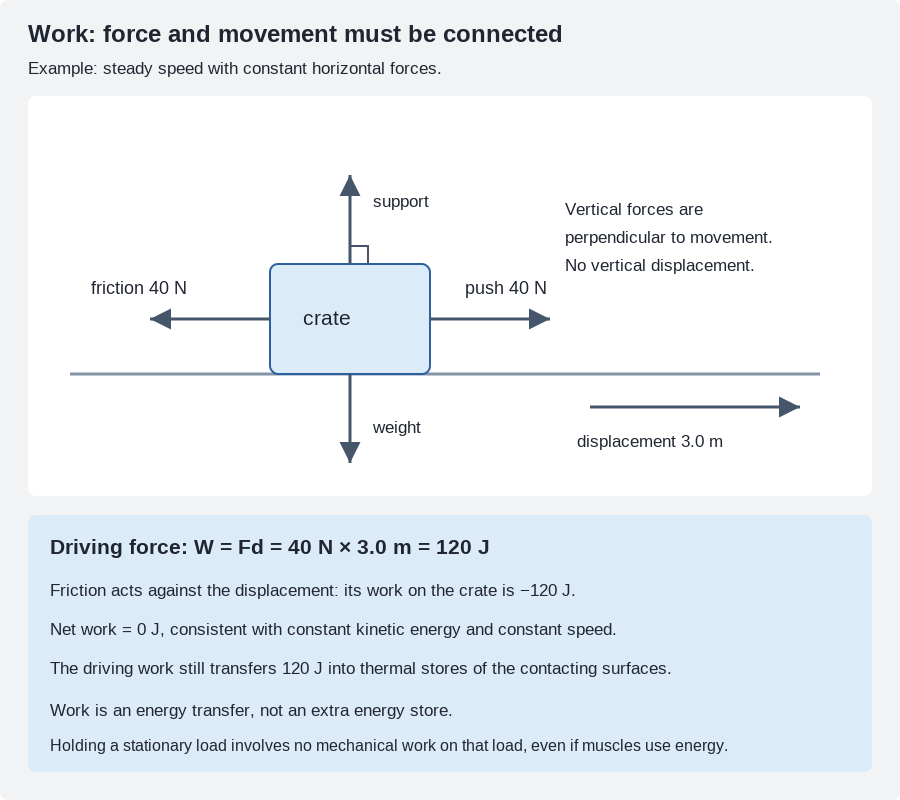
The person pushes with 40 N through 3.0 m and does 120 J work. Because the frictional forceA push or pull arising from an interaction between objects, measured in newtons. balances the push, the crate's speedThe distance travelled per unit time, without specifying direction. does not change: there is no net increase in its kinetic energyThe energy associated with motion, equal to half the mass multiplied by speed squared for a moving object..
The person's chemical store decreases as they drive the motion. For the idealised crate–floor system, the 120 J of mechanical input increases thermal stores through frictionA force opposing relative sliding or the tendency to slide between contacting surfaces.. Real human energyA conserved quantity transferred between stores by working, heating, electrical processes or radiation, measured in joules. expenditure is greater because the body also transfers energy internally and to its surroundings.
Choose a complete account
For a slow lift that starts and ends at rest, work against gravityThe attractive interaction between objects with mass. equals the gain in gravitational potential energyThe energy stored by the position of masses in a gravitational field, increasing when an object is raised. if other transfers are negligible. If a motor warms while lifting, its input must also supply that thermal increase; electrical input need not equal useful mechanical output.
Always identify the system and relevant stores. An apparently missing amount often indicates an omitted transfer, such as soundA mechanical wave produced by vibrations and transmitted through a material medium. or warming, rather than a failure of conservation. A value for work alone does not tell you the transfer time or the powerThe energy transferred or work done per unit time, measured in watts..
Equations
- work done = energy transferred mechanically
Common misconceptions
- Work is a process transferring energy; it is not another type of stored energy.
Separate lifting work from lifting power
Change mass, vertical lift height and duration to compare work, energy gain and average useful power.
What you see
- Labelled diagrams and numerical outputs describe the same selected state.
How to use it
- Change one control at a time, predict the outcome, then compare the readouts. All controls have keyboard-accessible sliders and step buttons.
- Reset restores every model control to its initial value. Nothing is saved.
What it shows
- Work=force×distance moved in the force direction. Here force=mg, so useful work equals the gravitational potential energy gain mgh. Average useful power=work÷time; doing the same work faster needs greater average useful power.
Limits of the model
- An ideal vertical lift with g=10 N/kg and no friction; starting and finishing kinetic energy are equal.
- The force shown balances weight during steady motion. Starting and stopping intervals are neglected. Output power is the average useful power, not electrical input power or motor efficiency.
Controls
Work=200×3=600 J. Average useful power=600÷6=100 W. At zero lift height the work and useful power are zero; supporting a stationary load still requires force.
Predict, change and explain
Lift 20 kg through 3 m in 6 s. Predict work and average useful power. Halve only the time: explain which quantities change. Then double only height and compare work and power.
Connect the outcome to the Physics
Work=force×distance moved in the force direction. Here force=mg, so useful work equals the gravitational potential energy gain mgh. Average useful power=work÷time; doing the same work faster needs greater average useful power.