Learning goals
- Use ΔGPE = mgΔh with correct units.
- Choose a height reference and direction.
- Compare direct and sloping routes.
Energy in the object–Earth system
Lifting an object against gravityThe attractive interaction between objects with mass. transfers energyA conserved quantity transferred between stores by working, heating, electrical processes or radiation, measured in joules. to the gravitational store of the object–Earth system. For nearly constant gravitational field strengthThe gravitational force per unit mass at a point, measured in newtons per kilogram., ΔGPE = mgΔh. massThe quantity measuring an object’s inertia, expressed in kilograms. m is in kg, g in N/kg and vertical height change Δh in m, giving joules.
Choose a reference level, then measure the vertical rise or fall of the object's centre of mass. Raising it gives a positive change; lowering it gives a negative change. A different zero level changes the assigned GPE values but not the difference between two positions.
Worked route comparison
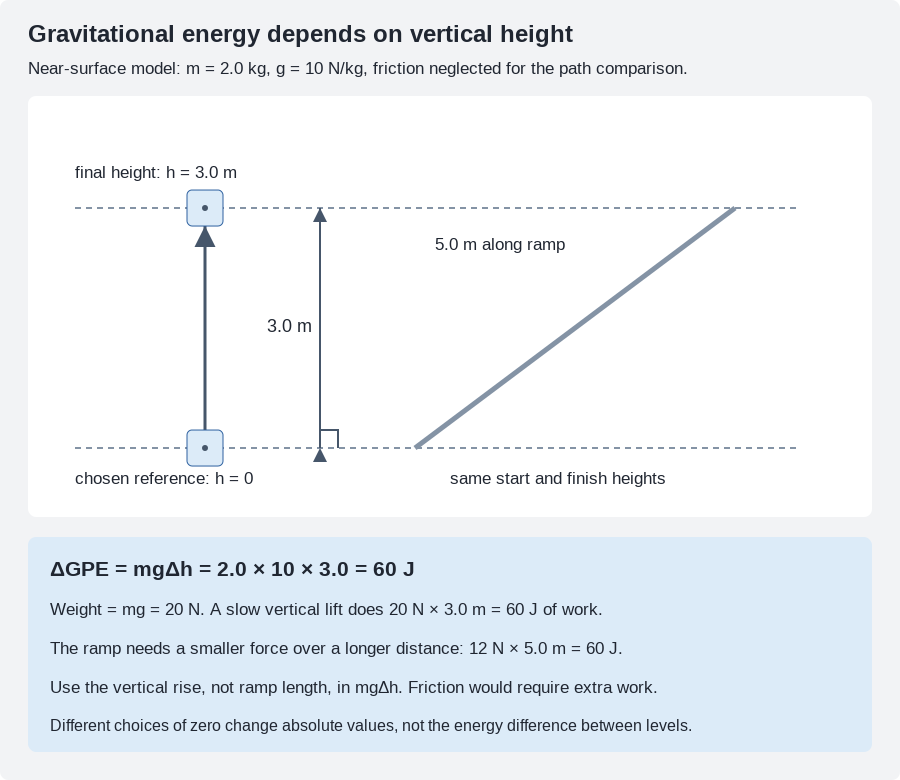
A 2.0 kg object rises 3.0 m where g = 10 N/kg. The gain is 2.0 × 10 × 3.0 = 60 J. Its weightThe gravitational force acting on an object, equal to its mass multiplied by gravitational field strength. is mg = 20 N, so a slow direct lift does 20 × 3.0 = 60 J work.
The illustrated ramp is 5.0 m long but rises only 3.0 m. The same object reaches the same height, so the gain is still 60 J. With negligible frictionA force opposing relative sliding or the tendency to slide between contacting surfaces. and no net kinetic-energy change, the constant forceA push or pull arising from an interaction between objects, measured in newtons. along the ramp is 60/5.0 = 12 N. A smaller force acts through a longer distanceThe length of a path travelled, without regard to direction..
Check assumptions and rearrange
Using 5.0 m as h would wrongly give 100 J: the extra path length does not change the height gain. frictionA force opposing relative sliding or the tendency to slide between contacting surfaces. on the ramp would require extra work, but the gravitational increase would remain 60 J.
To find height, rearrange Δh = ΔGPE/(mg). For 60 J, 2.0 kg and 10 N/kg this gives 3.0 m. Use the g stated in the question; the constant-g approximation is intended for height changes small relative to Earth's radius.
Equations
- ΔGPE = m × g × Δh
Common misconceptions
- Use vertical height change, not total path length, when calculating gravitational potential-energy change.
Follow energy as an object falls
Connect height lost, gravitational potential energy and kinetic energy during an ideal fall.
What you see
- Labelled diagrams and numerical outputs describe the same selected state.
How to use it
- Change one control at a time, predict the outcome, then compare the readouts. All controls have keyboard-accessible sliders and step buttons.
- Reset restores every model control to its initial value. Nothing is saved.
What it shows
- Lost gravitational potential energy mgh becomes kinetic energy ½mv². The total stays constant before impact. At the same release and observation heights, a larger mass has proportionally larger energy stores but the same speed in this no-resistance model.
Limits of the model
- An object is released from rest, with negligible air resistance and g=10 N/kg. The ground defines zero gravitational potential energy.
- The slider selects a fraction of the height fallen, not a fraction of the falling time. The model ends just before impact and does not model the collision.
Controls
The bars always use the same scale within one state. At zero release height, both stores and the speed are zero. Impact transfers energy to other stores and is outside this model.
Predict, change and explain
Release 2 kg from 10 m. Predict the two energy stores after half the height has been lost. Double mass and compare energy and speed at the same height. Explain why half the height fallen does not mean half the final speed.
Connect the outcome to the Physics
Lost gravitational potential energy mgh becomes kinetic energy ½mv². The total stays constant before impact. At the same release and observation heights, a larger mass has proportionally larger energy stores but the same speed in this no-resistance model.
Separate lifting work from lifting power
Change mass, vertical lift height and duration to compare work, energy gain and average useful power.
What you see
- Labelled diagrams and numerical outputs describe the same selected state.
How to use it
- Change one control at a time, predict the outcome, then compare the readouts. All controls have keyboard-accessible sliders and step buttons.
- Reset restores every model control to its initial value. Nothing is saved.
What it shows
- Work=force×distance moved in the force direction. Here force=mg, so useful work equals the gravitational potential energy gain mgh. Average useful power=work÷time; doing the same work faster needs greater average useful power.
Limits of the model
- An ideal vertical lift with g=10 N/kg and no friction; starting and finishing kinetic energy are equal.
- The force shown balances weight during steady motion. Starting and stopping intervals are neglected. Output power is the average useful power, not electrical input power or motor efficiency.
Controls
Work=200×3=600 J. Average useful power=600÷6=100 W. At zero lift height the work and useful power are zero; supporting a stationary load still requires force.
Predict, change and explain
Lift 20 kg through 3 m in 6 s. Predict work and average useful power. Halve only the time: explain which quantities change. Then double only height and compare work and power.
Connect the outcome to the Physics
Work=force×distance moved in the force direction. Here force=mg, so useful work equals the gravitational potential energy gain mgh. Average useful power=work÷time; doing the same work faster needs greater average useful power.