Learning goals
- Calculate kinetic energy using KE = ½mv².
- Predict effects of changing mass or speed.
- Rearrange for speed and distinguish energy from momentum.
Describe the quantity
An object moving relative to a chosen reference frame has kinetic energyThe energy associated with motion, equal to half the mass multiplied by speed squared for a moving object.. For the everyday speedThe distance travelled per unit time, without specifying direction. in this course, KE = ½mv², where m is massThe quantity measuring an object’s inertia, expressed in kilograms. in kg and v is speed in m/s. The result is in joules.
Speed is squared, so kinetic energy has no direction and is never negative. Reversing direction at the same speed leaves the same kinetic energy, although momentumThe product of an object’s mass and velocity, measured in kilogram metres per second. changes direction. State a consistent reference frame, usually the ground in these examples.
Work through the comparison
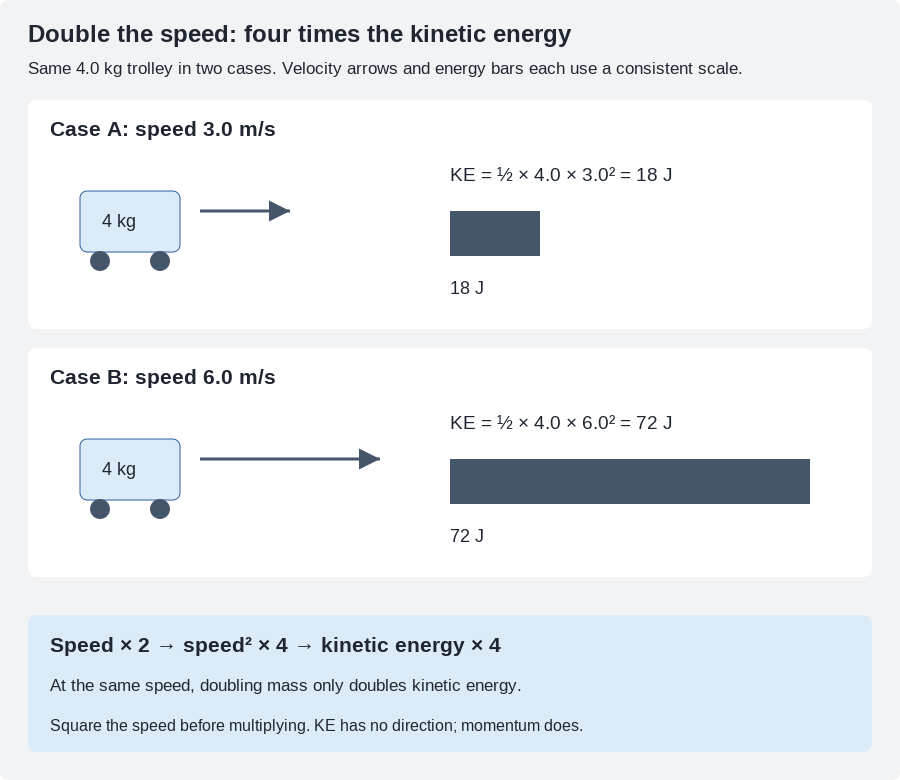
For a 4.0 kg trolley at 3.0 m/s, first square the speedThe distance travelled per unit time, without specifying direction.: 3.0² = 9.0 m²/s². Then KE = 0.5 × 4.0 × 9.0 = 18 J. At 6.0 m/s, KE = 0.5 × 4.0 × 36 = 72 J.
Doubling speed gives four times the energyA conserved quantity transferred between stores by working, heating, electrical processes or radiation, measured in joules., as the scaled bars show. Doubling massThe quantity measuring an object’s inertia, expressed in kilograms. at fixed speed gives twice the energy. Tripling speed at fixed mass would give nine times the energy, not three times.
Rearrange and apply
To find speedThe distance travelled per unit time, without specifying direction. from energyA conserved quantity transferred between stores by working, heating, electrical processes or radiation, measured in joules., use v = √(2KE/m). For 72 J and 4.0 kg, v = √(144/4.0) = √36 = 6.0 m/s. Remember the square root after dividing; 36 is the squared speed.
Brakes must transfer away a moving vehicle's kinetic energyThe energy associated with motion, equal to half the mass multiplied by speed squared for a moving object.. At a fixed braking forceA push or pull arising from an interaction between objects, measured in newtons., four times the kinetic energy requires four times the braking distanceThe distance a vehicle travels from the start of braking until it stops. because work = force × distanceThe length of a path travelled, without regard to direction.. Real stopping also includes reaction distance and changing grip, so state the assumptions.
Equations
- KE = ½ × m × v²
- v = √(2KE/m)
Common misconceptions
- Doubling speed multiplies kinetic energy by four, while momentum only doubles at fixed mass.
Follow energy as an object falls
Connect height lost, gravitational potential energy and kinetic energy during an ideal fall.
What you see
- Labelled diagrams and numerical outputs describe the same selected state.
How to use it
- Change one control at a time, predict the outcome, then compare the readouts. All controls have keyboard-accessible sliders and step buttons.
- Reset restores every model control to its initial value. Nothing is saved.
What it shows
- Lost gravitational potential energy mgh becomes kinetic energy ½mv². The total stays constant before impact. At the same release and observation heights, a larger mass has proportionally larger energy stores but the same speed in this no-resistance model.
Limits of the model
- An object is released from rest, with negligible air resistance and g=10 N/kg. The ground defines zero gravitational potential energy.
- The slider selects a fraction of the height fallen, not a fraction of the falling time. The model ends just before impact and does not model the collision.
Controls
The bars always use the same scale within one state. At zero release height, both stores and the speed are zero. Impact transfers energy to other stores and is outside this model.
Predict, change and explain
Release 2 kg from 10 m. Predict the two energy stores after half the height has been lost. Double mass and compare energy and speed at the same height. Explain why half the height fallen does not mean half the final speed.
Connect the outcome to the Physics
Lost gravitational potential energy mgh becomes kinetic energy ½mv². The total stays constant before impact. At the same release and observation heights, a larger mass has proportionally larger energy stores but the same speed in this no-resistance model.