Learning goals
- Use W = Fd for a constant force along the motion.
- Distinguish work by one force from net work.
- Recognise perpendicular forces and stationary cases.
Connect the force to the displacement
For a constant forceA push or pull arising from an interaction between objects, measured in newtons. parallel to an object's movement, work doneThe energy transferred by a force acting through a distance in its direction. is force multiplied by distanceThe length of a path travelled, without regard to direction. moved in that direction. Force F is in newtons, displacementThe straight-line change in position from a starting point, with a specified direction. distance d in metres and work W in joules. The force need not be the only force acting.
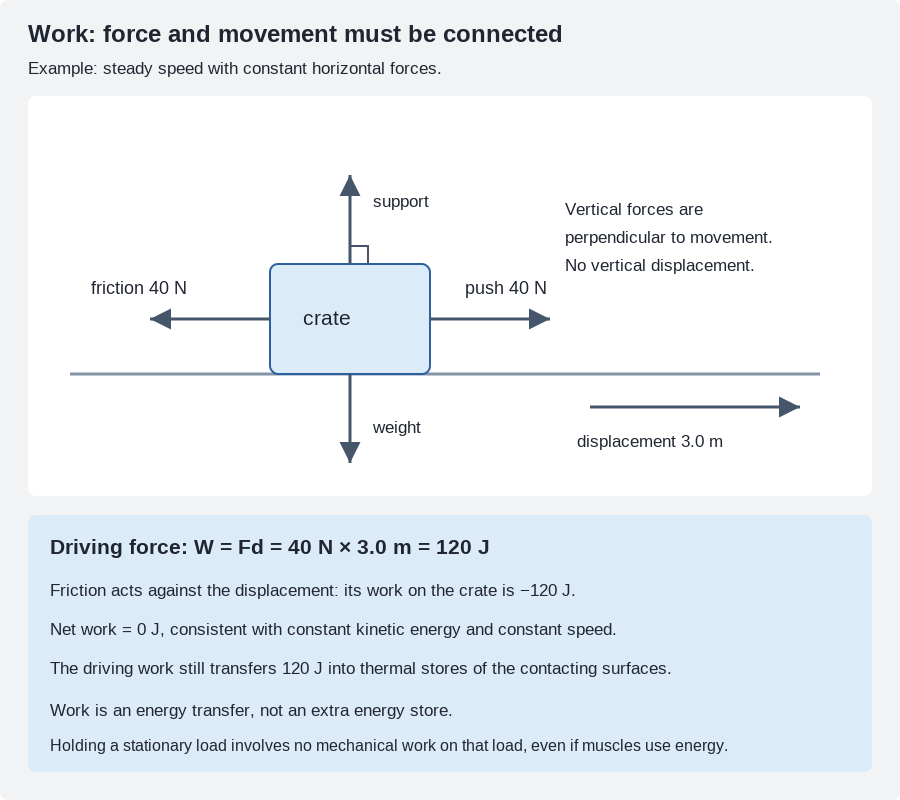
A force perpendicular to the displacement does no work on the object. For a crate moving horizontally without rising, weightThe gravitational force acting on an object, equal to its mass multiplied by gravitational field strength. and the upward support force do no work. If there is no displacement, a holding force does no mechanical work on the stationary load.
Worked example: the push and the friction
A 40 N horizontal push moves the crate 3.0 m to the right. Work by the push is 40 × 3.0 = 120 J. frictionA force opposing relative sliding or the tendency to slide between contacting surfaces. is also 40 N but points left, opposite the displacementThe straight-line change in position from a starting point, with a specified direction.: its work on the crate is −120 J. The minus sign denotes a transfer opposing the motion.
The forceA push or pull arising from an interaction between objects, measured in newtons. balance, so the crate's speedThe distance travelled per unit time, without specifying direction. and kinetic energyThe energy associated with motion, equal to half the mass multiplied by speed squared for a moving object. stay constant. Net work on its motion is 120 − 120 = 0 J, even though the person continues transferring energyA conserved quantity transferred between stores by working, heating, electrical processes or radiation, measured in joules.. Across the crate–floor system the driving work increases thermal stores.
Check which relationship applies
Use the forceA push or pull arising from an interaction between objects, measured in newtons. and displacementThe straight-line change in position from a starting point, with a specified direction. belonging to the same object and direction. Do not insert the weightThe gravitational force acting on an object, equal to its mass multiplied by gravitational field strength. when the relevant force is a horizontal pull, or use a sloping path length with a vertical force.
If the force varies or is at an angle to the movement, multiplying its full magnitude by the total distanceThe length of a path travelled, without regard to direction. is not generally valid. At this level use the given component along the displacement, or a situation where the force is constant and aligned. Muscles can consume energyA conserved quantity transferred between stores by working, heating, electrical processes or radiation, measured in joules. while holding still; that does not change the mechanical definition of work on the held object.
Equations
- work done = force × distance moved in the force direction
- W = Fd
Common misconceptions
- Zero resultant force does not mean every individual force does zero work.
Separate lifting work from lifting power
Change mass, vertical lift height and duration to compare work, energy gain and average useful power.
What you see
- Labelled diagrams and numerical outputs describe the same selected state.
How to use it
- Change one control at a time, predict the outcome, then compare the readouts. All controls have keyboard-accessible sliders and step buttons.
- Reset restores every model control to its initial value. Nothing is saved.
What it shows
- Work=force×distance moved in the force direction. Here force=mg, so useful work equals the gravitational potential energy gain mgh. Average useful power=work÷time; doing the same work faster needs greater average useful power.
Limits of the model
- An ideal vertical lift with g=10 N/kg and no friction; starting and finishing kinetic energy are equal.
- The force shown balances weight during steady motion. Starting and stopping intervals are neglected. Output power is the average useful power, not electrical input power or motor efficiency.
Controls
Work=200×3=600 J. Average useful power=600÷6=100 W. At zero lift height the work and useful power are zero; supporting a stationary load still requires force.
Predict, change and explain
Lift 20 kg through 3 m in 6 s. Predict work and average useful power. Halve only the time: explain which quantities change. Then double only height and compare work and power.
Connect the outcome to the Physics
Work=force×distance moved in the force direction. Here force=mg, so useful work equals the gravitational potential energy gain mgh. Average useful power=work÷time; doing the same work faster needs greater average useful power.