Learning goals
- Explain each feature of a vacuum flask.
- Apply the mechanisms to buildings and clothing.
- Identify remaining paths and direction of net transfer.
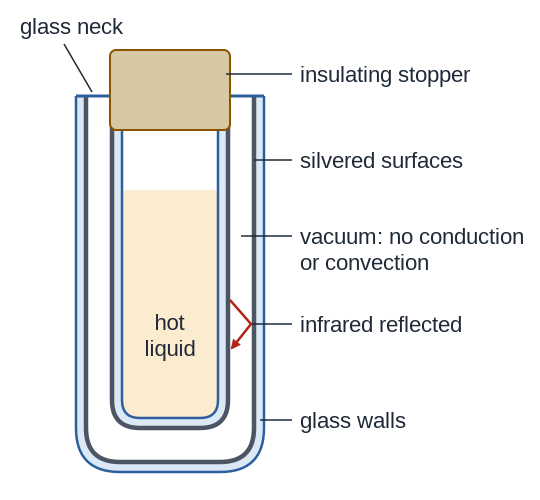
Why a vacuum is useful
conductionEnergy transfer through a material by particle interactions and, in metals, mobile electrons, without bulk flow of the material. needs particles and convectionEnergy transfer by bulk movement of a fluid, commonly driven by density differences within it. needs a fluid that can move. A well-evacuated gap between flask walls contains very little matter, so conduction across that gap is greatly reduced and there is no bulk fluid convection across it.
Radiation can still cross a vacuum. Reflective surfaces facing the gap reduce infrared absorption and emission, limiting radiative exchange. The vacuum and reflective finish therefore address different pathways; neither feature alone solves all heat transfer.
Explain the stopper and remaining losses
An insulating stopper limits conductionEnergy transfer through a material by particle interactions and, in metals, mobile electrons, without bulk flow of the material. through the opening and restricts movement of air or vapour. solidA state of matter whose closely packed particles vibrate around fixed positions, giving a fixed shape and volume. neck connections and supports still provide conducting paths. Removing the stopper allows much greater transfer, including convectionEnergy transfer by bulk movement of a fluid, commonly driven by density differences within it. and evaporationThe escape of higher-energy particles from a liquid’s surface into the gas phase below its boiling point. at a liquidA state of matter with closely spaced particles moving past one another, giving a fixed volume but no fixed shape. surface.
Insulation does not produce energyA conserved quantity transferred between stores by working, heating, electrical processes or radiation, measured in joules.. Hot contents lose energy to cooler surroundings more slowly, while cold contents gain energy from warmer surroundings more slowly. Given enough time and no active heating or cooling, ordinary flask contents still approach the surroundings' temperatureA measure of how hot a system is, related to the average kinetic energy of its particles..
Apply the principles elsewhere
Foam, loft insulation and clothing trap small pockets of air. Air is a poor conductorA material containing mobile charged particles that carry an electric current. and the small pockets restrict bulk circulation. Compressing fluffy insulation can remove these air spaces and reduce its effectiveness.
A cavity wall or double-glazed window reduces conductionEnergy transfer through a material by particle interactions and, in metals, mobile electrons, without bulk flow of the material. through its gap, but a large gap can allow convectionEnergy transfer by bulk movement of a fluid, commonly driven by density differences within it.. Low-emissivity coatings reduce radiative exchange. Draught proofing limits air exchange through openings rather than changing the conductivity of the wall itself.
Judge an insulation design by the dominant unwanted pathways, installation, moisture, durability and cost. No single material prevents all transfer, and a thicker layer does not correct an unsealed opening.
Equations
Common misconceptions
- A vacuum blocks ordinary conduction and convection across the gap, but not radiation; insulation can preserve cold as well as warmth.