Reasoning about matter, pressure and heating
Use particle and pressure models, evaluate measurements and distinguish temperature change from energy transfer.
Specification 4.3, 4.4, 4.5, 4.6, 4.7, 4.8P, 4.9P, 4.10P, 4.11P, 4.12P, 4.13P, 4.14P
Ratings, marks and Maths and Logic completion stay in this browser on this device. Written answers are temporary and are never recorded or transmitted. Reset clears only Physics practice progress, including Maths and Logic completion.
Answers and choices are temporary. Only started/completed flags are saved on this device. Practice can be retried or revealed; the check counts each question’s first answer. These are original practice tasks, not official exam questions.
Starting here
A measurement needs a model linking the reading to the quantity being investigated. Displaced liquid gives a submerged solid’s volume only when effects such as attached bubbles are controlled. A heater’s input energy equals energy absorbed by a sample only under an appropriate approximation.
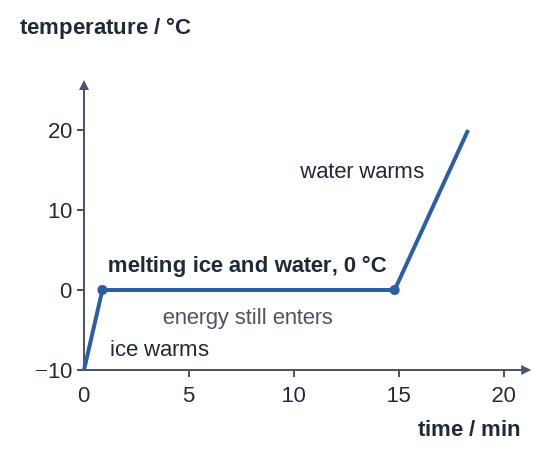
Particle models connect visible changes to arrangement, motion and separation. In the melting curve, temperature can remain constant while net energy enters the material. The plateau is a change of state, not evidence that energy transfer has stopped.
Key ideas
- Density is mass per volume; changes in sample size alone do not change the density of a uniform material at the same conditions.
- Pressure at a point in a fluid at rest is the same in all directions; pressure can still differ between depths.
- Use temperature rise in ΔQ=mcΔT, and distinguish sample absorption from heater input.
Worked example
A student sees the melting plateau in the figure and says the material cannot be gaining energy because its temperature does not rise. Assess this explanation for a pure material at constant pressure with net energy input.
- Observation. Temperature stays at the melting point while solid and liquid coexist.
- Model. Energy changes the particle arrangement and the interactions between particles during melting.
- Conclusion. Internal energy increases even though the average kinetic-energy indicator, temperature, remains constant.
Answer: Constant temperature does not mean zero energy transfer. During melting, the supplied net energy changes the state rather than raising temperature.
Activities
Opens when you finish the stage above.
Build the skill
Opens when you finish the stage above.
Check
Opens when you finish the stage above.