Learning goals
- Describe melting using particle motion and arrangement.
- Compare evaporation and boiling.
- Explain evaporative cooling and the meaning of vapour bubbles.
Solid to liquid: melting
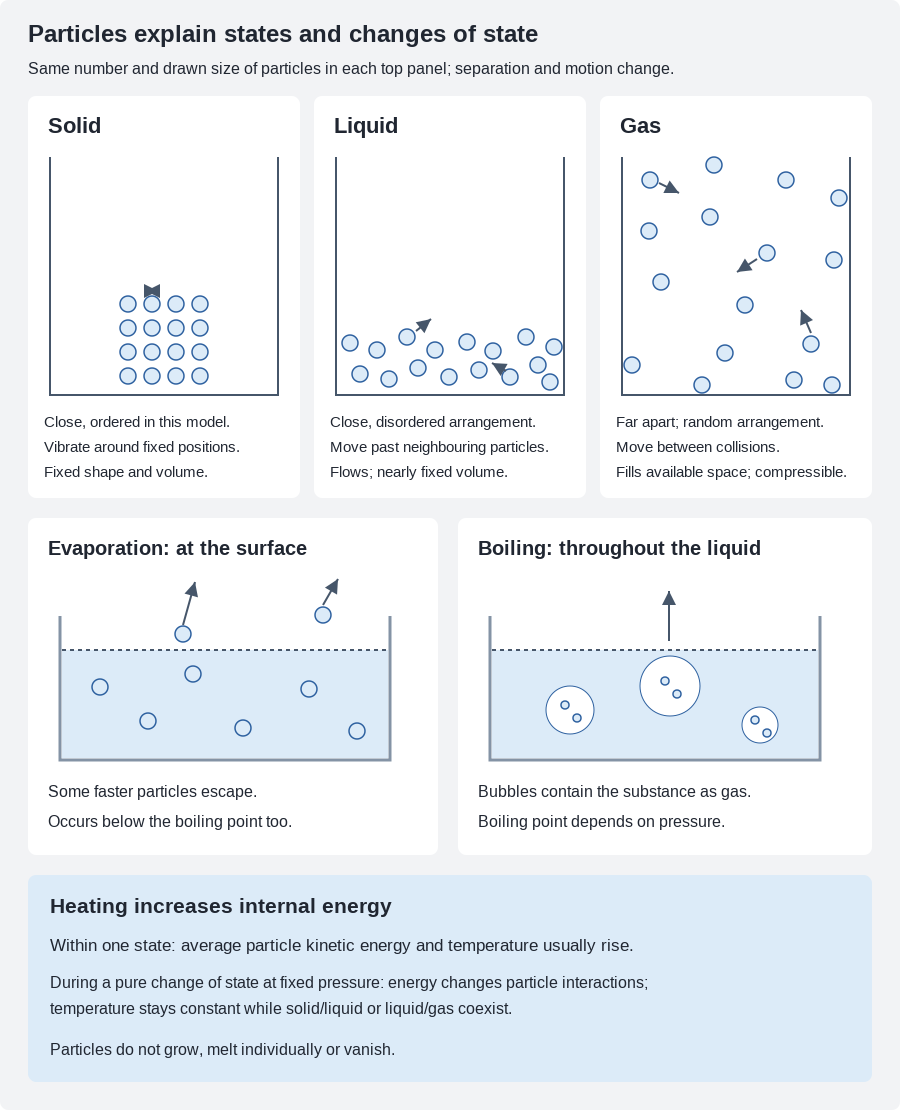
In a solidA state of matter whose closely packed particles vibrate around fixed positions, giving a fixed shape and volume., particles vibrate about fixed positions. As it warms they vibrate more energetically. At meltingThe change of state from solid to liquid as energy is supplied., enough energyA conserved quantity transferred between stores by working, heating, electrical processes or radiation, measured in joules. is supplied to change the arrangement so particles can move past one another. They remain close together, which is why the liquidA state of matter with closely spaced particles moving past one another, giving a fixed volume but no fixed shape. still has a nearly fixed volume but can take the shape of its container.
For a pure substance at fixed pressureThe normal force exerted per unit area, measured in pascals., the melting temperatureA measure of how hot a system is, related to the average kinetic energy of its particles. is approximately constant while solid and liquid coexist. Energy is needed to change the particle interactions, rather than increase average kinetic energyThe energy associated with motion, equal to half the mass multiplied by speed squared for a moving object.. Melting is a physical change; it does not turn the particles into a different substance.
Evaporation: escape from a surface
Particles in a liquidA state of matter with closely spaced particles moving past one another, giving a fixed volume but no fixed shape. have different kinetic energyThe energy associated with motion, equal to half the mass multiplied by speed squared for a moving object.. Some at the surface have enough energyA conserved quantity transferred between stores by working, heating, electrical processes or radiation, measured in joules. to escape the attractive interactions of neighbouring particles and enter the gasA state of matter whose widely separated particles move randomly, filling the available container. above. evaporationThe escape of higher-energy particles from a liquid’s surface into the gas phase below its boiling point. therefore happens at the surface and can occur below the boiling pointThe temperature at which a liquid boils at a given external pressure..
When faster particles escape, the average energy of those left can decrease. The liquid cools unless energy is replaced from its surroundings. This helps explain cooling by sweating. Warmer conditions, a larger exposed surface and removal of moist air usually increase the net evaporation rate. In a closed space, condensationThe change of state from gas to liquid as particles lose energy. back into the liquid can balance evaporation.
Boiling: gas forms within the liquid
At the boiling pointThe temperature at which a liquid boils at a given external pressure. for the surrounding pressureThe normal force exerted per unit area, measured in pascals., vapour bubbles can form and grow throughout the liquidA state of matter with closely spaced particles moving past one another, giving a fixed volume but no fixed shape.. They rise and release gasA state of matter whose widely separated particles move randomly, filling the available container. at the surface. The bubbles are the substance in its gaseous state, not air newly created by heating. Small bubbles of dissolved air seen before boilingVaporisation throughout a liquid when its vapour pressure equals the external pressure. are a different effect.
During steady boiling of a pure liquid at fixed pressure, continued energyA conserved quantity transferred between stores by working, heating, electrical processes or radiation, measured in joules. transfer changes liquid to gas while temperatureA measure of how hot a system is, related to the average kinetic energy of its particles. remains approximately constant. Increasing the heating rate then mainly increases the rate of boiling. The boiling point depends on pressure, so water does not always boil at 100 °C.
Water vapour itself is invisible. A white mist above a kettle consists of tiny liquid droplets formed when vapour cools and condenses. Do not describe the visible mist as individual gas particles.
Equations
Common misconceptions
- Evaporation does not require the liquid to reach its boiling point.
- Vapour bubbles during boiling contain the same substance as the liquid, in a different state.
- A larger flame does not continually raise the temperature of water while it boils at fixed pressure.