Learning goals
- Compare particles in all three states.
- Explain shape, volume, flow and compressibility.
- State important limits of the particle diagram.
Solids: neighbours remain in place
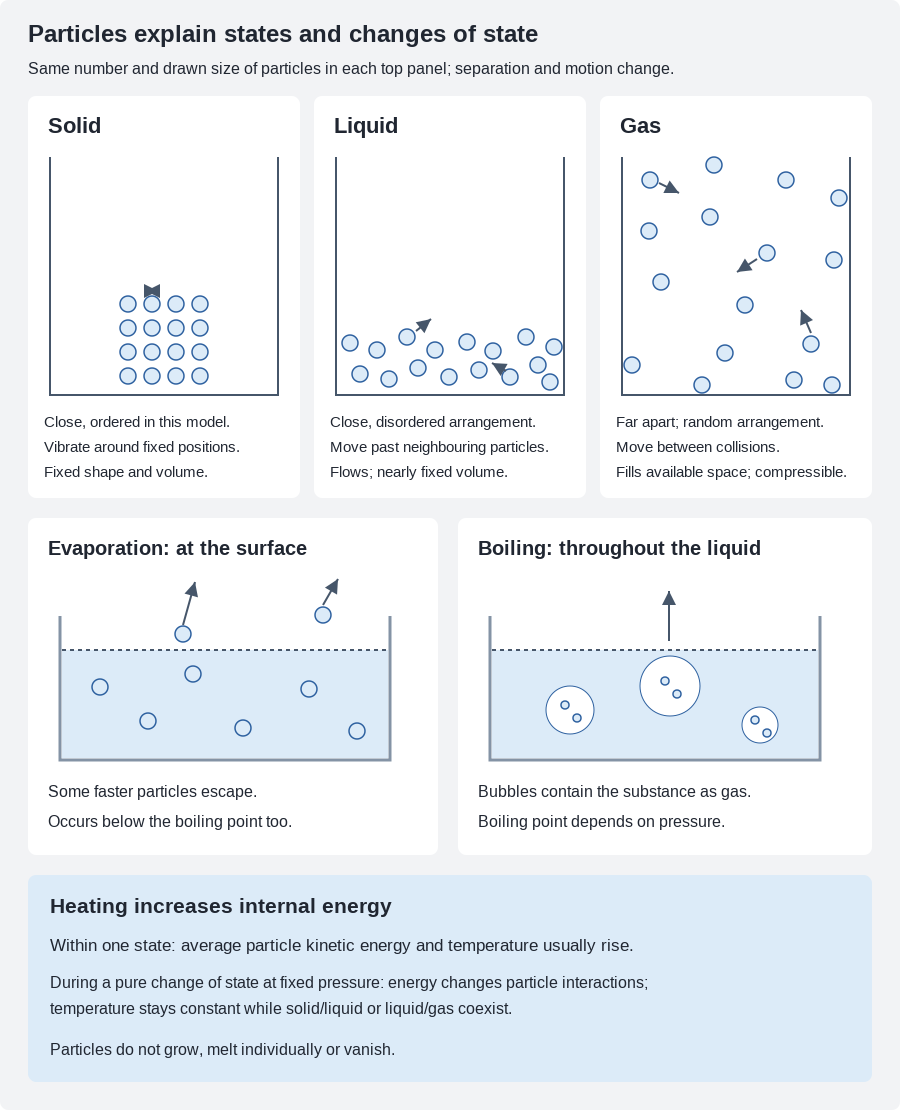
Particles in a solidA state of matter whose closely packed particles vibrate around fixed positions, giving a fixed shape and volume. are close together and held around fixed relative positions. They still vibrate; they are not motionless. The regular pattern in the figure represents a crystalline solid. Some solids have less regular structures, but their particles still cannot freely move past one another.
Because the neighbours remain fixed, a solid usually keeps its shape and volume. It is difficult to compress because its particles are already close. Heating increases vibration and often their average separation slightly; it does not make each particle swell.
Liquids: close together but able to rearrange
liquidA state of matter with closely spaced particles moving past one another, giving a fixed volume but no fixed shape. particles are also close together, but their arrangement changes as they move past one another. Attractions keep them close enough to have a nearly fixed volume, while movement allows the liquid to flow and take the shape of the lower part of its container.
A liquid is difficult to compress because there is little free space between neighbouring particles. densityThe mass of material per unit volume, measured in kilograms per cubic metre in SI units. changes on meltingThe change of state from solid to liquid as energy is supplied. depend on the material; do not assume every liquid is less dense than its solidA state of matter whose closely packed particles vibrate around fixed positions, giving a fixed shape and volume.. Water is a familiar exception, since ice is less dense than liquid water.
Gases: widely separated and moving randomly
gasA state of matter whose widely separated particles move randomly, filling the available container. particles are far apart relative to their size and move rapidly in random directions between collisions. They spread through the available space, so a gas has neither a fixed shape nor a fixed volume.
A gas is easily compressed mainly because the spaces between particles can decrease, not because the particles themselves are squeezed smaller. Collisions with surfaces explain pressureThe normal force exerted per unit area, measured in pascals.. Gas at rest means no overall flow; microscopic random motion continues.
Use the model carefully
Each top panel contains sixteen equal-size symbols, representing the same number of particles in different states. The solidA state of matter whose closely packed particles vibrate around fixed positions, giving a fixed shape and volume. occupies a compact shape, the liquidA state of matter with closely spaced particles moving past one another, giving a fixed volume but no fixed shape. spreads along the bottom and the gasA state of matter whose widely separated particles move randomly, filling the available container. fills the container. Symbols and gaps are not drawn to atomic scale, and arrows are selected examples of motion.
A static two-dimensional diagram cannot show all three-dimensional motion or attractive interactions. The model explains broad properties; it is not a literal photograph, and individual atomAn electrically neutral particle with a small positive nucleus surrounded by electrons. or molecules do not have the bulk properties of a solid, liquid or gas.
Equations
Common misconceptions
- Solid particles vibrate even when the solid object is stationary.
- Gases are compressible because of the spaces between particles, not because their particles are soft.
- A liquid has a nearly fixed volume even though it has no fixed shape.