Learning goals
- Define density as mass per unit volume.
- Use and rearrange ρ = m/V with consistent units.
- Choose a volume method suited to the sample.
What density tells us
massThe quantity measuring an object’s inertia, expressed in kilograms. measures the amount of matter in a sample; volume is the space it occupies. densityThe mass of material per unit volume, measured in kilograms per cubic metre in SI units., symbol ρ (rho), is mass divided by volume. Two solidA state of matter whose closely packed particles vibrate around fixed positions, giving a fixed shape and volume. samples of the same uniform material at the same temperatureA measure of how hot a system is, related to the average kinetic energy of its particles. normally have the same density even if one is much larger. Doubling both mass and volume leaves their ratio unchanged.
For a regular cuboid, measure three perpendicular dimensions and multiply them. For a suitable irregular solid, the rise in water volume when it is fully submerged gives its volume. The mass and volume must refer to the same sample. Hollow objects have an overall average density that includes their cavities.
Worked regular-block example
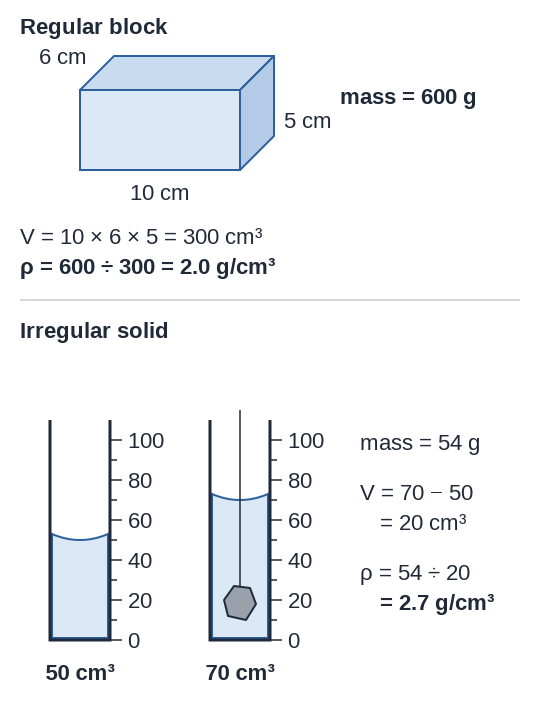
A block has massThe quantity measuring an object’s inertia, expressed in kilograms. 600 g and dimensions 10 cm × 6 cm × 5 cm. First calculate volume: V = 10 × 6 × 5 = 300 cm³. Then ρ = 600/300 = 2.0 g/cm³.
To use SI units, m = 0.600 kg and V = 0.000300 m³. Therefore ρ = 0.600/0.000300 = 2000 kg/m³. This agrees with multiplying 2.0 g/cm³ by 1000. Do not divide grams by cubic metres and label the answer kg/m³.
Other unknowns and irregular shapes
Multiplying ρ = m/V by V gives m = ρV. Dividing by ρ then gives V = m/ρ. For a 0.0040 m³ sample of densityThe mass of material per unit volume, measured in kilograms per cubic metre in SI units. 2000 kg/m³, massThe quantity measuring an object’s inertia, expressed in kilograms. = 2000 × 0.0040 = 8.0 kg. Check that kg/m³ × m³ leaves kg.
In the figure, an irregular solidA state of matter whose closely packed particles vibrate around fixed positions, giving a fixed shape and volume. has mass 54 g and changes the cylinder reading from 50 to 70 cm³. Its volume is the difference, 20 cm³, so its density is 54/20 = 2.7 g/cm³ = 2700 kg/m³. The final cylinder reading includes the water already present.
Density can change when a material expands or changes state. Compare quoted values under the same conditions; gasA state of matter whose widely separated particles move randomly, filling the available container. density especially depends on pressureThe normal force exerted per unit area, measured in pascals. and temperatureA measure of how hot a system is, related to the average kinetic energy of its particles..
Equations
- ρ = m/V; m = ρV; V = m/ρ
- ρ in kg/m³, m in kg, V in m³
Common misconceptions
- A greater mass alone does not establish greater density; compare mass per equal volume.
- For displacement, use final minus initial volume, not the final reading alone.
Measure the volume that belongs to the mass
Read before/after cylinder volumes and combine displacement with the matching mass.
What you see
- Labelled diagrams and numerical outputs describe the same selected state.
How to use it
- Change one control at a time, predict the outcome, then compare the readouts. All controls have keyboard-accessible sliders and step buttons.
- Reset restores every model control to its initial value. Nothing is saved.
What it shows
- The sample volume is final water volume minus initial water volume. Divide the mass of that same sample by this displacement. A larger final reading is not the sample volume itself. Convert g/cm³ to kg/m³ by multiplying by 1000; air bubbles or incomplete submersion would invalidate the model measurement.
Limits of the model
- A non-absorbing sample is fully submerged with no trapped air, no dissolved material and negligible support-tool volume. A floating sample is held below the surface.
- Controls select different test objects, not compression of one fixed material. The sample is omitted from the cylinder drawing so both menisci can be read clearly.
Controls
Volume=70−50=20 cm³. Density=60÷20=3 g/cm³. All calculated readouts use unrounded values.
Predict, change and explain
Choose 60 g and 20 cm³ displacement. Read both cylinder levels before calculating density. Double mass and displacement together. Then keep mass fixed but increase displacement: explain the change in density.
Connect the outcome to the Physics
The sample volume is final water volume minus initial water volume. Divide the mass of that same sample by this displacement. A larger final reading is not the sample volume itself. Convert g/cm³ to kg/m³ by multiplying by 1000; air bubbles or incomplete submersion would invalidate the model measurement.