Learning goals
- Measure regular-solid, irregular-solid and liquid densities.
- Record and process mass and volume readings.
- Explain sources of error and practical improvements.
Purpose and regular-solid method
The investigation tests how much massThe quantity measuring an object’s inertia, expressed in kilograms. occupies each unit volume of a sample. Use a balance for mass and a ruler or suitable length-measuring instrument for a regular solidA state of matter whose closely packed particles vibrate around fixed positions, giving a fixed shape and volume.. Zero the balance, check units and measure the dry sample. Read the scale with the eye above the mark to reduce parallax.
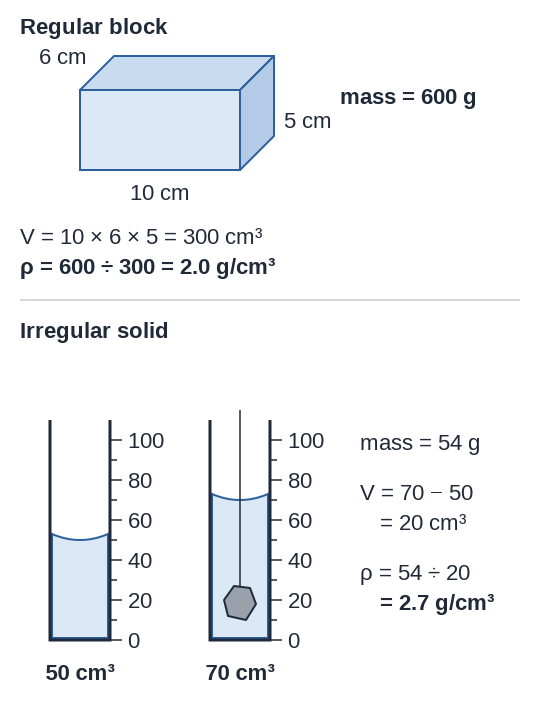
For a cuboid, measure length, width and height in perpendicular directions. Repeat dimensions at several positions if edges are imperfect, then use representative dimensions to calculate V = length × width × height. Record mass, all three dimensions, calculated volume and densityThe mass of material per unit volume, measured in kilograms per cubic metre in SI units. with units. A cylinder needs its appropriate geometric volume instead.
Irregular-solid displacement method
Measure the dry solidA state of matter whose closely packed particles vibrate around fixed positions, giving a fixed shape and volume.’s massThe quantity measuring an object’s inertia, expressed in kilograms. before immersion. Put enough water in a measuring cylinder to cover the object, without risking overflow. Record the initial reading at the bottom of the water meniscus with the eye level with it. Lower the object gently on a thin thread; ensure it is fully submerged, not touching the rim, and has no trapped air bubbles. Record the new meniscus reading.
Calculate volume as final minus initial reading. One millilitre equals one cubic centimetre. For the readings 50 and 70 cm³, V = 20 cm³; with mass 54 g, ρ = 54/20 = 2.7 g/cm³. If a displacementThe straight-line change in position from a starting point, with a specified direction. can is used instead, collect all displaced water and measure its volume.
This method is unsuitable without adaptation for a solid that dissolves, absorbs water or reacts with it. A floating object cannot simply be pressed partly under and treated as fully measured. A suitable alternative liquidA state of matter with closely spaced particles moving past one another, giving a fixed volume but no fixed shape. or a separately allowed-for sinker may be needed. Keep the balance dry and handle glassware securely.
Liquid method and processing
Measure the massThe quantity measuring an object’s inertia, expressed in kilograms. of an empty dry container, then the mass of that container plus a measured liquidA state of matter with closely spaced particles moving past one another, giving a fixed volume but no fixed shape. volume. Subtract to obtain liquid mass; alternatively tare the container before filling. Read the volume at eye level. For masses 42 g empty and 122 g filled with 100 cm³, liquid mass = 80 g and densityThe mass of material per unit volume, measured in kilograms per cubic metre in SI units. = 0.80 g/cm³ = 800 kg/m³.
Repeat independent measurements and calculate a mean when repeats are consistent. Record instrument resolutionThe smallest change in a quantity that an instrument distinguishes. and avoid extra digits unsupported by the readings. Repeat measurements can reveal scatter but do not remove a balance zero error or a consistently misread meniscus.
What the result supports
Trapped bubbles increase apparent displacementThe straight-line change in position from a starting point, with a specified direction. and make the calculated densityThe mass of material per unit volume, measured in kilograms per cubic metre in SI units. too low. Using the container’s massThe quantity measuring an object’s inertia, expressed in kilograms. as part of the liquidA state of matter with closely spaced particles moving past one another, giving a fixed volume but no fixed shape. mass makes density too high. A small displacement relative to the scale divisions has a large percentage uncertaintyThe estimated range around a measured value within which the true value is expected to lie.; a larger suitable sample or finer cylinder can improve this.
Compare the measured density with a reference value only after considering temperatureA measure of how hot a system is, related to the average kinetic energy of its particles., sample composition and uncertainty. Agreement supports identification of a material but does not uniquely prove its identity; different materials or mixtures can have similar densities.
Equations
- density = measured mass / measured volume
- solid volume = final cylinder reading − initial cylinder reading
- liquid mass = filled-container mass − empty-container mass
Common misconceptions
- The mass and volume must describe the same material; the container is not part of the liquid mass.
- Repeating an incorrectly zeroed balance reading does not correct its systematic error.
Measure the volume that belongs to the mass
Read before/after cylinder volumes and combine displacement with the matching mass.
What you see
- Labelled diagrams and numerical outputs describe the same selected state.
How to use it
- Change one control at a time, predict the outcome, then compare the readouts. All controls have keyboard-accessible sliders and step buttons.
- Reset restores every model control to its initial value. Nothing is saved.
What it shows
- The sample volume is final water volume minus initial water volume. Divide the mass of that same sample by this displacement. A larger final reading is not the sample volume itself. Convert g/cm³ to kg/m³ by multiplying by 1000; air bubbles or incomplete submersion would invalidate the model measurement.
Limits of the model
- A non-absorbing sample is fully submerged with no trapped air, no dissolved material and negligible support-tool volume. A floating sample is held below the surface.
- Controls select different test objects, not compression of one fixed material. The sample is omitted from the cylinder drawing so both menisci can be read clearly.
Controls
Volume=70−50=20 cm³. Density=60÷20=3 g/cm³. All calculated readouts use unrounded values.
Predict, change and explain
Choose 60 g and 20 cm³ displacement. Read both cylinder levels before calculating density. Double mass and displacement together. Then keep mass fixed but increase displacement: explain the change in density.
Connect the outcome to the Physics
The sample volume is final water volume minus initial water volume. Divide the mass of that same sample by this displacement. A larger final reading is not the sample volume itself. Convert g/cm³ to kg/m³ by multiplying by 1000; air bubbles or incomplete submersion would invalidate the model measurement.