Learning goals
- Define pressure and the pascal.
- Calculate pressure, normal force or area.
- Explain pressure changes at constant force.
Force spread over an area
A normal reactionA contact force exerted perpendicular to a surface supporting an object. acts perpendicular to a surface. Divide its magnitude F by the contact area A to find the mean pressureThe normal force exerted per unit area, measured in pascals. p. One pascal is one newton acting normally over one square metre: 1 Pa = 1 N/m². Pressure is a scalarA physical quantity described by magnitude alone. quantity; the associated forceA push or pull arising from an interaction between objects, measured in newtons. has a direction set by the surface.
The same weightThe gravitational force acting on an object, equal to its mass multiplied by gravitational field strength. produces a smaller mean pressure over a larger contact area. Snowshoes spread a person’s force and reduce sinking; a sharp blade concentrates force over a small area. For an object at rest on level ground with no other vertical forces, its downward contact forceAn interaction requiring objects to touch, such as friction or a normal reaction. equals its weight.
Worked area comparison
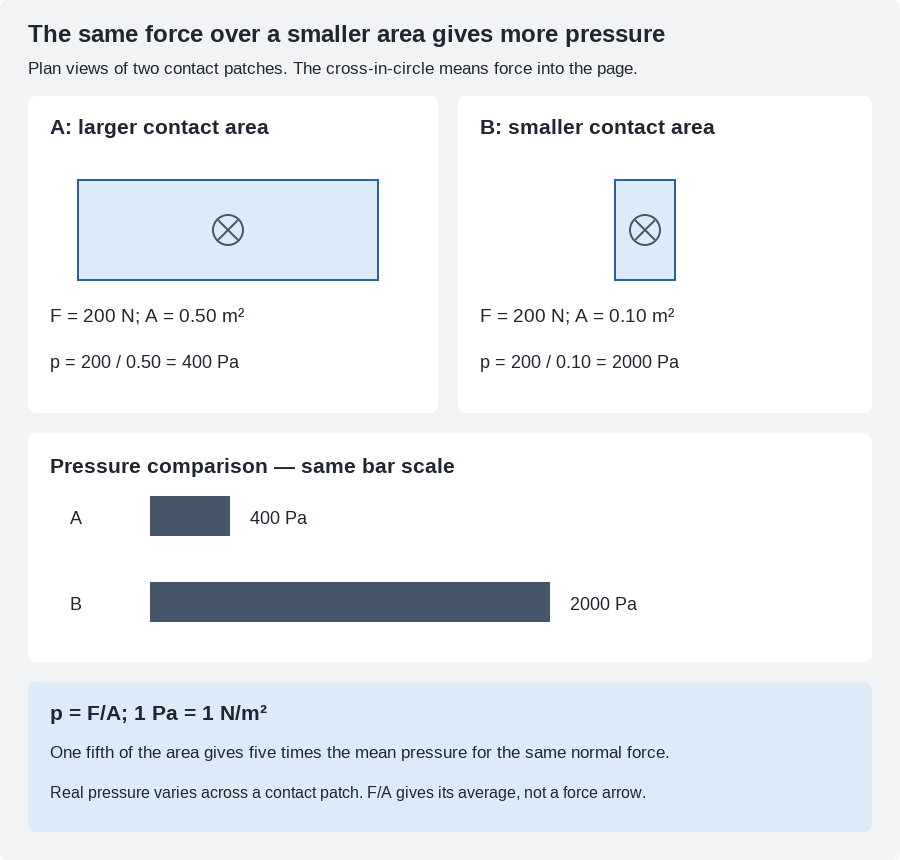
A 200 N normal reactionA contact force exerted perpendicular to a surface supporting an object. acts over 0.50 m². pressureThe normal force exerted per unit area, measured in pascals. = 200/0.50 = 400 Pa. Reduce the area to 0.10 m² while keeping 200 N: pressure = 200/0.10 = 2000 Pa. The area is one fifth as large and the pressure is five times larger.
The plan views in the figure show contact areas in a 5:1 ratio; the cross-in-circle represents a forceA push or pull arising from an interaction between objects, measured in newtons. into the page. The separate bar chart compares pressure values. It does not show larger total force on the smaller patch.
Rearrange and convert
From p = F/A, multiply by A to obtain F = pA, or divide F by p to obtain A = F/p. A pressureThe normal force exerted per unit area, measured in pascals. of 40 000 Pa across 50 cm² acts over 50 × 10⁻⁴ = 0.0050 m², giving F = 40 000 × 0.0050 = 200 N.
These calculations give the mean pressure. Real contact surfaces may have uneven pressure distributions; dividing by total area does not locate the greatest local pressure.
Equations
- p = F/A; F = pA; A = F/p
- p in Pa, F in N, A in m²
Common misconceptions
- Pressure is not another name for force; the same force can produce different pressures.
- Convert square centimetres using 1 cm² = 0.0001 m², not 0.01 m².