Learning goals
- Describe pressure at one point in a fluid.
- Connect pressure to normal forces on surfaces.
- Distinguish direction independence from changes with position.
A fluid pushes sideways as well as downwards
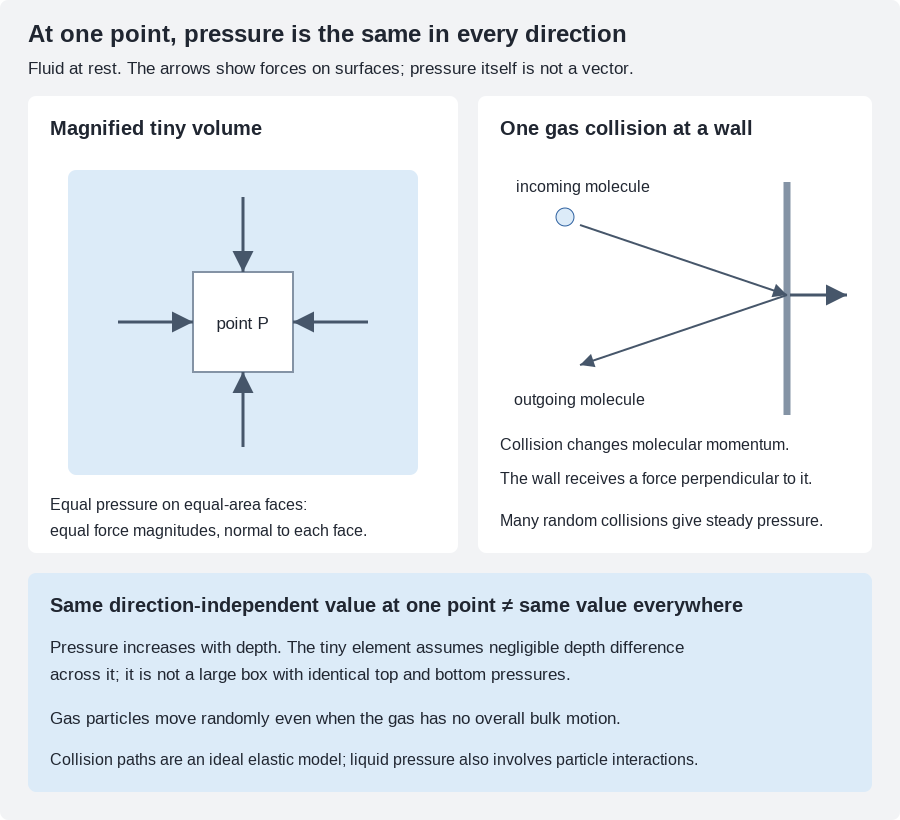
liquidA state of matter with closely spaced particles moving past one another, giving a fixed volume but no fixed shape. and gasA state of matter whose widely separated particles move randomly, filling the available container. are fluids: they can flow. A fluid at rest exerts forceA push or pull arising from an interaction between objects, measured in newtons. on the walls, base and any immersed surfaces. At a given point its pressureThe normal force exerted per unit area, measured in pascals. is independent of direction. Equal small areas facing different ways at that point experience forces of the same magnitude, directed perpendicular to their surfaces.
Pressure itself is a scalarA physical quantity described by magnitude alone., not an arrow. In the figure, arrows represent the forces exerted on the faces of a tiny imagined volume. The equal-arrow approximation neglects the tiny difference in depth between its top and bottom. For a large submerged object, pressure at the lower surface is greater and can produce an upward resultant.
Particles and walls
gasA state of matter whose widely separated particles move randomly, filling the available container. particles move randomly even when the gas has no overall flow. When a particle rebounds from a wall, its momentumThe product of an object’s mass and velocity, measured in kilogram metres per second. changes. It exerts a forceA push or pull arising from an interaction between objects, measured in newtons. on the wall; many collisions over a large number of particles give a steady average pressureThe normal force exerted per unit area, measured in pascals.. Random motion has no preferred direction in a gas at rest.
The collision sketch uses an ideal smooth wall and elastic collision: the perpendicular velocityThe rate of change of displacement, including the direction of motion. component reverses and the parallel component stays the same. liquidA state of matter with closely spaced particles moving past one another, giving a fixed volume but no fixed shape. pressure also involves closely spaced particles and their interactions; the dilute-gas sketch is not a literal picture of all liquids.
One point is not every point
Turn a small pressureThe normal force exerted per unit area, measured in pascals. probe to different orientations at the same position: the static pressure is unchanged. Move it deeper into a liquidA state of matter with closely spaced particles moving past one another, giving a fixed volume but no fixed shape.: the reading increases because the fluid above has weightThe gravitational force acting on an object, equal to its mass multiplied by gravitational field strength.. Thus direction independence and variation with depth are compatible.
This statement concerns fluids at rest. A flowing jet or wind can create additional forceA push or pull arising from an interaction between objects, measured in newtons. associated with its motion, so do not use this static model alone to describe every moving-fluid situation.
Equations
- normal force on a small area: F = pA
Common misconceptions
- Fluid pressure is not only downward; it also gives sideways forces on container walls.
- Same pressure in every direction at one point does not mean the same pressure at every depth.
- Fluid at rest means no bulk flow, not motionless particles.
Compare liquid pressure at different depths
Change liquid density and depth, then compare the pressure increase and its equal action in every direction.
What you see
- Labelled diagrams and numerical outputs describe the same selected state.
How to use it
- Change one control at a time, predict the outcome, then compare the readouts. All controls have keyboard-accessible sliders and step buttons.
- Reset restores every model control to its initial value. Nothing is saved.
What it shows
- The pressure increase below the free surface is Δp=ρgh. At one point the pressure acts equally in all directions; forces on small faces are normal to those faces. The arrows show that pressure increase on equal-area imagined faces. Zero depth means zero increase over the surface pressure, not an absence of atmospheric pressure.
Limits of the model
- A stationary, uniform-density liquid and g=10 N/kg. Depth is measured vertically below its free surface.
- The readout and arrows show pressure in excess of the surface pressure, not absolute pressure. The small square marks a point; its drawn size is not a depth interval or a real probe.
Controls
Δp=1000×10×2=20000 Pa. This is a pressure difference; the surface pressure has not been included.
Predict, change and explain
At 1000 kg/m³, compare depths of 2 m and 4 m. Then hold depth fixed and halve density. Explain why the four equal arrows at one point do not mean pressure only acts downwards.
Connect the outcome to the Physics
The pressure increase below the free surface is Δp=ρgh. At one point the pressure acts equally in all directions; forces on small faces are normal to those faces. The arrows show that pressure increase on equal-area imagined faces. Zero depth means zero increase over the surface pressure, not an absence of atmospheric pressure.