Learning goals
- Explain the origin of the liquid-pressure equation.
- Calculate pressure difference or depth with SI units.
- Distinguish pressure increase from total pressure and identify model assumptions.
Why pressure increases with depth
Imagine a vertical column of liquidA state of matter with closely spaced particles moving past one another, giving a fixed volume but no fixed shape. with cross-sectional area A and height h. Its volume is Ah, its massThe quantity measuring an object’s inertia, expressed in kilograms. is ρAh and its weightThe gravitational force acting on an object, equal to its mass multiplied by gravitational field strength. is ρAhg. The extra upward forceA push or pull arising from an interaction between objects, measured in newtons. at its base supports this weight, so the pressureThe normal force exerted per unit area, measured in pascals. increase is weight/area = ρAhg/A = hρg.
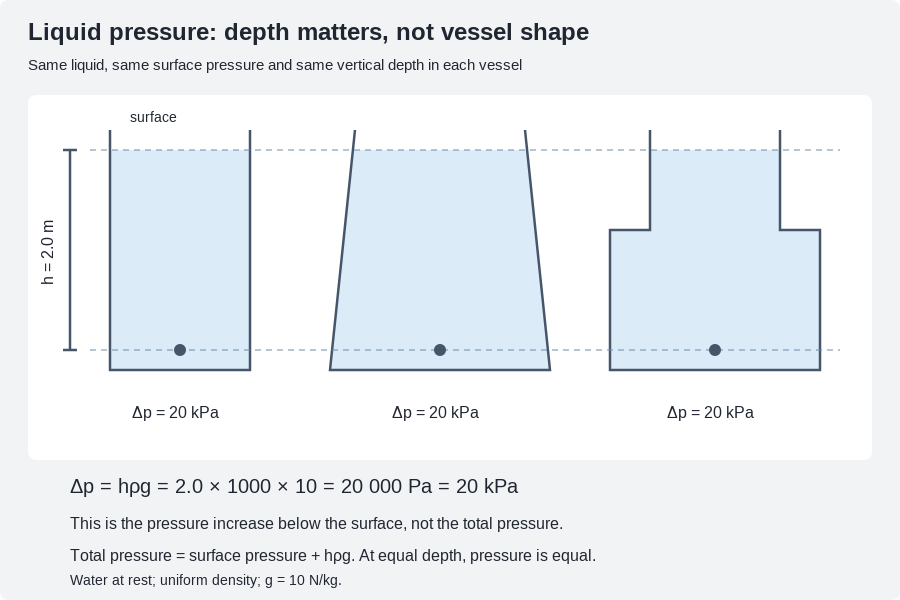
Area cancels. For the same liquid, surface pressure and depth, the pressure is independent of vessel width or shape. The depth must be vertical, not distanceThe length of a path travelled, without regard to direction. along a sloping wall. Greater densityThe mass of material per unit volume, measured in kilograms per cubic metre in SI units. or greater gravitational field strengthThe gravitational force per unit mass at a point, measured in newtons per kilogram. gives a larger increase for the same depth.
Worked pressure and total-pressure example
For water at rest, use ρ = 1000 kg/m³, h = 2.0 m and the stated g = 10 N/kg. The pressureThe normal force exerted per unit area, measured in pascals. increase is Δp = 2.0 × 1000 × 10 = 20 000 Pa = 20 kPa. The three differently shaped vessels in the figure therefore have equal pressure at the marked points.
This is the increase above the surface pressure. If the surface pressure is given as 100 kPa, the total pressure at 2.0 m is 100 + 20 = 120 kPa. Do not add surface pressure when a question asks only for the difference.
Rearrange and interpret
To find depth, divide by ρg: h = Δp/(ρg). An increase of 15 000 Pa in this water corresponds to h = 15 000/(1000 × 10) = 1.5 m. Convert centimetres to metres and kPa to Pa before substituting.
A dam must withstand increasing water pressureThe normal force exerted per unit area, measured in pascals. towards its base; the greater pressure there produces greater forceA push or pull arising from an interaction between objects, measured in newtons. on equal areas. Equal-depth points can still have different total pressures if their surfaces are under different applied pressures.
Limits of the simple model
The equation assumes fluid at rest, approximately uniform densityThe mass of material per unit volume, measured in kilograms per cubic metre in SI units. and constant g over the height range. These are good approximations for ordinary laboratory liquidA state of matter with closely spaced particles moving past one another, giving a fixed volume but no fixed shape. columns. For a gasA state of matter whose widely separated particles move randomly, filling the available container. over a large altitude range, density changes substantially, so a single constant-density calculation may be unsuitable.
Equations
- Δp = hρg; h = Δp/(ρg)
- total pressure at depth = surface pressure + hρg
- Δp in Pa, h in m, ρ in kg/m³, g in N/kg
Common misconceptions
- Δp is a pressure difference, not automatically the absolute pressure.
- A wider container holds more liquid but does not give greater pressure at the same depth and density.
Compare liquid pressure at different depths
Change liquid density and depth, then compare the pressure increase and its equal action in every direction.
What you see
- Labelled diagrams and numerical outputs describe the same selected state.
How to use it
- Change one control at a time, predict the outcome, then compare the readouts. All controls have keyboard-accessible sliders and step buttons.
- Reset restores every model control to its initial value. Nothing is saved.
What it shows
- The pressure increase below the free surface is Δp=ρgh. At one point the pressure acts equally in all directions; forces on small faces are normal to those faces. The arrows show that pressure increase on equal-area imagined faces. Zero depth means zero increase over the surface pressure, not an absence of atmospheric pressure.
Limits of the model
- A stationary, uniform-density liquid and g=10 N/kg. Depth is measured vertically below its free surface.
- The readout and arrows show pressure in excess of the surface pressure, not absolute pressure. The small square marks a point; its drawn size is not a depth interval or a real probe.
Controls
Δp=1000×10×2=20000 Pa. This is a pressure difference; the surface pressure has not been included.
Predict, change and explain
At 1000 kg/m³, compare depths of 2 m and 4 m. Then hold depth fixed and halve density. Explain why the four equal arrows at one point do not mean pressure only acts downwards.
Connect the outcome to the Physics
The pressure increase below the free surface is Δp=ρgh. At one point the pressure acts equally in all directions; forces on small faces are normal to those faces. The arrows show that pressure increase on equal-area imagined faces. Zero depth means zero increase over the surface pressure, not an absence of atmospheric pressure.