Reasoning about fields, motors and induction
Choose the relevant magnetic effect, trace its causes and test direction or transformer predictions against stated conditions.
Specification 7.2, 7.3, 7.4, 7.5, 7.6, 7.7, 7.8, 7.9P, 7.10P, 7.11P, 7.12, 7.13, 7.14, 7.15, 7.16, 7.17P, 7.18P, 7.19P, 7.20P
Ratings, marks and Maths and Logic completion stay in this browser on this device. Written answers are temporary and are never recorded or transmitted. Reset clears only Physics practice progress, including Maths and Logic completion.
Answers and choices are temporary. Only started/completed flags are saved on this device. Practice can be retried or revealed; the check counts each question’s first answer. These are original practice tasks, not official exam questions.
Starting here
Different magnetic questions need different explanations. A current produces a magnetic field. A current-carrying wire in an external field can experience a force. A changing magnetic field through a coil can induce voltage. Do not interchange these three effects.
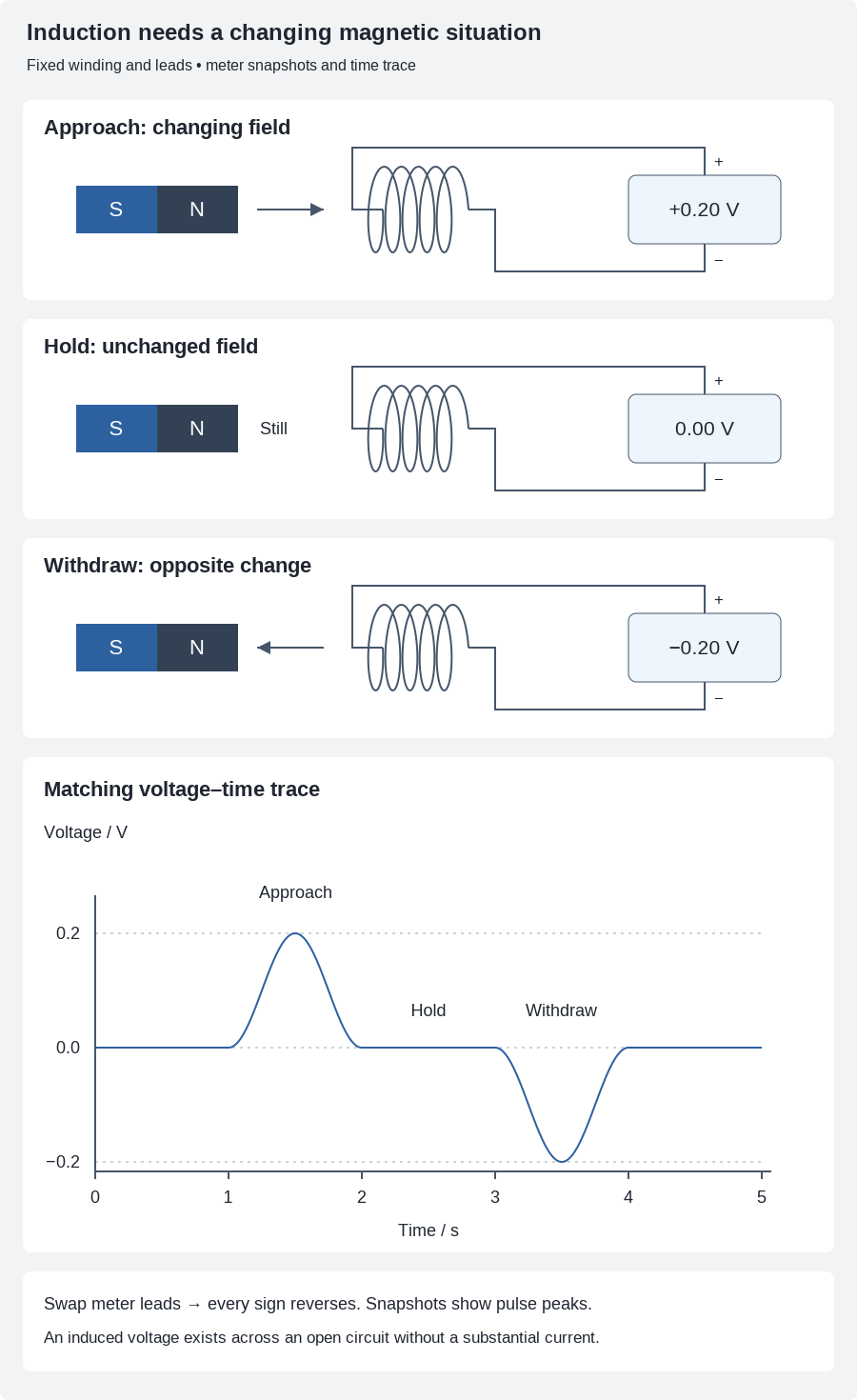
The induction figure compares motion with a pause. A stationary magnet can still have a magnetic field, yet no voltage is induced if the field through the coil is no longer changing. Direction predictions also need the current convention, field direction and geometry to be stated.
Key ideas
- A field line is a representation of field direction and strength, not a material wire or a compulsory path for every particle.
- For motor-force direction use conventional current, field and the left-hand rule. One reversal reverses force; two reversals restore its direction.
- An ideal transformer conserves power. Its voltage ratio follows the turns ratio, while a sustained secondary voltage requires changing magnetic field.
Worked example
The magnet in the figure pauses beside the coil. A student predicts a continuing meter voltage because the magnet’s field has not disappeared. Assess the claim.
- Effect. This is an induction question, so the relevant feature is change in the field through the coil.
- Pause. With the magnet and coil stationary and the field steady, that change stops.
- Prediction. The induced voltage returns to zero even though the permanent magnet still produces a field.
Answer: Field presence and field change are different conditions. The pause removes the cause of the sustained induced voltage in this model.
Activities
Opens when you finish the stage above.
Build the skill
Opens when you finish the stage above.
Check
Opens when you finish the stage above.