Learning goals
- Explain the motor effect in terms of current and field.
- Describe a simple d.c. motor and its split-ring commutator.
- Explain how an alternating signal moves a loudspeaker cone.
From moving charges to a wire
An electric currentThe amount of electric charge passing a point per unit time, measured in amperes. is a flow of electric chargeA property of particles responsible for electrical interactions, measured in coulombs.. In an external magnetic fieldA region where magnets, magnetic materials or moving charges experience magnetic forces., moving charges experience magnetic forceA push or pull arising from an interaction between objects, measured in newtons., which are transferred to the conductorA material containing mobile charged particles that carry an electric current.. A wire can therefore move even if it was initially stationary.
The force is greatest when the wire's current is perpendicular to the field and zero for parallel current. A magnetic field made by the wire is not, by itself, a reason to claim an isolated straight wire pushes itself sideways.
Forces make a turning effect
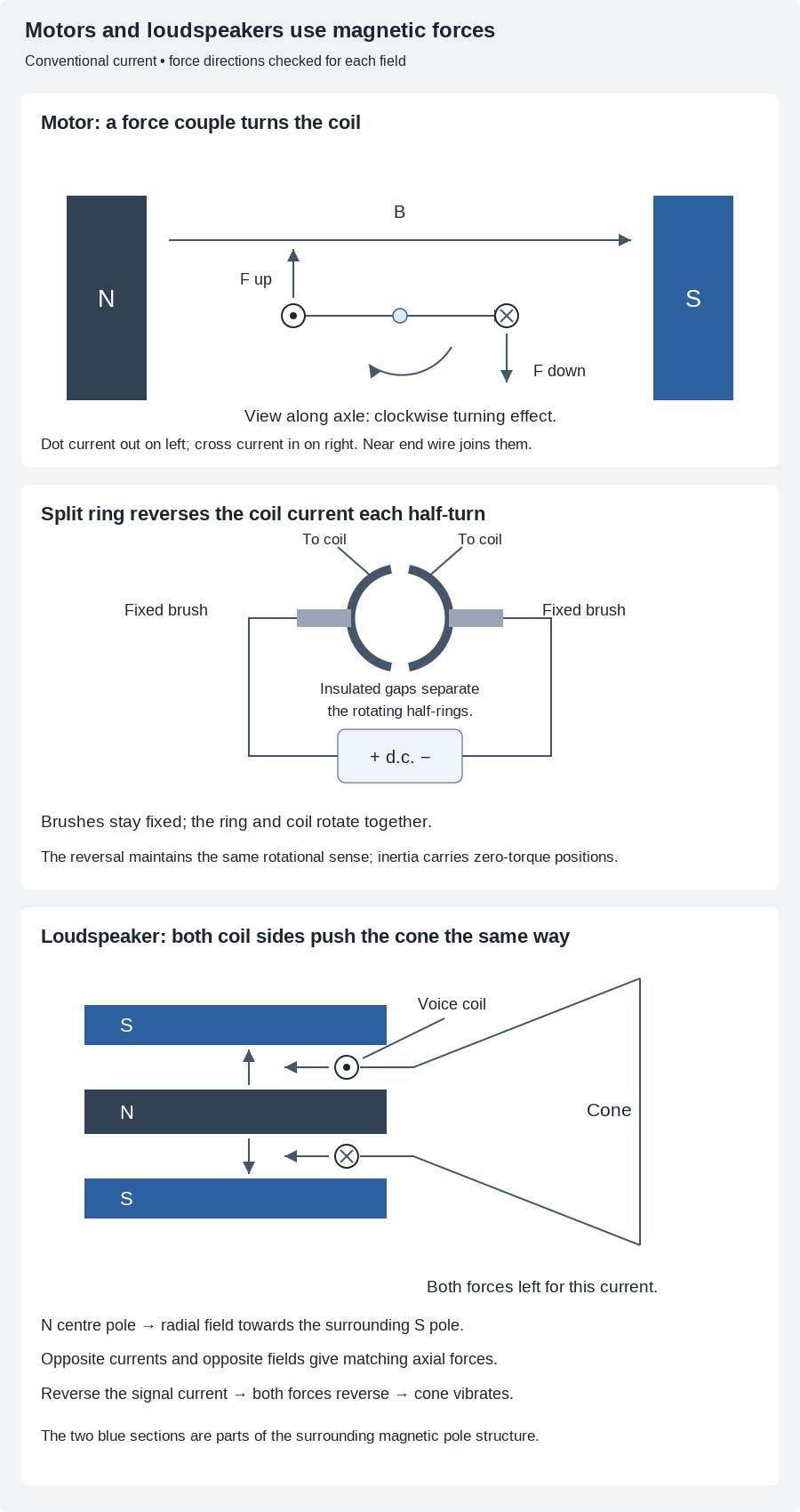
In a motor, a coil lies between magnetic poleA region of a magnet where its magnetic effects are strongest, labelled north or south.. electric currentThe amount of electric charge passing a point per unit time, measured in amperes. runs in opposite directions along the two active sides. Those sides experience opposite forceA push or pull arising from an interaction between objects, measured in newtons., creating a turning effect about the axle.
The end-on figure has field rightwards, current out of the page on the left and into it on the right. The left side is forced up and the right side down, producing clockwise rotation in that view. The force pair has no resultant forceThe single force that has the same combined effect as all the forces acting on an object. but does have a momentThe turning effect of a force about a point, equal to force multiplied by perpendicular distance from that point to its line of action..
Keep a d.c. motor turning
Fixed brushes connect the d.c. supply to a split-ring commutatorA rotating contact that reverses current in a motor coil every half-turn to maintain torque in one direction. attached to the rotating coil. The two conducting half-rings are insulated from each other.
The commutator reverses the electric currentThe amount of electric charge passing a point per unit time, measured in amperes. through the coil every half-turn. Each physical side changes its forceA push or pull arising from an interaction between objects, measured in newtons. direction after passing to the other side of the axle, maintaining the same rotational sense. inertiaThe tendency of an object to retain its velocity unless acted on by a resultant force. carries a simple coil through positions of zero turning effect.
More coil turns, larger current or a stronger field can increase the turning effect, subject to heating and design limits. The motor transfers electrical energyA conserved quantity transferred between stores by working, heating, electrical processes or radiation, measured in joules. into mechanical output, with some energy dissipated.
Loudspeaker action
A voice coil is attached to a cone and sits in the radial gap of a permanent magnetAn object that retains its magnetisation without an external magnetising field.. The field direction above and below the central pole is opposite, while the electric currentThe amount of electric charge passing a point per unit time, measured in amperes. direction around opposite sides of the coil is also opposite.
These two reversals make the forceA push or pull arising from an interaction between objects, measured in newtons. on both sides act in the same axial direction. Reversing the current reverses that overall force. An alternating audio current therefore makes the coil and cone vibrate, producing pressureThe normal force exerted per unit area, measured in pascals. variations in air.
The signal frequencyThe number of complete oscillations or wave cycles per second, measured in hertz. controls the vibration frequency in normal operation. A larger signal can give a larger force and vibration amplitudeThe maximum displacement from the equilibrium position in an oscillation., but response depends on the speaker and its operating range.
Equations
Common misconceptions
- The wire need not already be moving before the motor force acts.
- Opposite forces can produce a turning effect even when resultant force is zero.
- The commutator rotates with the coil; the brushes remain fixed.
- A loudspeaker cone vibrates rather than rotating continuously.
Predict the motor-force direction
Reverse current or rotate the field and use the left-hand rule to predict the force on a wire.
What you see
- Labelled diagrams and numerical outputs describe the same selected state.
How to use it
- Change one control at a time, predict the outcome, then compare the readouts. All controls have keyboard-accessible sliders and step buttons.
- Reset restores every model control to its initial value. Nothing is saved.
What it shows
- With conventional current out of the page and field right, the left-hand rule gives force up. Reversing one of current or field reverses force; reversing both restores the original direction. Increasing current magnitude increases force with field and wire fixed. At zero current the wire has no motor force, although the external field remains.
Limits of the model
- A straight wire is perpendicular to a uniform magnetic field. Current is out of the page when positive and into it when negative.
- Field strength and wire length stay fixed. Blue arrow lengths compare relative force at different current magnitudes, not a force in newtons. This is a force-direction model, not a motor-rotation or charged-particle trajectory model.
Controls
Predict, change and explain
Start with +2 A and field direction 0° (right). Predict force. Reverse only current, then reverse only field in a separate comparison. Finally reverse both. Explain what happens at zero current and when the current magnitude increases.
Connect the outcome to the Physics
With conventional current out of the page and field right, the left-hand rule gives force up. Reversing one of current or field reverses force; reversing both restores the original direction. Increasing current magnitude increases force with field and wire fixed. At zero current the wire has no motor force, although the external field remains.