Learning goals
- Assign the thumb, first and second fingers correctly.
- Read dot/cross current symbols.
- Predict force without confusing the force and field rules.
Set up your left hand
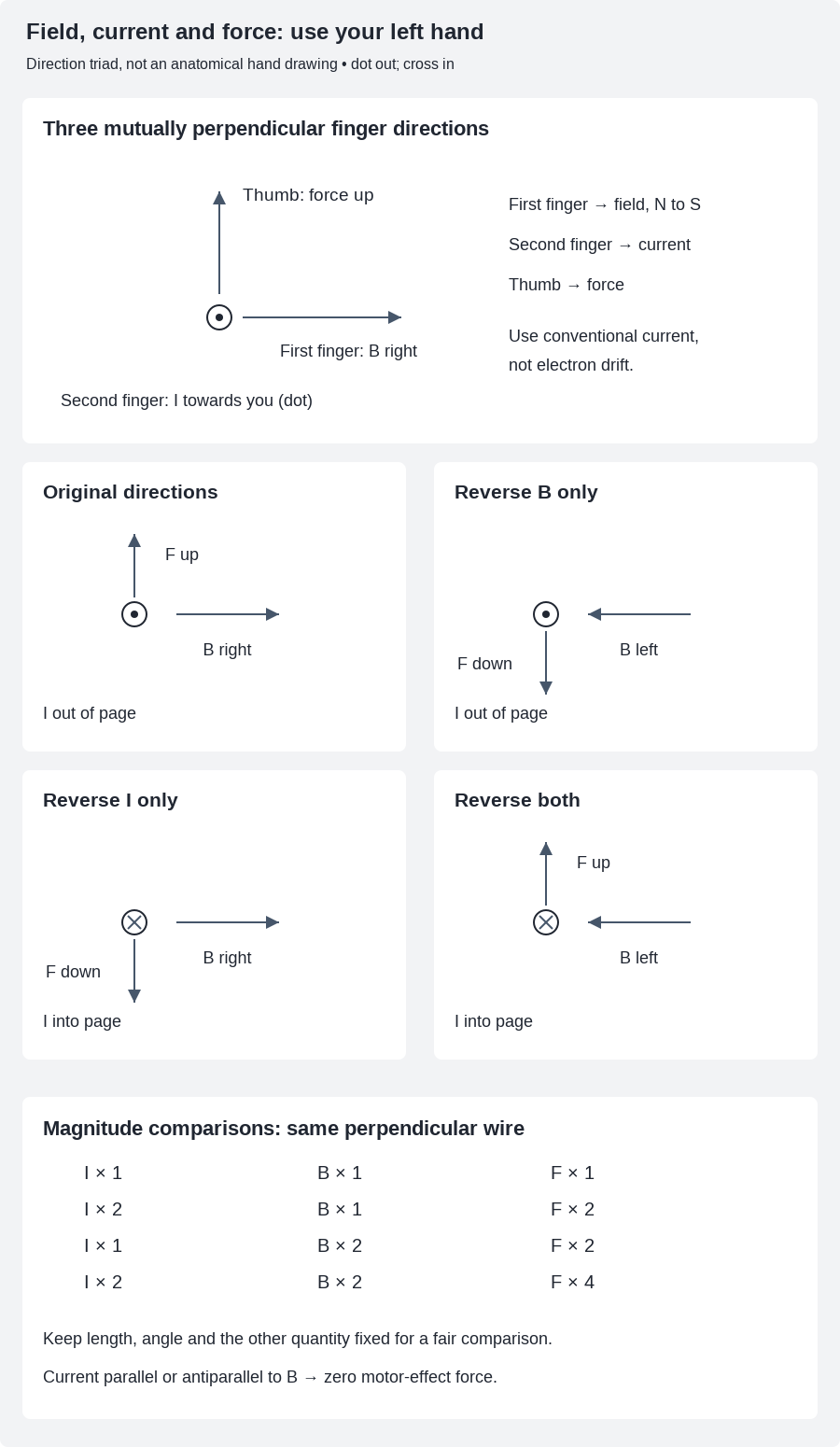
Hold the thumb, first finger and second finger of your left hand mutually perpendicular. The first finger points along the magnetic fieldA region where magnets, magnetic materials or moving charges experience magnetic forces., the second finger along conventional currentThe direction positive charge would flow, opposite to electron movement in a metal., and the thumb gives the forceA push or pull arising from an interaction between objects, measured in newtons. on the conductorA material containing mobile charged particles that carry an electric current..
Use the external field direction at the wire. Between opposite poles this is from N to S. Do not point the first finger along the wire's own circular field.
Worked direction example
Let the field point right and electric currentThe amount of electric charge passing a point per unit time, measured in amperes. come out of the page. Point your first finger right and second finger towards you. Your thumb then points up: the forceA push or pull arising from an interaction between objects, measured in newtons. is upwards.
The dot at the wire represents current towards you. A cross would represent current away from you. The direction triad labels the three perpendicular directions.
Reverse and check
If only the electric currentThe amount of electric charge passing a point per unit time, measured in amperes. reverses, the second finger points away from you and the forceA push or pull arising from an interaction between objects, measured in newtons. reverses downwards. If only the field reverses, the force also reverses.
Reversing both field and current leaves the force direction unchanged. In every perpendicular case, check that force is at right angles to both field and current.
Keep conventions consistent
In metal wires, electronA negatively charged subatomic particle found outside an atom’s nucleus. drift is opposite to conventional currentThe direction positive charge would flow, opposite to electron movement in a metal.. Convert an electron-direction description before using the rule; for an individual negative particle reverse the positive-charge result.
The right-hand grip ruleA rule giving the field direction around a wire from curled right fingers when the thumb points along conventional current. predicts the magnetic fieldA region where magnets, magnetic materials or moving charges experience magnetic forces. made by electric currentThe amount of electric charge passing a point per unit time, measured in amperes.. The left-hand rule predicts the forceA push or pull arising from an interaction between objects, measured in newtons. on a current in an existing field. The separate rules answer different questions.
Equations
Common misconceptions
- Use the left hand for the motor-force rule.
- First finger is field; second finger is conventional current; thumb is force.
- A dot comes out of the page and a cross goes in.
- Force is not parallel to either current or field in the perpendicular case.
Predict the motor-force direction
Reverse current or rotate the field and use the left-hand rule to predict the force on a wire.
What you see
- Labelled diagrams and numerical outputs describe the same selected state.
How to use it
- Change one control at a time, predict the outcome, then compare the readouts. All controls have keyboard-accessible sliders and step buttons.
- Reset restores every model control to its initial value. Nothing is saved.
What it shows
- With conventional current out of the page and field right, the left-hand rule gives force up. Reversing one of current or field reverses force; reversing both restores the original direction. Increasing current magnitude increases force with field and wire fixed. At zero current the wire has no motor force, although the external field remains.
Limits of the model
- A straight wire is perpendicular to a uniform magnetic field. Current is out of the page when positive and into it when negative.
- Field strength and wire length stay fixed. Blue arrow lengths compare relative force at different current magnitudes, not a force in newtons. This is a force-direction model, not a motor-rotation or charged-particle trajectory model.
Controls
Predict, change and explain
Start with +2 A and field direction 0° (right). Predict force. Reverse only current, then reverse only field in a separate comparison. Finally reverse both. Explain what happens at zero current and when the current magnitude increases.
Connect the outcome to the Physics
With conventional current out of the page and field right, the left-hand rule gives force up. Reversing one of current or field reverses force; reversing both restores the original direction. Increasing current magnitude increases force with field and wire fixed. At zero current the wire has no motor force, although the external field remains.