Learning goals
- Predict controlled magnitude changes.
- Predict one or two direction reversals.
- Recognise the zero-force orientation.
Control the comparison
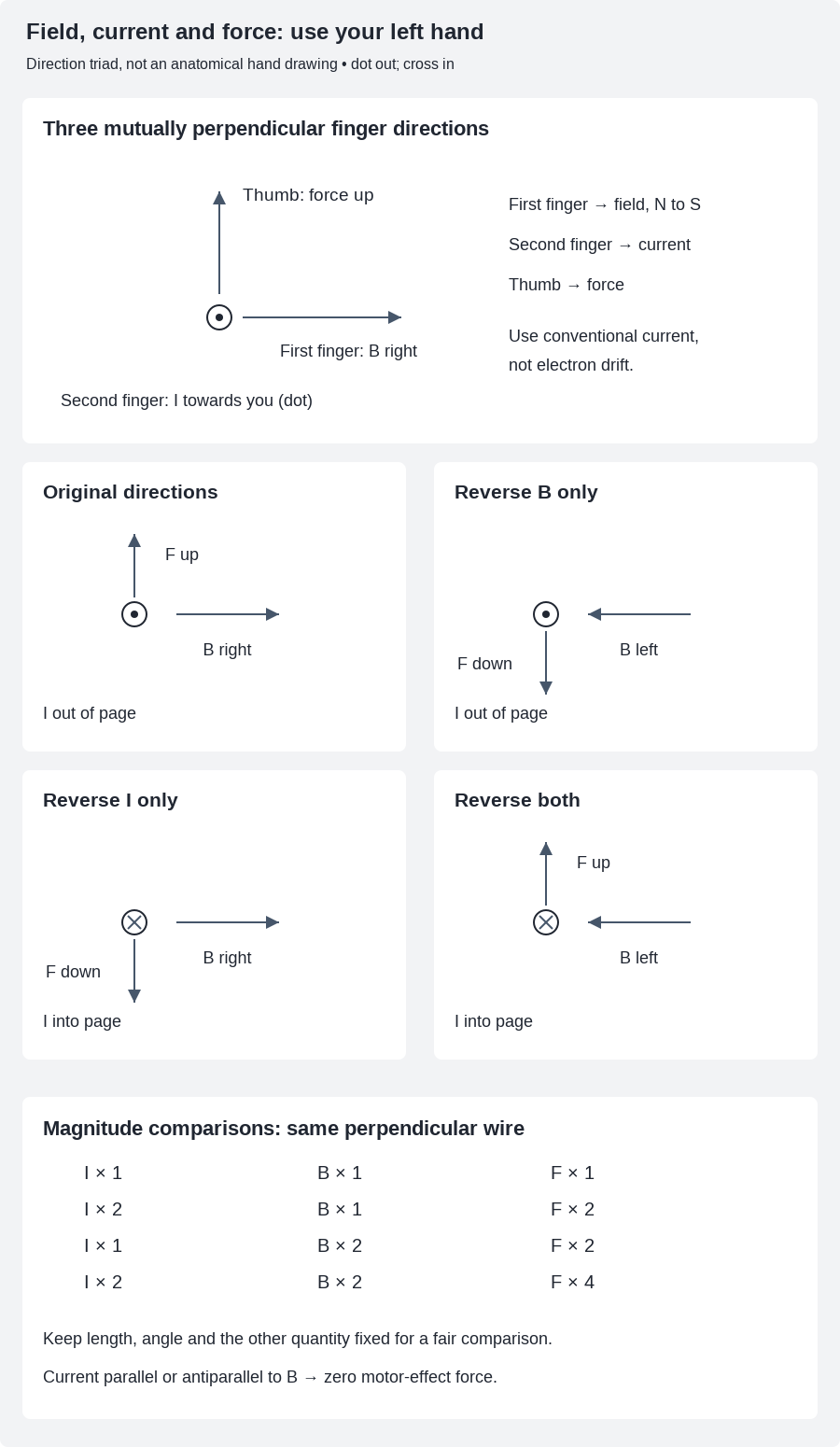
Compare the same length of wire with electric currentThe amount of electric charge passing a point per unit time, measured in amperes. perpendicular to the same field region. Increasing the current increases the forceA push or pull arising from an interaction between objects, measured in newtons.; increasing field strength also increases it.
For this fixed geometry, force is proportional to current and field strength. Doubling either doubles the force in the simple model. Doubling both gives four times the force, not a reversal. Numerical ratios illustrate the relationship; the required statement is the qualitative change.
One reversal
Start with field rightwards and electric currentThe amount of electric charge passing a point per unit time, measured in amperes. out of the page. The forceA push or pull arising from an interaction between objects, measured in newtons. is upwards. Reverse current alone to into the page and the force is downwards.
Instead, keep current out of the page but reverse the field leftwards. The force is again downwards. Check each case using the left-hand rule rather than memorising the picture's orientation.
Two reversals
Reverse both field and electric currentThe amount of electric charge passing a point per unit time, measured in amperes. from the original setting. Field is now leftwards and current into the page; the forceA push or pull arising from an interaction between objects, measured in newtons. is upwards again.
The force direction is unchanged relative to the original case. Its magnitude is unchanged only if the current and field magnitudes are also unchanged.
Change the orientation
The illustrated comparisons keep electric currentThe amount of electric charge passing a point per unit time, measured in amperes. and field perpendicular. Rotating the wire until it is parallel or antiparallel to the field reduces the forceA push or pull arising from an interaction between objects, measured in newtons. to zero.
Do not apply a perpendicular-wire comparison to a different angle without considering the component across the field. In real motors, the turning effect also depends on the coil's position and the lever arm of the forces.
Equations
Common misconceptions
- Reversing both current and field does not reverse force.
- Larger magnitude is different from reversed direction.
- Keep wire length and orientation fixed when comparing strengths.
- Parallel current and field give no motor-effect force.
Predict the motor-force direction
Reverse current or rotate the field and use the left-hand rule to predict the force on a wire.
What you see
- Labelled diagrams and numerical outputs describe the same selected state.
How to use it
- Change one control at a time, predict the outcome, then compare the readouts. All controls have keyboard-accessible sliders and step buttons.
- Reset restores every model control to its initial value. Nothing is saved.
What it shows
- With conventional current out of the page and field right, the left-hand rule gives force up. Reversing one of current or field reverses force; reversing both restores the original direction. Increasing current magnitude increases force with field and wire fixed. At zero current the wire has no motor force, although the external field remains.
Limits of the model
- A straight wire is perpendicular to a uniform magnetic field. Current is out of the page when positive and into it when negative.
- Field strength and wire length stay fixed. Blue arrow lengths compare relative force at different current magnitudes, not a force in newtons. This is a force-direction model, not a motor-rotation or charged-particle trajectory model.
Controls
Predict, change and explain
Start with +2 A and field direction 0° (right). Predict force. Reverse only current, then reverse only field in a separate comparison. Finally reverse both. Explain what happens at zero current and when the current magnitude increases.
Connect the outcome to the Physics
With conventional current out of the page and field right, the left-hand rule gives force up. Reversing one of current or field reverses force; reversing both restores the original direction. Increasing current magnitude increases force with field and wire fixed. At zero current the wire has no motor force, although the external field remains.