Learning goals
- Identify moving-charge cases with and without magnetic force.
- Predict how charge sign changes deflection.
- Explain constant-speed magnetic bending in the ideal model.
Conditions for a force
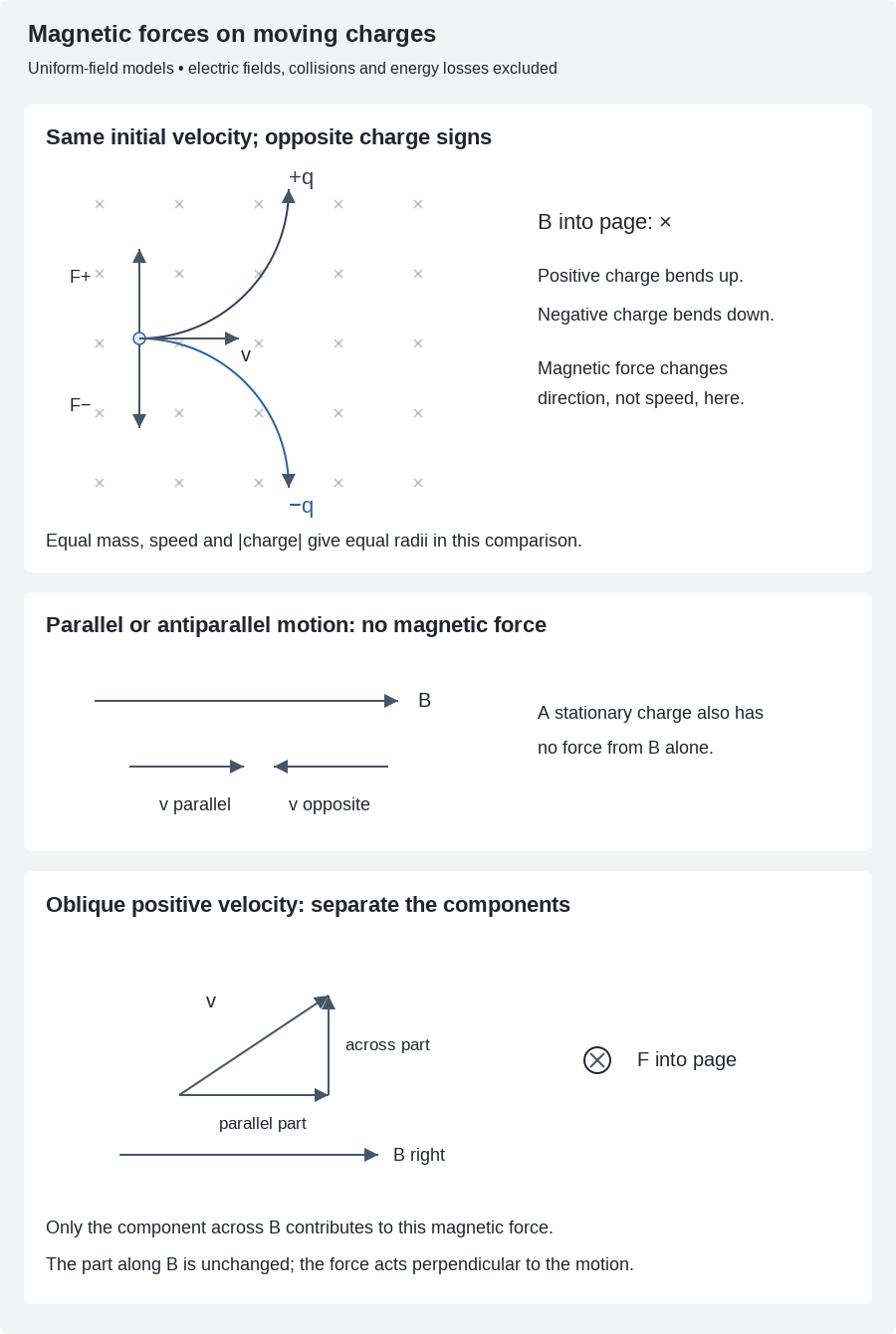
A stationary electric chargeA property of particles responsible for electrical interactions, measured in coulombs. has no forceA push or pull arising from an interaction between objects, measured in newtons. from a magnetic fieldA region where magnets, magnetic materials or moving charges experience magnetic forces. alone. A moving charge also has zero magnetic force if it moves parallel or antiparallel to the field. Motion across the field gives a magnetic force.
For an oblique velocityThe rate of change of displacement, including the direction of motion., separate the motion into a component parallel to the field and a component perpendicular to it. The perpendicular component is responsible for the magnetic deflection; the parallel component is unchanged by this force.
Direction and charge sign
Use conventional currentThe direction positive charge would flow, opposite to electron movement in a metal. direction for a positive electric chargeA property of particles responsible for electrical interactions, measured in coulombs.'s motion when applying the left-hand forceA push or pull arising from an interaction between objects, measured in newtons. rule. For a negative charge moving in the same direction, reverse the resulting force.
In the figure the field is into the page and the initial velocityThe rate of change of displacement, including the direction of motion. is rightwards. A positive charge initially bends upwards, and a negative charge bends downwards. The comparison assumes equal massThe quantity measuring an object’s inertia, expressed in kilograms., speedThe distance travelled per unit time, without specifying direction. and magnitude of charge.
Why the path bends
In a uniform fieldA field with the same magnitude and direction at every point in a region., a particle moving perpendicular to it can follow a circular path. The forceA push or pull arising from an interaction between objects, measured in newtons. continually changes direction to remain perpendicular to velocityThe rate of change of displacement, including the direction of motion., providing the inward force needed for the curve.
A purely magnetic force does no work on the particle because it is perpendicular to its motion. speedThe distance travelled per unit time, without specifying direction. and kinetic energyThe energy associated with motion, equal to half the mass multiplied by speed squared for a moving object. remain constant in this ideal case, although velocity changes because direction changes. electric fieldA region where an electric charge experiences an electrical force., collisions and energyA conserved quantity transferred between stores by working, heating, electrical processes or radiation, measured in joules. losses would require a different model.
An angled case
For a positive particle moving upwards and rightwards while the field points right, only the upward component contributes to the forceA push or pull arising from an interaction between objects, measured in newtons.. The initial magnetic force points into the page.
The part of the motion along the field does not produce magnetic deflection. The component diagram explains why an angled path can experience a force even though one part of its motion is parallel to the field.
Equations
Common misconceptions
- A stationary charge is not deflected by a magnetic field alone.
- Parallel and antiparallel motion both give zero magnetic force.
- Negative charges deflect opposite to positive charges with the same velocity.
- A curved path does not necessarily mean speed is changing.