Learning goals
- Predict induced poles near either magnet pole.
- Explain attraction using the non-uniform field.
- Distinguish induced magnetisation from charge transfer.
Before the magnet approaches
An unmagnetised iron object contains domains whose magnetic effects largely cancel overall. Unmagnetised does not mean the material has no microscopic magnetic behaviour.
Bring a permanent magnetAn object that retains its magnetisation without an external magnetising field. nearby without touching the iron. Its field changes the balance of domain directions, giving the iron an overall magnetisation. Contact, rubbing and transfer of electric chargeA property of particles responsible for electrical interactions, measured in coulombs. are not required.
Predict the induced poles
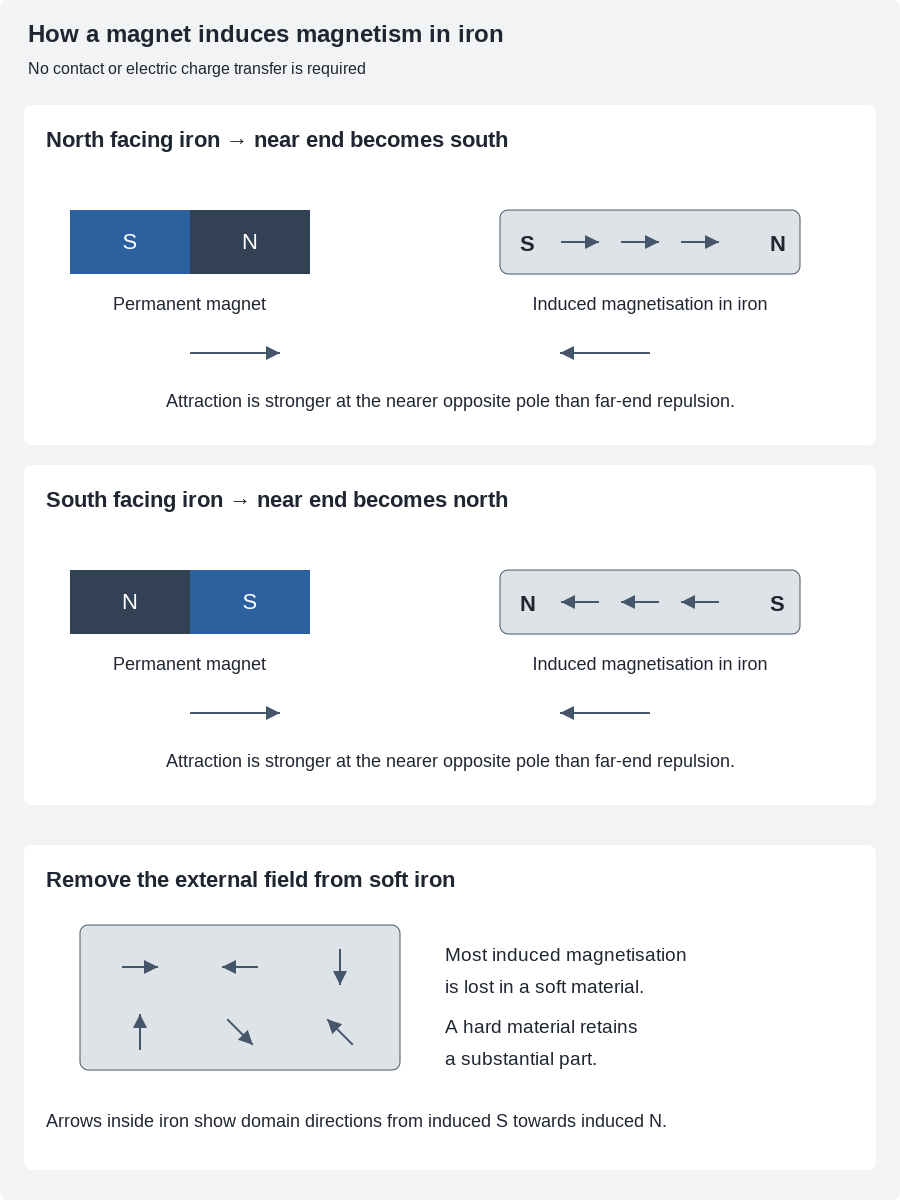
If a north pole faces the iron, the near end becomes south and the far end becomes north. Reversing the permanent magnetAn object that retains its magnetisation without an external magnetising field. reverses the induced polarity: a nearby south pole induces a north pole at the near end.
The object still has two poles. Domain arrows represent the magnetisation direction from its induced south end towards its north end; they are not the external field-line direction around the object.
Why the force is attractive
The nearer induced pole is opposite to the nearby permanent pole and is attracted. The farther induced pole is like the nearby pole and is repelled, but the interaction is weaker farther away in this non-uniform field. The overall forceA push or pull arising from an interaction between objects, measured in newtons. is towards the magnet.
This explains why either N or S can attract initially unmagnetised iron. It also explains why attraction by itself does not reveal whether an object was already magnetised.
After removing the field
Soft iron loses most of its induced magnetisation when the external field is removed. A magnetically hardResistant to demagnetisation, making a material suitable for permanent magnets. material can retain a substantial part, depending on how it was magnetised.
A chain of iron pieces can be supported while the field is present because each magnetised piece induces magnetism in the next. Removing the field may make the chain fall apart; residual magnetism and the material affect the result.
Equations
Common misconceptions
- Magnetic induction does not require contact or electric charge transfer.
- Both magnet poles can attract initially unmagnetised soft iron.
- The near induced pole is opposite to the nearby permanent pole.
- Removing a magnet does not guarantee identical retention for every material.