Learning goals
- Define the direction represented by a magnetic field line.
- Interpret the tangent and spacing of lines.
- Explain why field lines form loops and do not cross.
What the line represents
A magnetic fieldA region where magnets, magnetic materials or moving charges experience magnetic forces. is a region where magnetic objects or moving electric chargeA property of particles responsible for electrical interactions, measured in coulombs. can experience magnetic effects. At a point, its direction is the direction in which the north-seeking end of a small plotting compass points.
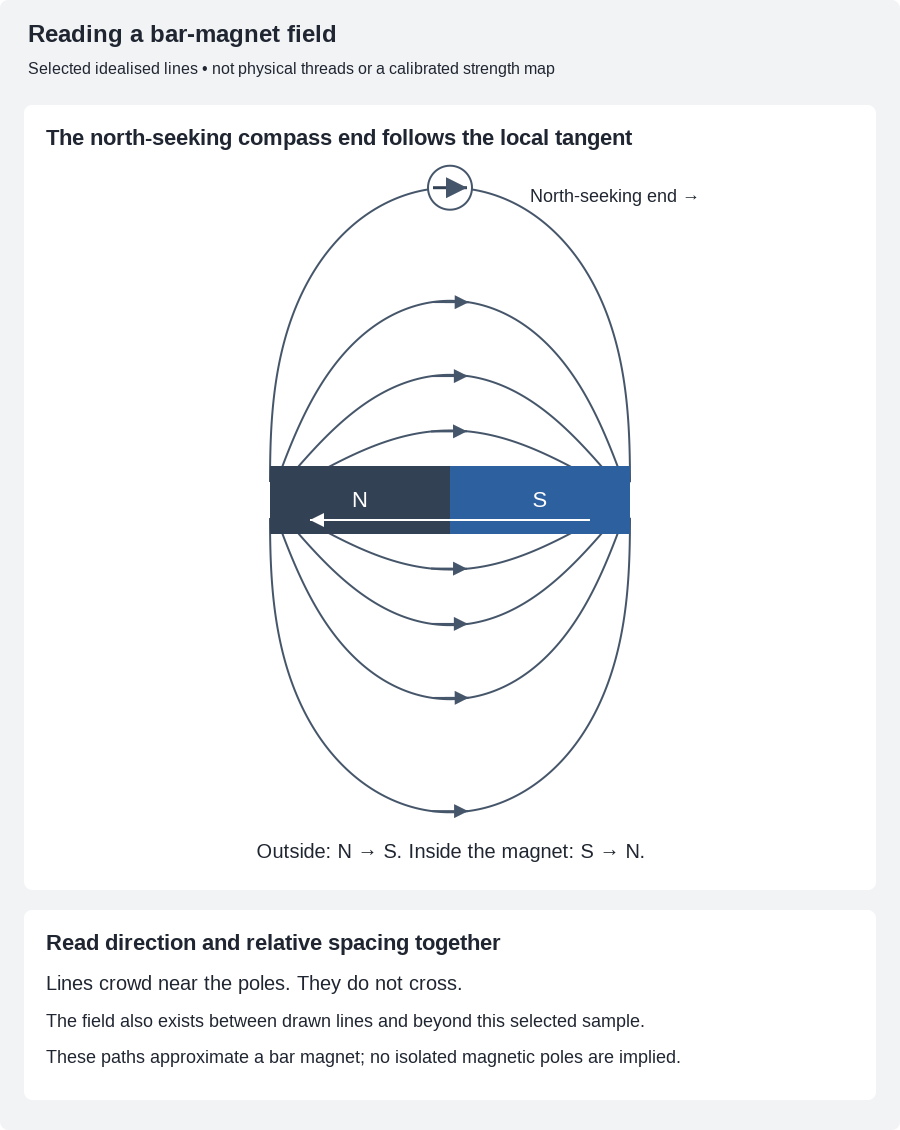
A small compass has two poles and usually rotates to align with the field. Its north-seeking end points along the local field direction, tangentA straight line with the same local gradient as a curve at the point where it touches. to a field line. Do not assume the whole compass travels along the line.
Bar-magnet direction
Outside a bar magnet, field-line arrows go from N to S. Inside the magnet the lines return from S to N, forming continuous loops. The figure shows selected outside paths and the internal S-to-N return direction.
A field line is not a wire, stream of particles or boundary beyond which the field disappears. There is a field between the drawn lines too. Only a small sample of lines can be shown on paper.
Spacing and strength
Closely spaced lines indicate a stronger field in a consistently drawn representation. Around a bar magnet the field is particularly strong near the poles, and the selected lines crowd as they approach those regions.
Line counting alone does not measure field strength: the number of lines is chosen by the illustrator. Compare spacing within the same representation, with its stated scale and conventions, rather than comparing unrelated drawings.
Why lines cannot cross
At an ordinary point, a nonzero magnetic fieldA region where magnets, magnetic materials or moving charges experience magnetic forces. has one direction. Two crossing field lines would assign two different directions at that same point, which is inconsistent.
At a neutral point where contributions cancel, the resultant field is zero and has no defined direction. This does not permit two distinct resultant-field lines to cross there. In a real compass investigation, the Earth and nearby equipment can affect the measured resultant.
Equations
Common misconceptions
- A compass aligns tangent to a line, not necessarily towards the nearest pole in a straight line.
- Field lines are not physical objects.
- The field does not vanish between the lines.
- Field-line direction and force on an entire magnet are not the same statement.