Learning goals
- Compare magnetisation and retention in soft and hard materials.
- Choose a suitable material for a temporary or permanent magnet.
- Distinguish magnetic hardness from strength and mechanical hardness.
A useful domain model
A magnetic material such as iron contains small regions called magnetic domainA region within a magnetic material in which microscopic magnetic effects align in a common direction.. Within a domain, many microscopic magnetic effects align. In an unmagnetised sample the domains point in different directions, so their effects largely cancel overall.
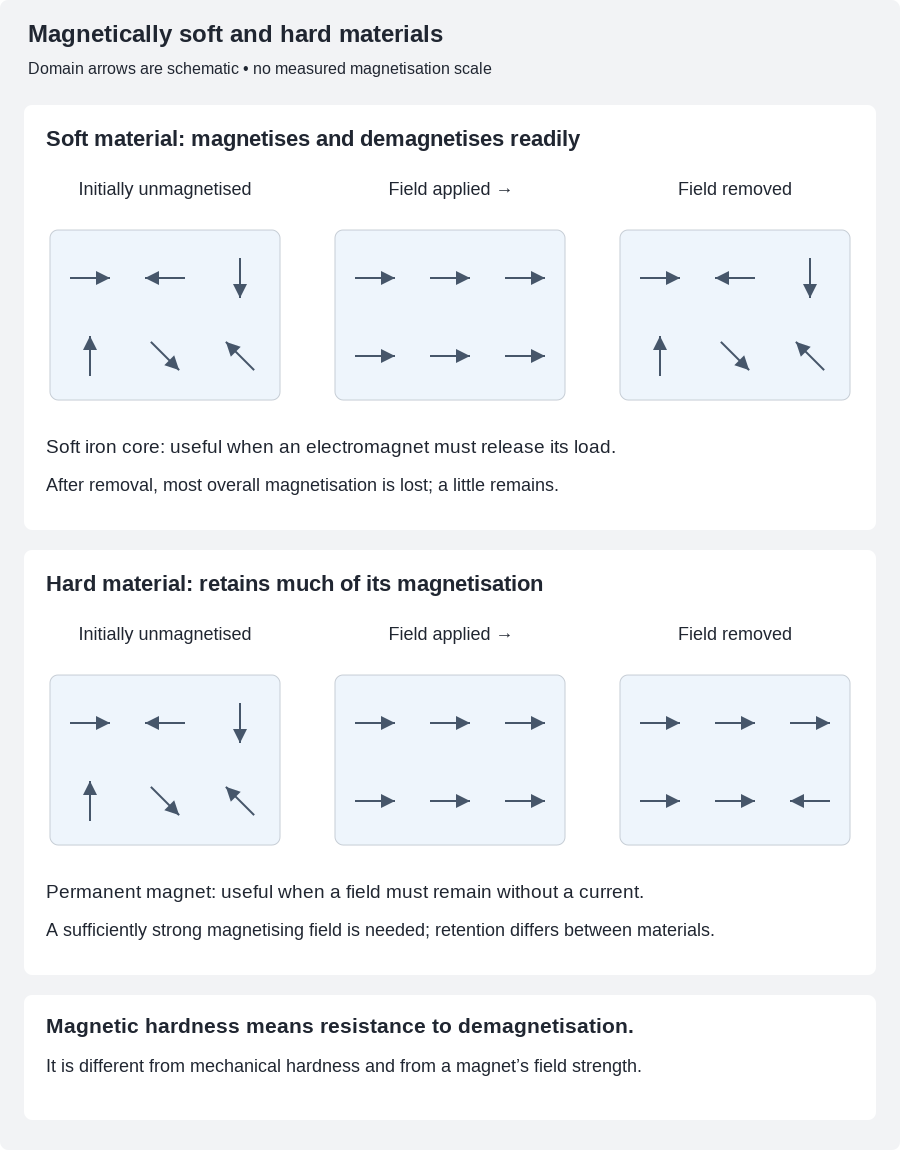
An applied field can favour domains aligned with it, through changes in domain size and direction. The simple arrows in the diagram represent these net domain directions; they are not individual atomAn electrically neutral particle with a small positive nucleus surrounded by electrons. and do not show the actual shapes of domains.
Soft magnetic materials
Soft iron magnetises readily in an applied field and loses most of its induced magnetisation when that field is removed. This makes it useful as the core of an electromagnetA coil carrying current that produces a magnetic field, usually strengthened by a soft iron core. that must pick up and then release objects.
A transformerA device using electromagnetic induction between coils to change alternating voltage. core is repeatedly magnetised in alternating directions. A suitable soft magnetic material responds easily; this reduces energyA conserved quantity transferred between stores by working, heating, electrical processes or radiation, measured in joules. dissipated during repeated magnetisation changes. Material choice also depends on other losses and practical requirements.
Hard magnetic materials
A magnetically hardResistant to demagnetisation, making a material suitable for permanent magnets. material needs a sufficiently strong magnetising field and retains much of its magnetisation after that field is removed. It is harder to demagnetise or reverse than a soft material.
Suitable steels and modern permanent-magnet alloys can keep a field without a continuous electric currentThe amount of electric charge passing a point per unit time, measured in amperes.. permanent magnetAn object that retains its magnetisation without an external magnetising field. in compasses and many motors use this retained magnetisation. Hard does not mean impossible to demagnetise.
Choose from the required behaviour
For a switching scrapyard electromagnetA coil carrying current that produces a magnetic field, usually strengthened by a soft iron core., easy magnetisation and release favour a soft core. For a permanent compass magnet, retention favours a hard material.
Magnetic hardness concerns resistanceThe ratio of potential difference across a component to the current through it, measured in ohms. to changes of magnetisation. It does not describe how difficult the material is to scratch, and it is not a synonym for the strength of a particular magnet. The domain arrows show directions of alignment rather than measured magnetisation values.
Equations
Common misconceptions
- Magnetically hard is not the same as mechanically hard.
- A soft magnetic material can produce a strong field while magnetised.
- A permanent magnet is not impossible to demagnetise.
- Domain arrows are a model, not a drawing of electron paths.