Learning goals
- Predict forces between named magnetic poles.
- Identify examples of magnetic materials.
- Explain why attraction alone does not identify a permanent magnet.
Two poles and two interaction rules
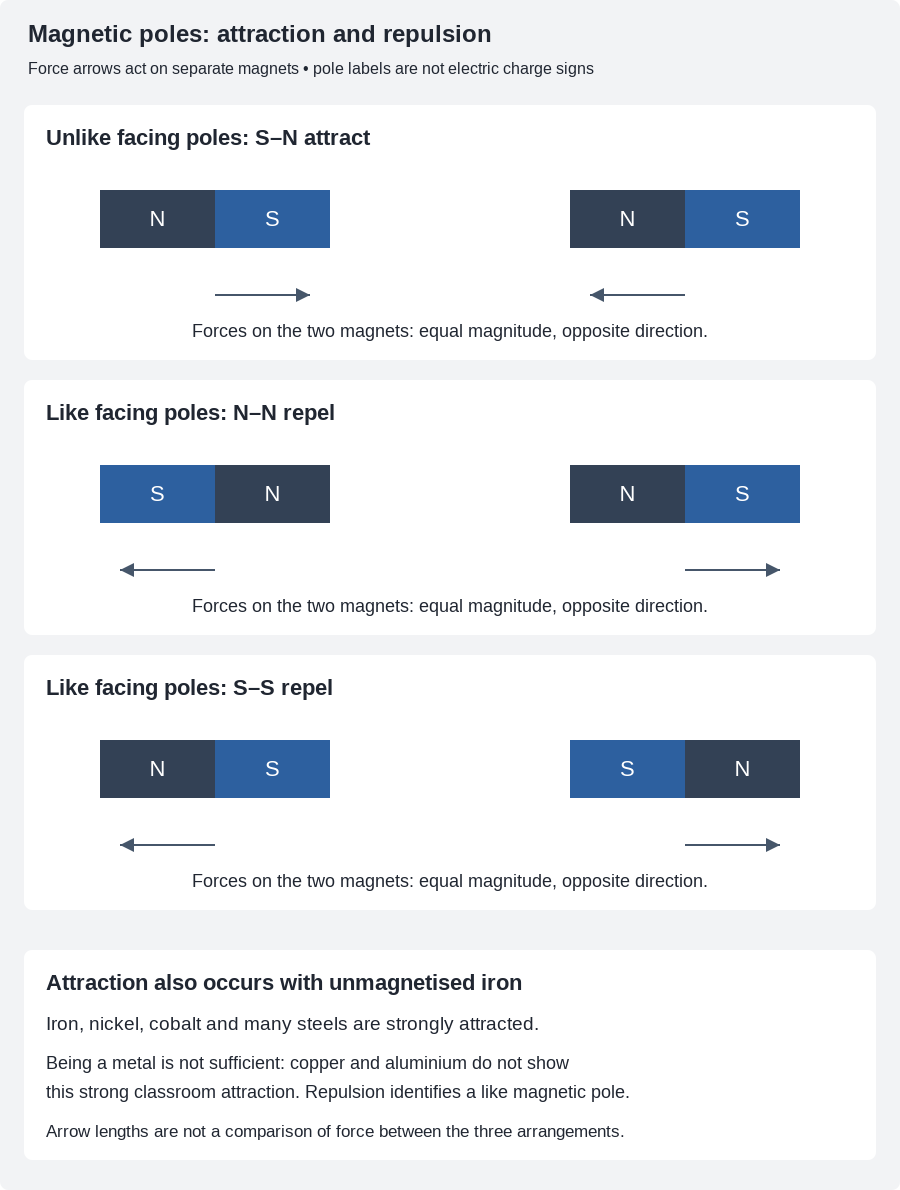
A permanent bar magnet has a north pole and a south pole. The labels describe magnetic behaviour, not positive and negative electric chargeA property of particles responsible for electrical interactions, measured in coulombs.. Bringing unlike poles together produces attraction; bringing like poles together produces repulsion.
Both magnets experience forceA push or pull arising from an interaction between objects, measured in newtons.. The forces on the two bodies are equal in magnitude and opposite in direction. A force arrow belongs to the magnet on which that force acts, so the pair does not cancel on either individual magnet.
Read the facing poles
In the first diagram, the right-hand end of the left magnet is S and the facing end of the right magnet is N, so the arrows point towards one another. In the other two cases, N faces N or S faces S, so the arrows point apart.
Turning one magnet end-for-end changes its facing pole and reverses attraction to repulsion, or vice versa. Moving the magnets farther apart generally weakens the forceA push or pull arising from an interaction between objects, measured in newtons.; the schematic equal arrow lengths compare the action–reaction pair, not different separations.
Which materials are attracted?
Iron, nickel and cobalt are familiar magnetic substances. Many steels are magnetic because they contain iron, although the behaviour depends on the alloy; not every stainless steel is strongly attracted.
Copper, aluminium, wood and plastic do not show the strong attraction of these magnetic materials in a classroom bar-magnet test. Being a metal or an electrical conductorA material containing mobile charged particles that carry an electric current. is not sufficient to predict strong magnetic attraction.
What does a test show?
A permanent magnetAn object that retains its magnetisation without an external magnetising field. can attract an unmagnetised piece of iron. The field induces an opposite pole at the nearer end; this is developed in 7.5. Either pole of a magnet can attract the same initially unmagnetised iron object.
Repulsion from a known pole is a reliable way to demonstrate that an object is magnetised and identify a like pole. Attraction alone could indicate an unlike permanent pole or induced magnetismMagnetisation produced in a material by an external magnetic field., so it cannot distinguish those explanations.
Equations
Common misconceptions
- Both N–N and S–S repel; N–S attracts.
- North and south are not electric charge signs.
- Not all metals show strong magnetic attraction.
- Attraction alone does not prove that the object was already a permanent magnet.