Learning goals
- Describe the field around a straight conductor.
- Use a consistent current-direction convention.
- Explain how current and distance affect field strength.
Observe a magnetic effect
A small compass near a wire can turn when electric currentThe amount of electric charge passing a point per unit time, measured in amperes. is switched on. The compass responds to the resultant of the wire's field and background fields, including the Earth's. Reversing current reverses the wire's contribution.
Use a low-voltage supply and suitable current limiting for a demonstration. A short bare wire connected directly across a supply can heat strongly; switching should be brief and controlled.
Read the cross-sectional diagram
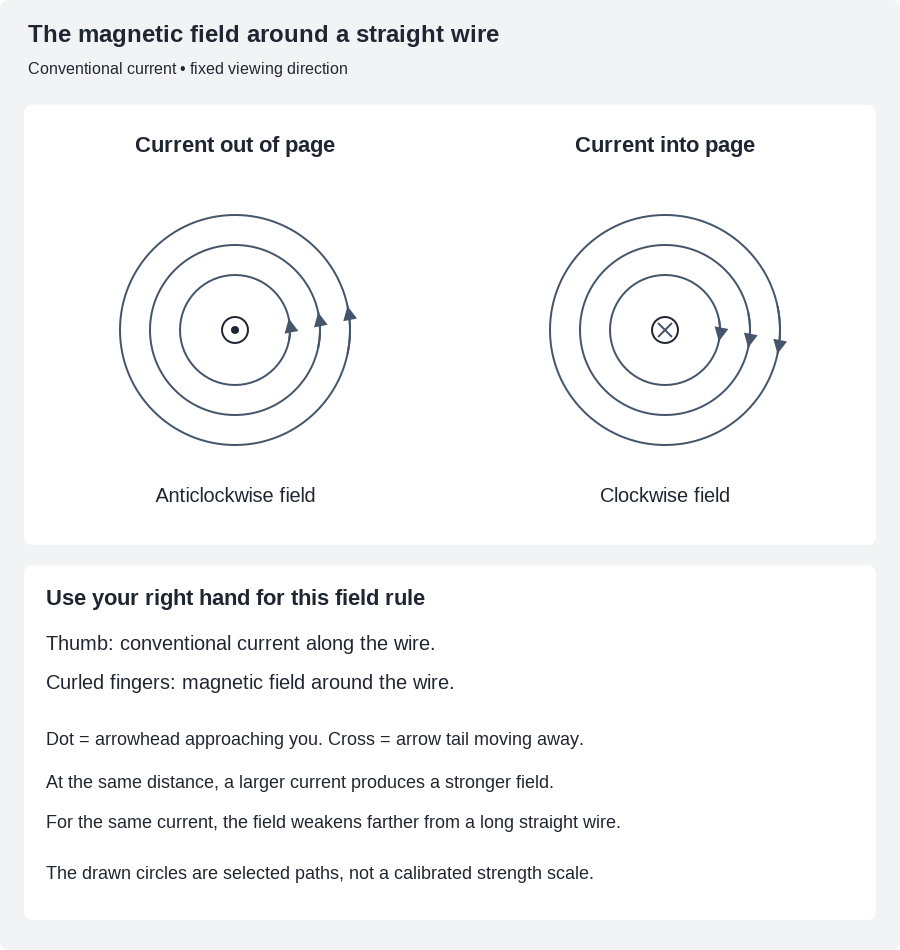
The view looks along the wire. A dot represents conventional currentThe direction positive charge would flow, opposite to electron movement in a metal. coming out of the page, like an arrowhead approaching. A cross represents electric currentThe amount of electric charge passing a point per unit time, measured in amperes. going into the page, like the tail feathers of an arrow going away.
The field lines are circles in planes perpendicular to the wire. For current out of the page they go anticlockwise; for current into the page they go clockwise. These are field directions, not circular paths taken by the electric chargeA property of particles responsible for electrical interactions, measured in coulombs. carriers.
Right-hand grip rule
Point your right thumb along conventional currentThe direction positive charge would flow, opposite to electron movement in a metal.. Your curled fingers give the magnetic-field direction around the wire. Keep the viewing direction fixed when comparing the two pictures.
This right-hand rule predicts the field created by a electric currentThe amount of electric charge passing a point per unit time, measured in amperes.. It is different from Fleming’s left-hand ruleA rule using mutually perpendicular left-hand fingers to relate magnetic field, conventional current and force directions., used later to predict forceA push or pull arising from an interaction between objects, measured in newtons. in an external field.
Strength and limits
At a fixed distanceThe length of a path travelled, without regard to direction., increasing electric currentThe amount of electric charge passing a point per unit time, measured in amperes. strengthens the field. For the same current, the field weakens farther from a long straight wire. The diagram samples circles; their chosen number does not measure field strength.
Real circuits have return wires and bends whose fields also contribute. The simple concentric pattern describes a sufficiently long straight section when those other contributions are small.
Equations
Common misconceptions
- The field surrounds the wire, not only its ends.
- Use conventional current, not electron drift, for the grip rule.
- Reversing the viewing direction changes the apparent clockwise direction.
- The right-hand grip rule and left-hand force rule serve different purposes.