Learning goals
- Describe the components and connections of an electromagnet.
- Explain why insulated wire and a soft core are useful.
- Predict changes from current, turns and polarity.
Build the structure
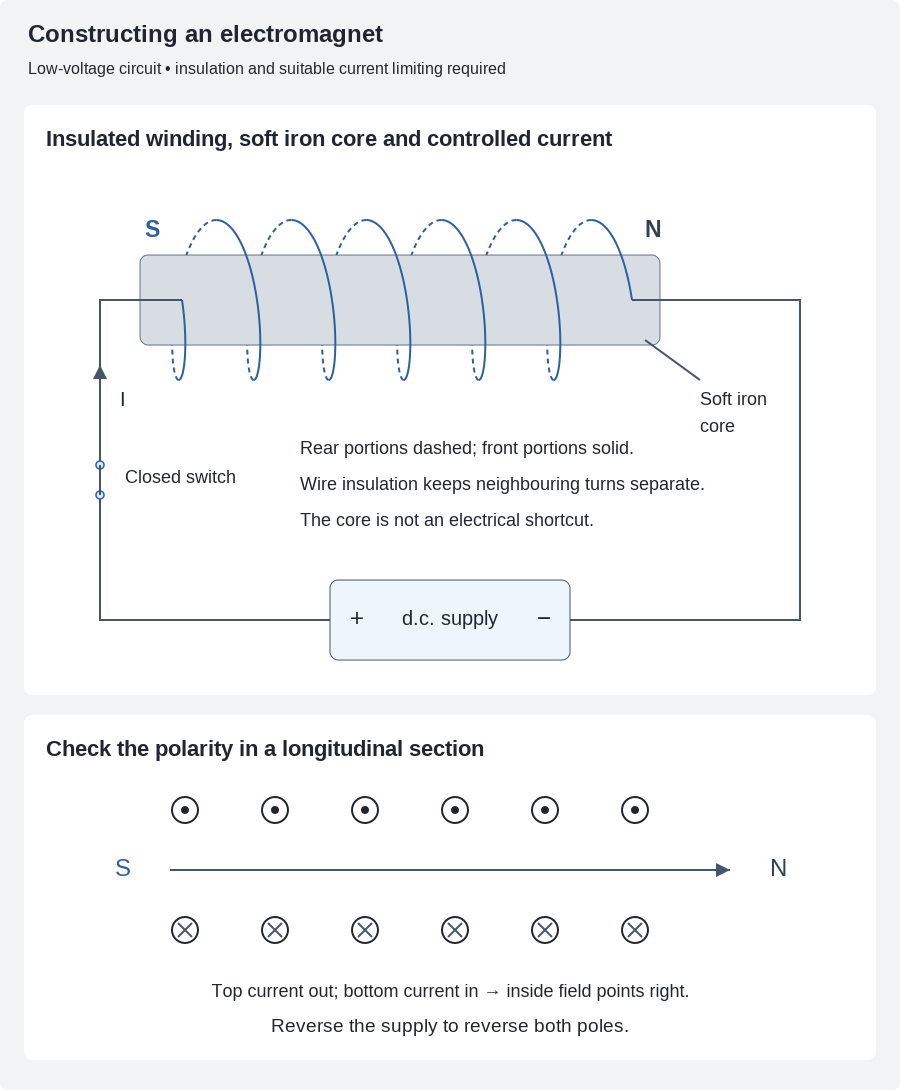
Wind several turns of insulated conducting wire around a soft iron core. Connect the two wire ends to a suitable low-voltage d.c. supply through a switch and current-limiting arrangement. The insulation prevents neighbouring turns making an electrical shortcut.
The core is inside the winding; it is not the conducting route that replaces the wire. electric currentThe amount of electric charge passing a point per unit time, measured in amperes. flows through the complete wire circuit. The construction drawing separates the hidden rear winding from the visible front winding.
Why a coil and core help
The fields of successive turns reinforce one another inside the coil. The resulting pattern resembles a bar magnet, with opposite poles at the two ends.
The coil's field magnetises the soft iron. The core adds to the field and concentrates it. Soft iron magnetises readily and loses most of its magnetisation when the electric currentThe amount of electric charge passing a point per unit time, measured in amperes. stops, helping an electromagnetA coil carrying current that produces a magnetic field, usually strengthened by a soft iron core. release an iron object.
Choose and reverse the poles
Curl the fingers of your right hand in the conventional-current direction around the turns. Your thumb points along the inside field towards the north end.
In the specified winding, electric currentThe amount of electric charge passing a point per unit time, measured in amperes. emerges from the page at the top of a longitudinal section and enters at the bottom; the inside field points right, making the right end north. Reverse the supply and both poles reverse.
Control strength sensibly
At fixed geometry, increasing electric currentThe amount of electric charge passing a point per unit time, measured in amperes. generally strengthens the field. More turns per unit length also strengthen it when current is kept the same. Adding a soft iron core increases the field relative to the same air-cored coil.
Adding turns also increases wire resistanceThe ratio of potential difference across a component to the current through it, measured in ohms., so a fixed supply potential differenceThe energy transferred per unit charge between two points, measured in volts. may change the current. State what is controlled. Heating and the core material limit how far this trend applies; use rated apparatus rather than treating stronger as unlimited.
Applications
A lifting electromagnetA coil carrying current that produces a magnetic field, usually strengthened by a soft iron core. can pick up magnetic scrap and release it when switched off. A relay uses an electromagnet to move an armature and operate another circuit. Both depend on a controllable magnetic effect.
A magnetically hardResistant to demagnetisation, making a material suitable for permanent magnets. core would tend to retain more magnetism, making clean release less reliable.
Equations
Common misconceptions
- Insulation prevents electrical shortcuts between turns.
- The iron core strengthens a field made by current; it is not a power supply.
- More turns is a fair strength comparison only with current and geometry considered.
- Soft iron can retain a little magnetism; switching off is not a guarantee of exact zero field.