Learning goals
- Identify changes that induce voltage.
- Describe factors that increase its magnitude.
- Distinguish induced voltage, current and energy transfer.
Change the magnetic situation
Connect a coil to a sensitive voltmeterAn instrument connected in parallel to measure potential difference. and move a bar magnet towards it. The changing field through the turns produces an induced voltageA potential difference produced by electromagnetic induction.. Holding the magnet still gives no sustained potential differenceThe energy transferred per unit charge between two points, measured in volts.; withdrawing it reverses the voltage for the same leads.
The sign on the illustrated meter depends on which terminal is connected to which end of the coil. Reversing the leads reverses every sign. The diagram declares one fixed lead convention instead of treating positive as an intrinsic property of approaching magnets.
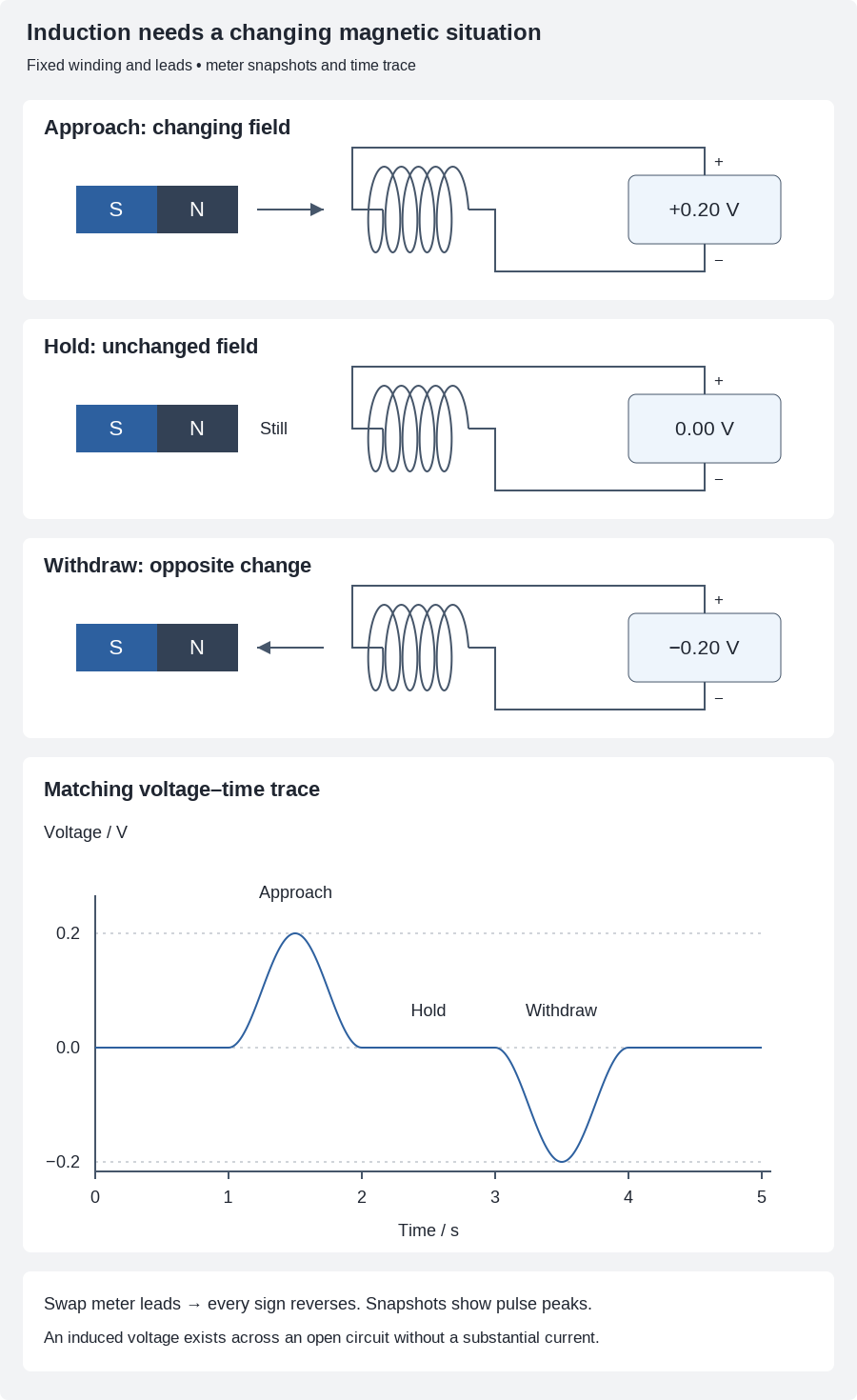
Motion is one way to cause change
A stationary coil can also have an induced voltageA potential difference produced by electromagnetic induction. if an electromagnetA coil carrying current that produces a magnetic field, usually strengthened by a soft iron core. nearby creates a changing field. Relative motion is not essential when the field itself changes.
A straight conductorA material containing mobile charged particles that carry an electric current. moving across a magnetic fieldA region where magnets, magnetic materials or moving charges experience magnetic forces. can develop a potential differenceThe energy transferred per unit charge between two points, measured in volts. between its ends. Motion parallel to the field does not give the same charge-separating effect. Moving a magnet and coil together with an unchanged relative arrangement does not automatically induce voltage.
Increase the induced voltage
A faster change of field through the coil gives a larger induced voltageA potential difference produced by electromagnetic induction.: move the same magnet faster along the same path, use a stronger magnet, or use more turns linking the changing field. State what is held constant in a comparison.
Faster motion through the same change can produce a taller, shorter potential differenceThe energy transferred per unit charge between two points, measured in volts. pulse.
Voltage does not guarantee current
A voltmeterAn instrument connected in parallel to measure potential difference. can detect an induced potential differenceThe energy transferred per unit charge between two points, measured in volts. across an open coil. A substantial induced electric currentThe amount of electric charge passing a point per unit time, measured in amperes. needs a complete conducting circuit; its size also depends on circuit resistanceThe ratio of potential difference across a component to the current through it, measured in ohms..
When induced current flows, its magnetic effect opposes the change producing it. Work is needed to sustain the motion, transferring mechanical energyA conserved quantity transferred between stores by working, heating, electrical processes or radiation, measured in joules. into electrical energy and eventual dissipationTransfer of energy to less useful stores, usually spread through the surroundings by heating.. Induction is not a source of energy without an input.
A useful investigation
Keep coil turns, magnet, lead polarity and approach path fixed while comparing slow and fast movements. Repeat runs and compare peak potential differenceThe energy transferred per unit charge between two points, measured in volts. or an oscilloscopeAn instrument displaying how an input voltage changes with time. trace; hand motion is a significant source of variation.
Then change one factor at a time. Record zero while the magnet is held still and the reversed pulse on withdrawal. This demonstrates the need for change, not merely the presence of a strong magnet.
Equations
Common misconceptions
- A stationary magnet beside a stationary coil gives no sustained induced voltage.
- An open circuit can have induced voltage without a substantial current.
- Changing field can induce voltage without mechanical motion.
- Voltage sign depends on the fixed wiring convention.