Learning goals
- Arrange two permanent magnets to create a useful uniform region.
- Describe uniform magnitude and direction.
- Identify edge effects and limits of the approximation.
Arrange opposite poles
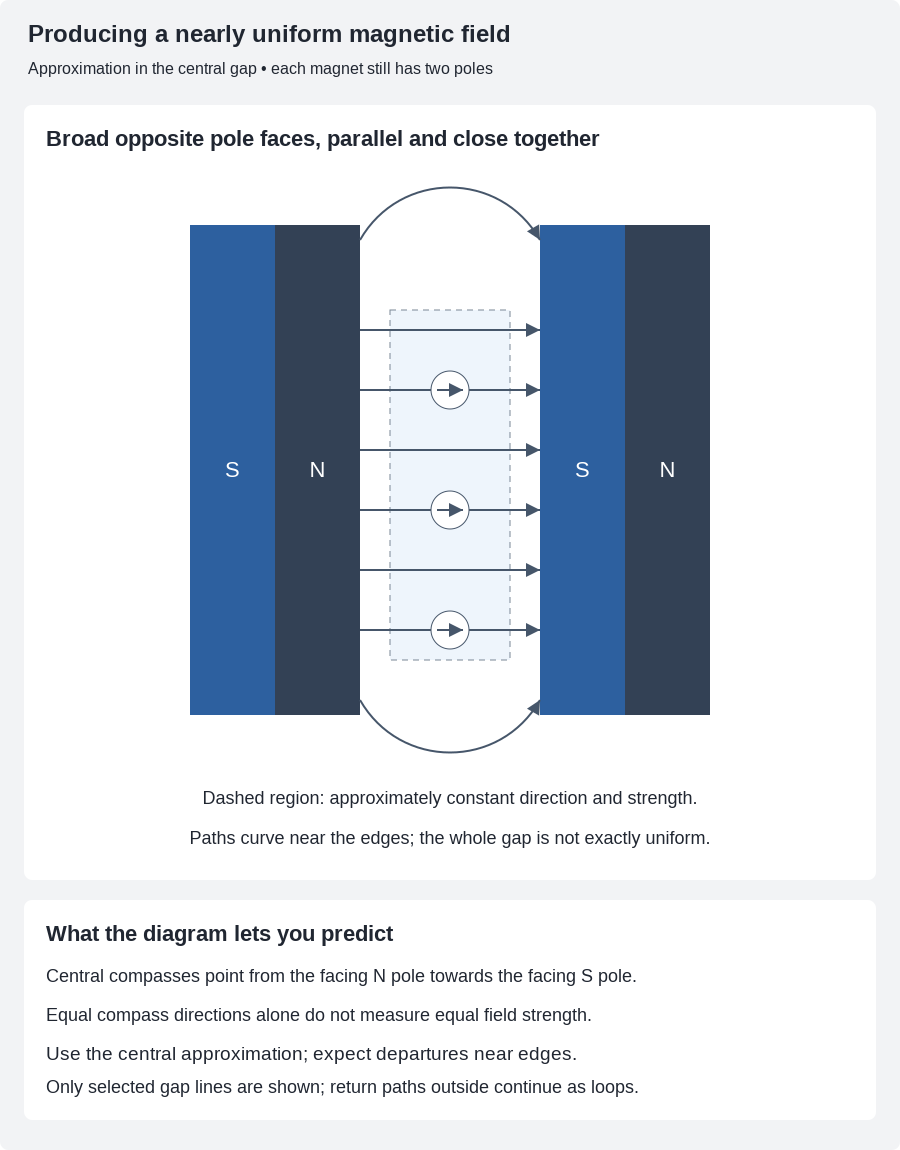
Place broad, flat north and south pole faces opposite one another with their faces parallel. Keep their separation small compared with the face dimensions. The field in the middle of the gap is then approximately uniform.
Two permanent magnetAn object that retains its magnetisation without an external magnetising field. can provide these facing poles. The figure shows their facing pole regions; each magnet also has an opposite pole farther from the gap. It does not show isolated single poles.
What uniform means
A uniform fieldA field with the same magnitude and direction at every point in a region. has the same magnitude and direction at every point in the selected region. Represent it using parallel, straight, equally spaced lines, with arrows from the north face towards the south face.
Several small compasses placed in that region point in nearly the same direction. Direction agreement alone does not prove the magnitude is constant, so it is only part of the evidence for uniformity.
Edges and distance matter
Near the edges the lines curve outward and the field is less uniform. The dashed box in the figure identifies the central region where the ideal uniform approximation is most useful.
Increasing the gap or using small curved pole tips makes the uniform region less extensive. Do not label the entire surrounding space uniform just because a few central lines are straight.
Connect to later applications
A current-carrying wire placed in a nearly uniform fieldA field with the same magnitude and direction at every point in a region. can experience a predictable forceA push or pull arising from an interaction between objects, measured in newtons.. Motors use the interaction between a field and electric currentThe amount of electric charge passing a point per unit time, measured in amperes., developed later in this topic.
Uniform does not mean zero. A nonzero uniform field has a definite direction and strength even though neither changes across the chosen region.
Equations
Common misconceptions
- Use opposite poles facing; like poles do not create this central uniform pattern.
- Uniform refers to both strength and direction.
- The approximation applies to the central gap, not the edge regions.
- Each permanent magnet still has both north and south poles.