Reasoning about circuits and charge
Trace charge and energy separately, predict circuit changes and test an electrical explanation against its conditions.
Specification 2.2, 2.3, 2.6, 2.7, 2.8, 2.9, 2.10, 2.11, 2.13, 2.14, 2.16, 2.17, 2.18, 2.19, 2.20, 2.24P, 2.25P, 2.26P, 2.27P
Ratings, marks and Maths and Logic completion stay in this browser on this device. Written answers are temporary and are never recorded or transmitted. Reset clears only Physics practice progress, including Maths and Logic completion.
Answers and choices are temporary. Only started/completed flags are saved on this device. Practice can be retried or revealed; the check counts each question’s first answer. These are original practice tasks, not official exam questions.
Starting here
Choose the physical quantity before building an explanation. Current is charge passing each second; voltage is energy transferred per charge. A component transfers energy without using up charge.
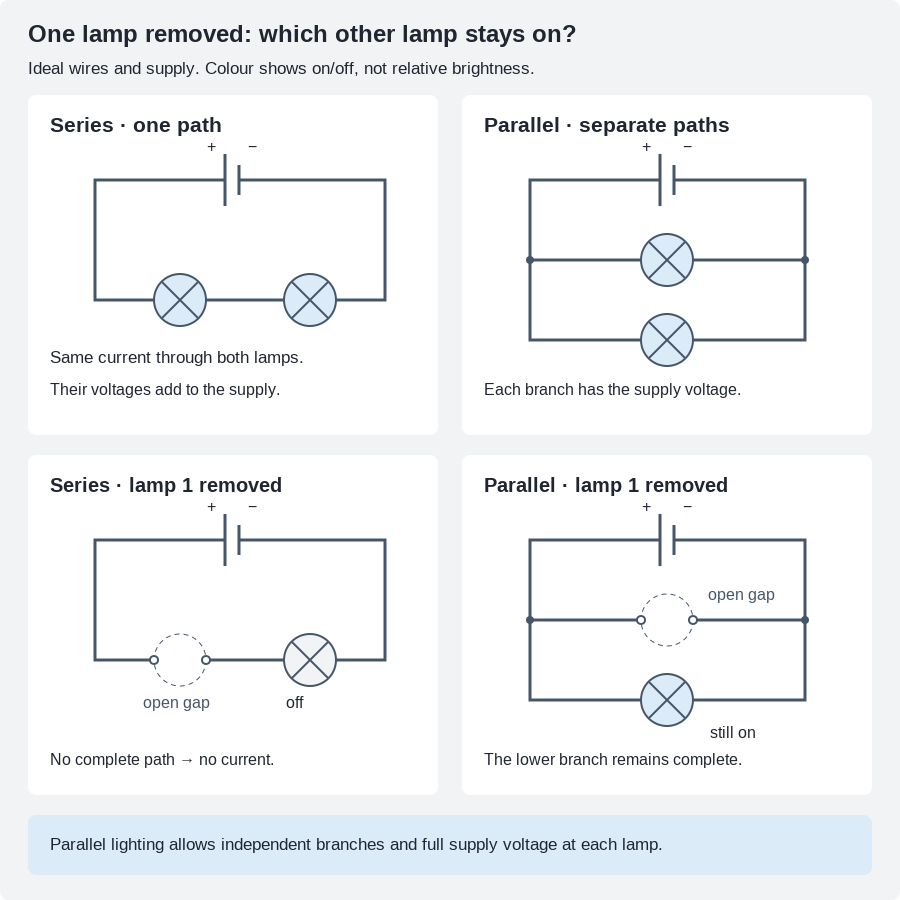
Circuit predictions depend on connections and controlled conditions. Trace whether paths are in series or parallel, then state whether the source voltage and component resistance stay fixed. The figure shows why breaking one series path differs from opening one parallel branch.
Key ideas
- Steady series current is the same throughout; branch currents add at junctions.
- Parallel components across the same two points have the same voltage, but need not have equal currents.
- R=V/I describes an operating point. Constant resistance requires appropriate physical conditions, such as a stable temperature for a metal resistor.
Worked example
Two resistors connect in parallel across an ideal fixed-voltage supply. One branch is opened. A student says the other resistor gets twice the voltage because it no longer shares the supply. Assess the claim.
- Connections. Both branches originally connected across the same two supply points.
- Rule. Each branch already had the full supply voltage.
- Prediction. Opening one branch leaves the other’s voltage unchanged. If its resistance stays fixed, its current is unchanged, while total supply current decreases.
Answer: The claim treats voltage like a substance divided between branches. Parallel voltage is set by the common endpoints, under the stated ideal-supply condition.
Activities
Opens when you finish the stage above.
Build the skill
Opens when you finish the stage above.
Check
Opens when you finish the stage above.