Learning goals
- Describe LDR behaviour in brighter light.
- Describe thermistor behaviour as temperature changes.
- Apply sensor changes to a control circuit.
Light-dependent resistance
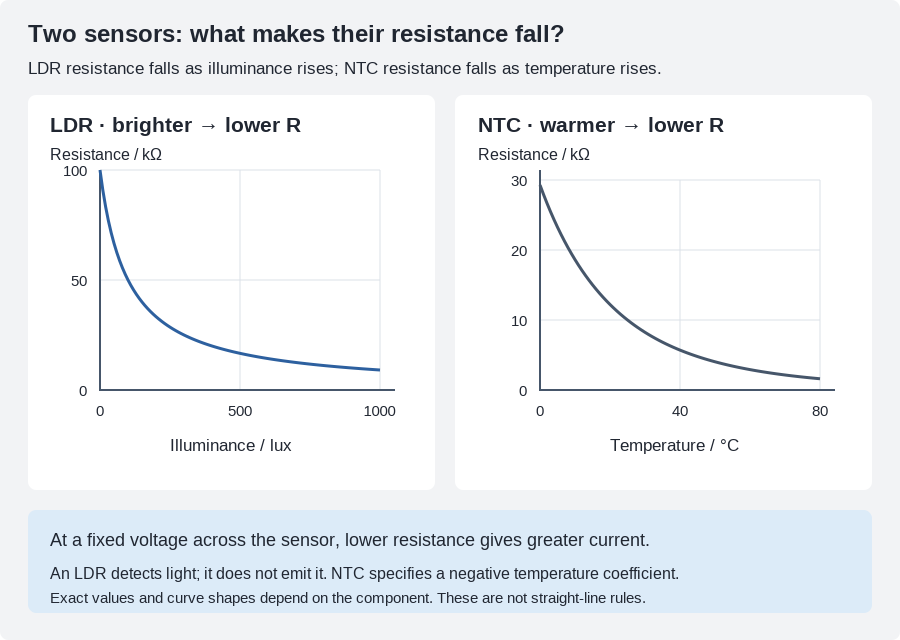
An light-dependent resistorA component whose resistance decreases as the light intensity on it increases. is a light-dependent resistor. Greater illumination reduces its resistanceThe ratio of potential difference across a component to the current through it, measured in ohms.; in darkness its resistance is much higher. It detects illumination rather than producing light. In a fixed-voltage circuit, a lower LDR resistance allows a larger electric currentThe amount of electric charge passing a point per unit time, measured in amperes..
The plotted curve is an example, not a universal calibration. Real resistance depends on the component and illumination conditions, and the relationship is not usually a straight line.
Temperature-dependent resistance
For the NTC thermistorA resistor whose resistance changes with temperature, decreasing on heating for the NTC type used in this course. used here, resistanceThe ratio of potential difference across a component to the current through it, measured in ohms. decreases as temperatureA measure of how hot a system is, related to the average kinetic energy of its particles. rises. NTC means negative temperature coefficient. At a fixed potential differenceThe energy transferred per unit charge between two points, measured in volts. across the thermistor, heating it therefore increases electric currentThe amount of electric charge passing a point per unit time, measured in amperes.. A cooling thermistor has the opposite change.
An ordinary metal wire usually increases in resistance when heated, so do not generalise its response to an NTC thermistor. Other thermistor types exist; this page explicitly uses NTC behaviour.
Turn a resistance change into a signal
A sensor can form part of a measuring or switching circuit. For example, an light-dependent resistorA component whose resistance decreases as the light intensity on it increases. can provide a resistanceThe ratio of potential difference across a component to the current through it, measured in ohms. change when illumination changes, and a thermistorA resistor whose resistance changes with temperature, decreasing on heating for the NTC type used in this course. can provide a resistance change when temperatureA measure of how hot a system is, related to the average kinetic energy of its particles. changes.
The graphs alone give the resistance trend. To predict electric currentThe amount of electric charge passing a point per unit time, measured in amperes., state whether the potential differenceThe energy transferred per unit charge between two points, measured in volts. across the sensor is fixed and consider any other components in the circuit. A lower sensor resistance does not by itself establish how every part of a more complex circuit responds.
Equations
Common misconceptions
- An LDR does not produce light; it changes resistance when light falls on it.