Learning goals
- Explain how a lamp indicates current.
- Compare lamps and LEDs qualitatively.
- Recognise polarity for an LED.
A visible sign of current
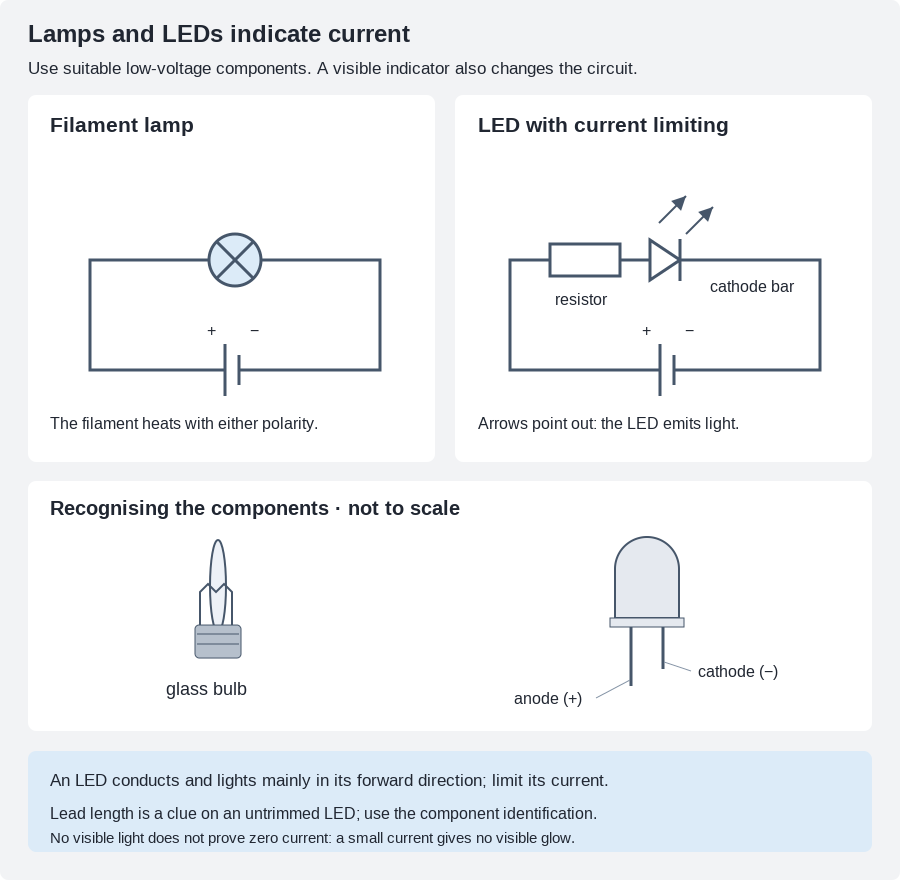
A filament lampA component that produces light by heating a thin wire with an electric current. becomes hot enough to emit visible lightElectromagnetic radiation with wavelengths detected by the human eye, from violet to red. when sufficient electric currentThe amount of electric charge passing a point per unit time, measured in amperes. flows. The circuit symbol is a circle containing a cross. A suitable filament lamp can operate with either current direction, and its resistanceThe ratio of potential difference across a component to the current through it, measured in ohms. changes as it heats.
A lit lamp is evidence of current, but an unlit lamp does not prove zero current. The current may be too small to make the filament visibly glow, the lamp may have failed, or the circuit may be open.
LED direction and protection
An light-emitting diodeA semiconductor diode that emits light when a suitable forward current passes through it. is a light-emitting diode. It lights when sufficiently forward biased, with conventional currentThe direction positive charge would flow, opposite to electron movement in a metal. from anode to cathode. Its symbol has a cathode bar and outward arrows for emitted light. The bar is not an arrow saying which way light travels through the wire.
Use an appropriate current-limiting arrangement, often a series resistorA circuit component designed to provide resistance to electric current., because forward electric currentThe amount of electric charge passing a point per unit time, measured in amperes. can rise sharply. Reverse polarity normally gives very little current and no light; excessive reverse potential differenceThe energy transferred per unit charge between two points, measured in volts. can damage the component.
Recognise the component and the limit of the indicator
On many untrimmed light-emitting diodeA semiconductor diode that emits light when a suitable forward current passes through it., the longer lead is the anode and a flat side or shorter lead marks the cathode, but identification must match the actual component. The figure labels the illustrated leads rather than assuming all packages look the same.
Neither indicator is an ideal wire or a precise electric currentThe amount of electric charge passing a point per unit time, measured in amperes. meter. It adds a component to the circuit and can change the current being investigated.
Equations
Common misconceptions
- A lamp or LED is not a perfect conductor; it changes the circuit current.