Learning goals
- Distinguish AC from DC by direction.
- Recognise a cell or battery as a DC source and mains as an AC supply.
- Interpret positive and negative regions of a current–time graph.
Choose a current direction
electric currentThe amount of electric charge passing a point per unit time, measured in amperes. direction is defined as the direction of flow of positive electric chargeA property of particles responsible for electrical interactions, measured in coulombs.: conventional currentThe direction positive charge would flow, opposite to electron movement in a metal.. In a metal the mobile electronA negatively charged subatomic particle found outside an atom’s nucleus. drift in the opposite direction. Pick a reference direction before drawing a signed current graph; a positive value means current in that direction and a negative value means the reverse.
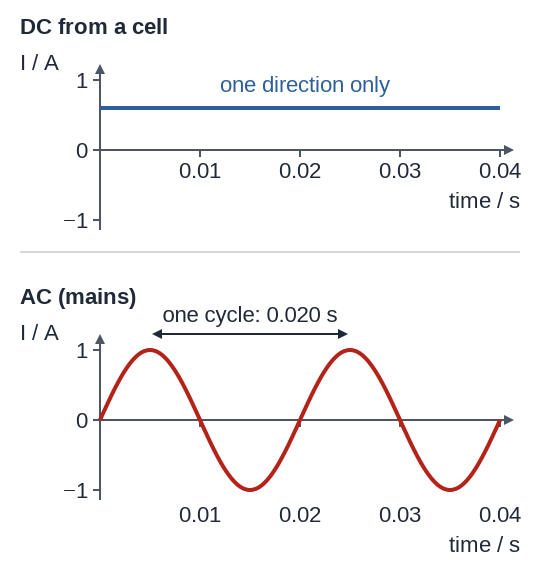
direct currentA flow of electric charge that keeps the same direction., DC, flows in one direction. A cell or battery supplies DC to a simple closed circuit. It is often drawn as a constant current, but the size can vary as resistanceThe ratio of potential difference across a component to the current through it, measured in ohms. or the source changes without reversing the current direction.
Alternating current
An alternating supply reverses its polarity repeatedly, causing the electric currentThe amount of electric charge passing a point per unit time, measured in amperes. to reverse in a resistive circuit. Mains electricity is AC. A current–time graph crosses zero and has both positive and negative regions when the current alternates.
The AC curve has a peak magnitude of 1 A and repeats every 0.020 s. That is 1/0.020 = 50 complete cycles per second, or 50 Hz. There are two direction changes per complete sinusoidal cycle; frequencyThe number of complete oscillations or wave cycles per second, measured in hertz. counts full cycles, not individual reversals. This graph is an example, not a measurement of a particular supply.
What the signs do not mean
A negative electric currentThe amount of electric charge passing a point per unit time, measured in amperes. does not mean negative energyA conserved quantity transferred between stores by working, heating, electrical processes or radiation, measured in joules. or less electric chargeA property of particles responsible for electrical interactions, measured in coulombs. exists: it records direction relative to your chosen reference. AC and DC are not distinguished by which has greater magnitude.
An AC-powered resistorA circuit component designed to provide resistance to electric current. heats during both directions of current. Reversing the drift direction does not undo the energy already transferred to the lattice.
Equations
Common misconceptions
- DC need not have constant magnitude; its defining feature is one direction.
- A 50 Hz sinusoid completes 50 cycles per second, rather than only 50 direction changes.