Learning goals
- Calculate energy using current, voltage and duration.
- Convert time into seconds for a joule answer.
- Distinguish power from energy and interpret a power–time area.
From a rate to a total
powerThe energy transferred or work done per unit time, measured in watts. is energyA conserved quantity transferred between stores by working, heating, electrical processes or radiation, measured in joules. transferred each second. If power stays constant, multiplying it by the duration gives the total energy: E = Pt. Since electrical power is IV, this becomes E = IVt. Use amperes, volts and seconds to obtain joules.
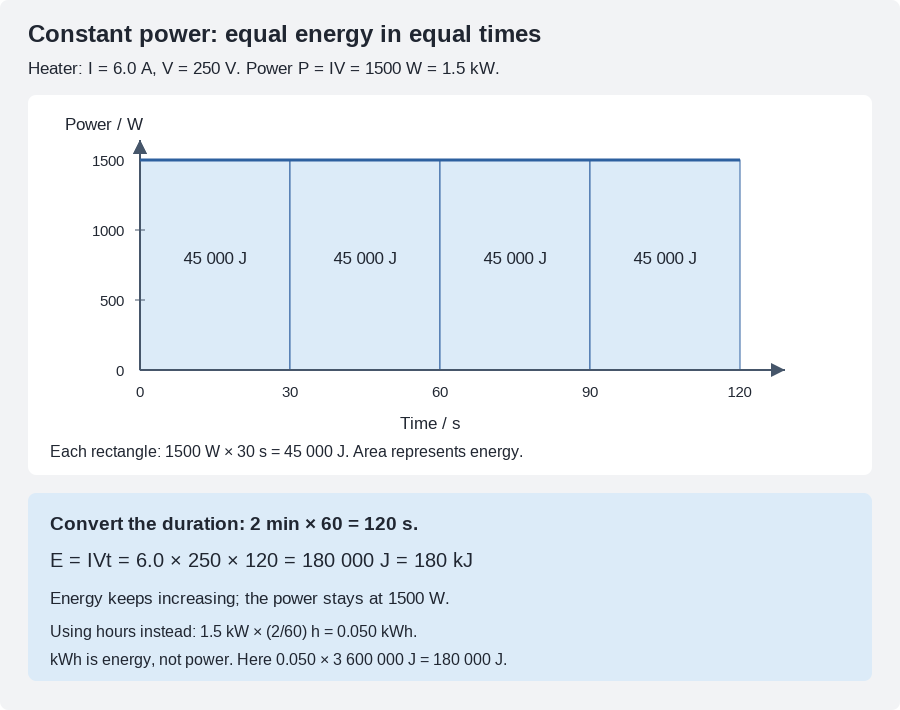
A power–time graph represents the same relationship. A rectangular area has height P and width t, so its area is Pt, the transferred energy. Equal durations at the same power contribute equal amounts of energy.
Worked example: two minutes of heating
A heater draws 6.0 A at 250 V for two minutes. powerThe energy transferred or work done per unit time, measured in watts. is 6.0 × 250 = 1500 W. Convert the duration: 2 × 60 = 120 s. Then E = 6.0 × 250 × 120 = 180 000 J = 180 kJ.
The figure divides 120 s into four 30 s intervals. Each transfers 1500 × 30 = 45 000 J, so the total is 4 × 45 000 = 180 000 J. Power remains 1500 W while accumulated energyA conserved quantity transferred between stores by working, heating, electrical processes or radiation, measured in joules. increases.
A different energy unit
When powerThe energy transferred or work done per unit time, measured in watts. is in kilowatts and duration in hours, their product is energyA conserved quantity transferred between stores by working, heating, electrical processes or radiation, measured in joules. in kilowatt-hours, kWh. For this example, 1.5 × (2/60) = 0.050 kWh. One kWh is 1000 W × 3600 s = 3 600 000 J; converting 0.050 kWh gives the same 180 000 J.
If electric currentThe amount of electric charge passing a point per unit time, measured in amperes. or potential differenceThe energy transferred per unit charge between two points, measured in volts. varies, do not use one arbitrary instantaneous value for the whole interval. Divide the transfer into suitable intervals or use the appropriate average power.
Equations
- E = IVt, with constant I and V
- E = Pt, with constant P
- 1 kWh = 3.6 × 10⁶ J
Common misconceptions
- Watts and kilowatts measure power; joules and kilowatt-hours measure energy.
- Using minutes in E = IVt without converting does not give joules.
Connect charge flow to energy transfer
Change steady current, voltage and elapsed time, then compare charge passing a point with energy transferred.
What you see
- Labelled diagrams and numerical outputs describe the same selected state.
How to use it
- Change one control at a time, predict the outcome, then compare the readouts. All controls have keyboard-accessible sliders and step buttons.
- Reset restores every model control to its initial value. Nothing is saved.
What it shows
- Q=It sets the charge passing a point. Voltage is energy transferred per unit charge, so E=QV=IVt and P=IV. Doubling voltage at fixed current doubles energy but leaves charge unchanged. A resistor transfers electrical energy to thermal stores; its temperature also depends on quantities this model does not specify.
Limits of the model
- Current and component voltage are held constant at the selected operating values. Their relationship for a particular real component is not modelled.
- Elapsed time is scrubbed over 60 s. Charge is the amount passing a point, not charge created or consumed in a component. No temperature rise or cooling rate is calculated.
Controls
Q=It=0.5×20=10 C. E=QV=10×6=60 J. P=IV=3 W. At zero elapsed time, no charge has yet passed and no energy has yet transferred, even if the operating power is non-zero.
Predict, change and explain
At 0.5 A and 6 V, predict charge and energy after 20 s. Double only voltage: which graph changes? Then restore voltage and double current. Explain how a component can transfer more energy per coulomb without using up the charge.
Connect the outcome to the Physics
Q=It sets the charge passing a point. Voltage is energy transferred per unit charge, so E=QV=IVt and P=IV. Doubling voltage at fixed current doubles energy but leaves charge unchanged. A resistor transfers electrical energy to thermal stores; its temperature also depends on quantities this model does not specify.