Learning goals
- Calculate power, current or voltage with P = IV.
- Convert kilowatts to watts.
- Choose a suitable offered fuse rating in a stated model.
Why power depends on current and voltage
potential differenceThe energy transferred per unit charge between two points, measured in volts. tells you how much energyA conserved quantity transferred between stores by working, heating, electrical processes or radiation, measured in joules. is transferred per coulomb, and electric currentThe amount of electric charge passing a point per unit time, measured in amperes. tells you how many coulombs pass each second. Multiplying them gives energy transferred each second: P = IV. powerThe energy transferred or work done per unit time, measured in watts. P is in watts, current I in amperes and voltage V in volts.
At a fixed voltage, a larger current means more power transferred. To find current, divide power by voltage: I = P/V. To find voltage, rearrange to V = P/I. The values must describe the same operating condition.
Worked example: an offered fuse choice
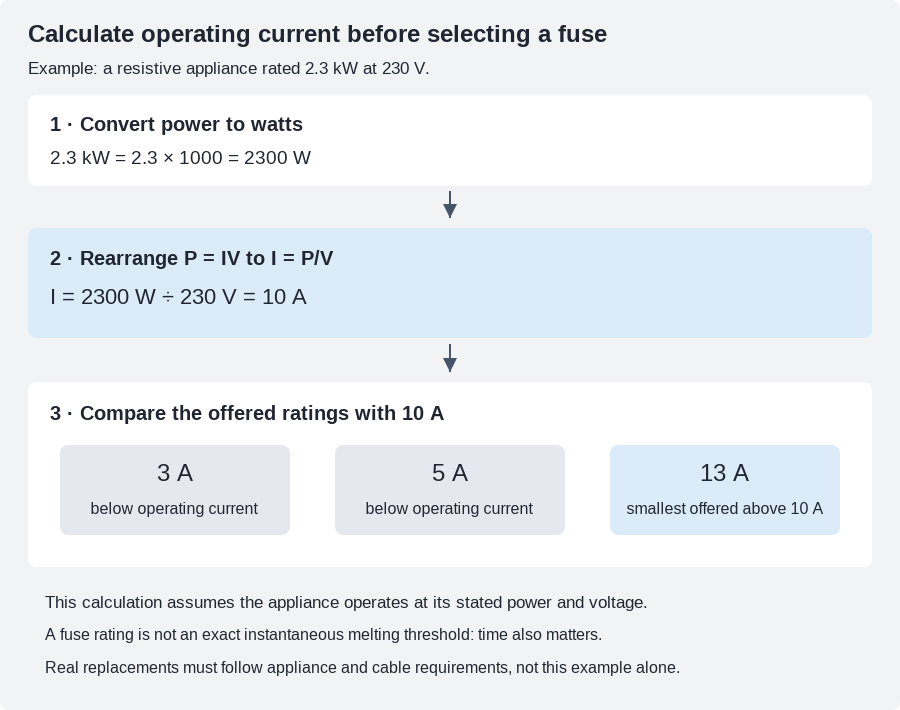
A resistive appliance is rated 2.3 kW at 230 V. First convert: 2.3 kW = 2300 W. Then I = 2300/230 = 10 A. Suppose a question offers fuseA safety device with a wire that melts when excessive current heats it, breaking the circuit. ratings of 3 A, 5 A and 13 A.
The 3 A and 5 A options are below the normal operating electric currentThe amount of electric charge passing a point per unit time, measured in amperes.. Of the offered options, 13 A is the smallest rating above 10 A and is the appropriate choice in this stated example. Explain the comparison rather than choosing a large fuse without calculation.
What the rating does and does not mean
A fuseA safety device with a wire that melts when excessive current heats it, breaking the circuit. must allow normal operation while providing protection against excessive electric currentThe amount of electric charge passing a point per unit time, measured in amperes.. A rating is not a sharp instantaneous threshold at which the wire always melts; its heating and operating time depend on the current.
Actual fuse selection must follow the appliance and cable requirements and account for operating characteristics, including any starting current. An arbitrarily higher rating can allow damaging current for too long.
Equations
- P = IV
- I = P/V
- V = P/I
Common misconceptions
- Convert kW to W before dividing by volts to obtain amperes.
- A higher-rated fuse is not automatically safer.