Learning goals
- Explain resistance heating in terms of charge and the material.
- Distinguish useful heating from unwanted energy transfer.
- Avoid treating current as a substance consumed by a component.
What changes inside a resistor?
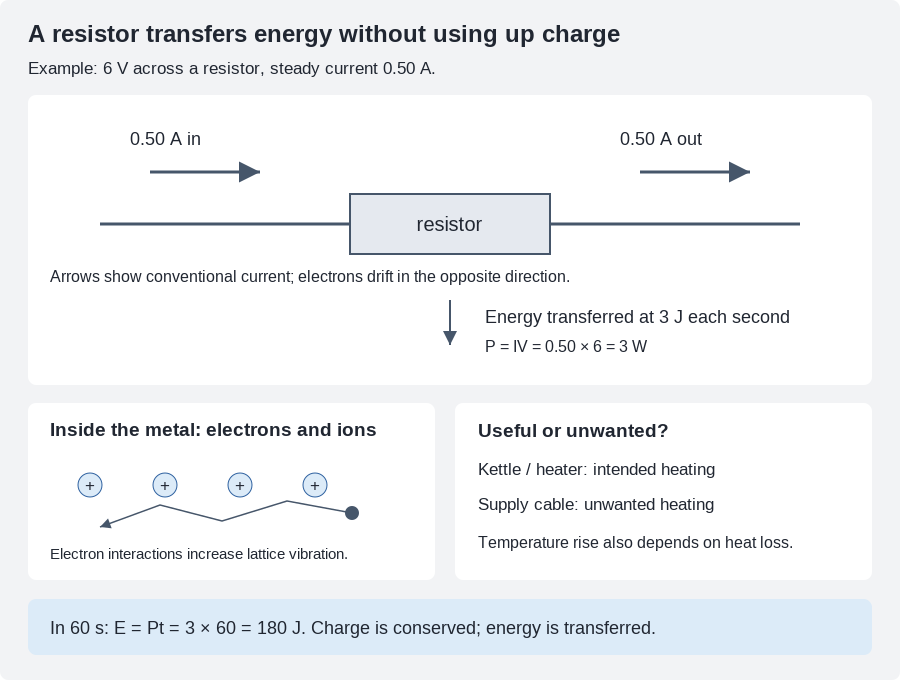
In a metal, mobile electronA negatively charged subatomic particle found outside an atom’s nucleus. move through a lattice of positive ionAn atom or group of atoms with a net charge because electrons have been gained or lost.. The electric fieldA region where an electric charge experiences an electrical force. drives a net electron drift, and interactions with the lattice transfer energyA conserved quantity transferred between stores by working, heating, electrical processes or radiation, measured in joules. to the material. Increased lattice vibration raises its internal energyThe total microscopic kinetic and potential energies of the particles within a system. and can increase its temperatureA measure of how hot a system is, related to the average kinetic energy of its particles.. The microscopic sketch shows electron drift; particle sizes, spacings and paths are not to scale.
electric chargeA property of particles responsible for electrical interactions, measured in coulombs. is not used up. In a steady series circuitA circuit with one continuous path through its components, so the same current passes through each., the amount of charge entering a resistorA circuit component designed to provide resistance to electric current. each second equals the amount leaving. Electrical energy is transferred by the component even though the electric currentThe amount of electric charge passing a point per unit time, measured in amperes. on its two sides is the same.
Useful applications and losses
A kettle or electric heater is designed to transfer energyA conserved quantity transferred between stores by working, heating, electrical processes or radiation, measured in joules. into thermal stores. In a kettle, the element transfers energy to the water. A toaster uses a hot element that transfers energy to the bread, including by infrared radiationElectromagnetic radiation with wavelengths longer than visible red light, emitted by objects because of their temperature..
Heating in supply cables is usually unwanted: it reduces useful energy delivery and excessive heating can damage insulation. A hot component may reach a steady temperatureA measure of how hot a system is, related to the average kinetic energy of its particles. when energy transfer to its surroundings balances electrical input; continued energy transfer does not always mean continued temperature rise.
Connect heating to power
In the example, a resistorA circuit component designed to provide resistance to electric current. has 6 V across it and electric currentThe amount of electric charge passing a point per unit time, measured in amperes. 0.50 A. The electrical powerThe energy transferred or work done per unit time, measured in watts. is IV = 0.50 × 6 = 3 W: 3 J is transferred each second. Over 60 s, E = Pt = 3 × 60 = 180 J. The next pages develop these equations.
The temperatureA measure of how hot a system is, related to the average kinetic energy of its particles. change also depends on the massThe quantity measuring an object’s inertia, expressed in kilograms., material and heat lost to the surroundings. Do not claim that a larger resistanceThe ratio of potential difference across a component to the current through it, measured in ohms. always gives more heating without stating what happens to the current and potential differenceThe energy transferred per unit charge between two points, measured in volts..
Equations
- power transferred = IV
- energy transferred = power × time
Common misconceptions
- A resistor transfers energy; it does not consume charge or reduce the steady current from one side to the other.
- Constant electrical input need not cause an indefinite temperature rise.
Connect charge flow to energy transfer
Change steady current, voltage and elapsed time, then compare charge passing a point with energy transferred.
What you see
- Labelled diagrams and numerical outputs describe the same selected state.
How to use it
- Change one control at a time, predict the outcome, then compare the readouts. All controls have keyboard-accessible sliders and step buttons.
- Reset restores every model control to its initial value. Nothing is saved.
What it shows
- Q=It sets the charge passing a point. Voltage is energy transferred per unit charge, so E=QV=IVt and P=IV. Doubling voltage at fixed current doubles energy but leaves charge unchanged. A resistor transfers electrical energy to thermal stores; its temperature also depends on quantities this model does not specify.
Limits of the model
- Current and component voltage are held constant at the selected operating values. Their relationship for a particular real component is not modelled.
- Elapsed time is scrubbed over 60 s. Charge is the amount passing a point, not charge created or consumed in a component. No temperature rise or cooling rate is calculated.
Controls
Q=It=0.5×20=10 C. E=QV=10×6=60 J. P=IV=3 W. At zero elapsed time, no charge has yet passed and no energy has yet transferred, even if the operating power is non-zero.
Predict, change and explain
At 0.5 A and 6 V, predict charge and energy after 20 s. Double only voltage: which graph changes? Then restore voltage and double current. Explain how a component can transfer more energy per coulomb without using up the charge.
Connect the outcome to the Physics
Q=It sets the charge passing a point. Voltage is energy transferred per unit charge, so E=QV=IVt and P=IV. Doubling voltage at fixed current doubles energy but leaves charge unchanged. A resistor transfers electrical energy to thermal stores; its temperature also depends on quantities this model does not specify.