Learning goals
- Explain insulation and double insulation.
- Trace a live-to-case fault through earth and a fuse.
- Distinguish overcurrent protection from residual-current protection.
Prevent a conducting path through a person
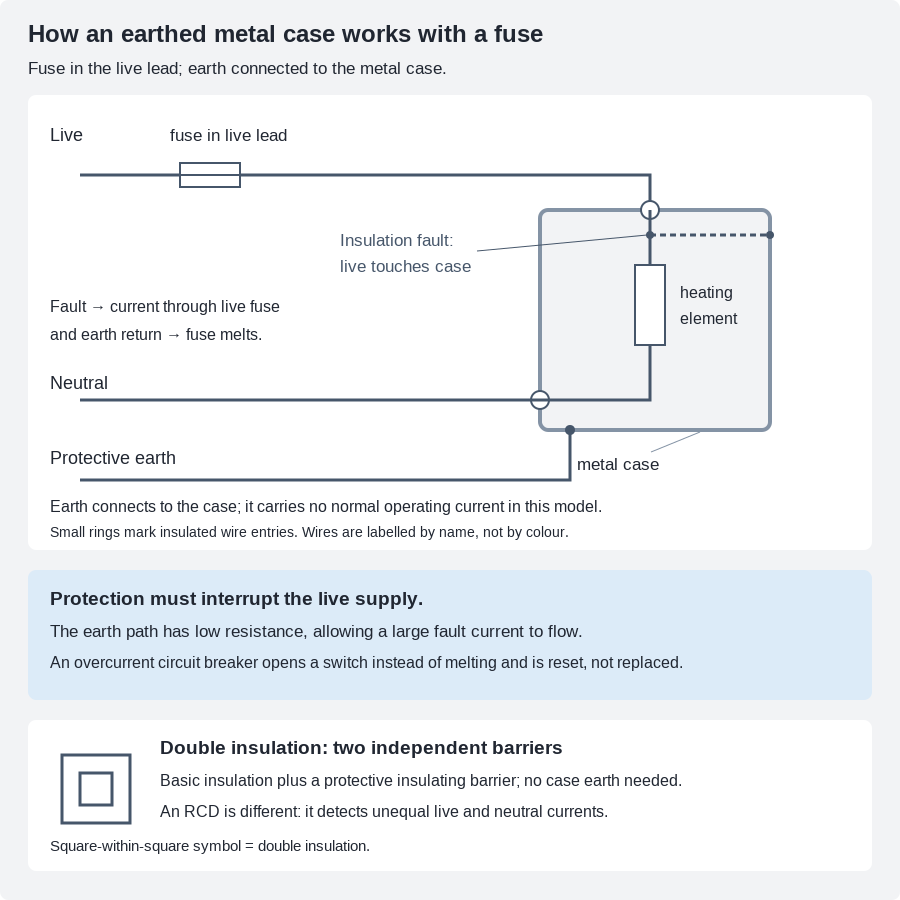
A conducting connection between points at different potentials can drive electric currentThe amount of electric charge passing a point per unit time, measured in amperes. through the body. Insulating material around live conductorA material containing mobile charged particles that carry an electric current. prevents contact. In a double-insulated appliance, basic insulation and an additional protective insulating barrier keep accessible parts separated from live conductors. The square-within-square symbol identifies double insulationProtection using insulated internal parts and an insulating outer case so that no earth connection is required.; such equipment does not require a protective earth connection to its case.
Earthing a metal case
An earthed appliance has a protective conductorA material containing mobile charged particles that carry an electric current. connecting its metal case to earth. In normal operation the electric currentThe amount of electric charge passing a point per unit time, measured in amperes. flows through live, the working component and neutral; the protective earth carries no normal operating current in the circuit shown. The figure marks insulated entries so normal conductors are not connected to the case.
If damaged insulation lets live touch the case, the low-resistance earth path allows a large fault current to flow. That current also passes through the live fuseA safety device with a wire that melts when excessive current heats it, breaking the circuit. or overcurrent breaker. Protection disconnects the live supply, reducing the time for which the fault persists. Earth does not “absorb electricity”; it provides a conducting fault-return path.
Fuses and circuit breakers
A fuseA safety device with a wire that melts when excessive current heats it, breaking the circuit. contains a thin wire that heats and melts under sufficient excess electric currentThe amount of electric charge passing a point per unit time, measured in amperes., opening the circuit. It is placed in the live conductorA material containing mobile charged particles that carry an electric current. so opening it disconnects the appliance from live. An overcurrent circuit breakerA safety device that opens a circuit when the current becomes excessive and is reset after the fault is corrected. opens a switch when an excessive current condition is detected and can be reset after the fault is addressed.
A residual-current device (RCD, beyond the specification) detects a difference between currents in live and neutral, indicating that some current is taking another path. This is a different operating principle from a fuse. Protection devices reduce risk but do not make touching live parts safe.
Equations
Common misconceptions
- The earth wire is not the normal return conductor; neutral performs that role.
- A fuse in neutral alone can leave an appliance connected to live after it opens.
- Double insulation and protective earthing are different protective arrangements.