Learning goals
- State the junction rule.
- Add branch currents.
- Explain conservation of charge.
Charge conservation at a junction
A junctionA point where circuit branches meet, with total current entering equal to total current leaving. joins conducting paths. In a steady circuit, electric chargeA property of particles responsible for electrical interactions, measured in coulombs. cannot continually accumulate there, so the total electric currentThe amount of electric charge passing a point per unit time, measured in amperes. entering equals the total current leaving. Current is charge per second, making this a statement of conservation of charge.
Identify arrow directions before adding values. Several currents may enter or leave; do not assume every labelled branch points the same way.
Worked parallel example
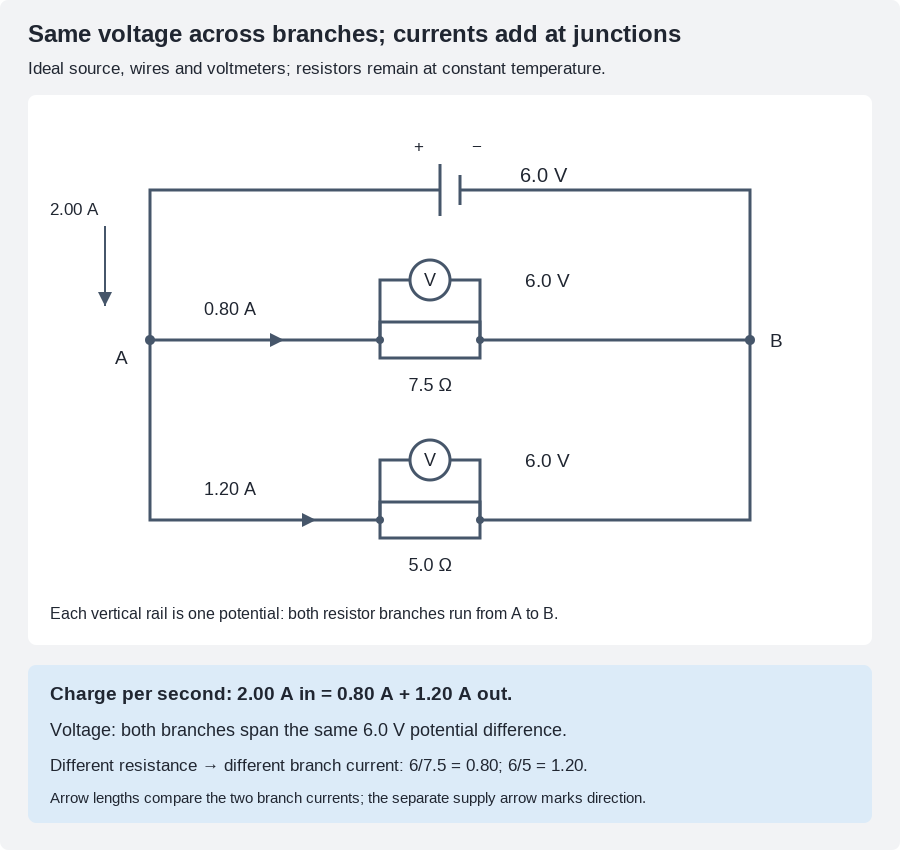
In the figure, 2.00 A enters junctionA point where circuit branches meet, with total current entering equal to total current leaving. A. The upper resistorA circuit component designed to provide resistance to electric current. branch carries 0.80 A. The remaining electric currentThe amount of electric charge passing a point per unit time, measured in amperes. in the lower path must be 2.00 − 0.80 = 1.20 A. At the return junction the two branch currents combine to give 2.00 A again.
Over one second this means 2.00 C enters, 0.80 C takes the upper branch and 1.20 C the lower branch. The bookkeeping is the same whether you describe currents or equal-time electric chargeA property of particles responsible for electrical interactions, measured in coulombs. transfers.
Assumptions and distinctions
The voltmeterAn instrument connected in parallel to measure potential difference. are ideal and draw negligible electric currentThe amount of electric charge passing a point per unit time, measured in amperes. in this model. Real meter currents would need inclusion if they were significant. The division is determined by the branch resistanceThe ratio of potential difference across a component to the current through it, measured in ohms. and potential differenceThe energy transferred per unit charge between two points, measured in volts., not an automatic equal split.
The junctionA point where circuit branches meet, with total current entering equal to total current leaving. rule concerns current. Voltage is a difference between two points and is not a substance divided at a junction; the following page explains why parallel voltages are equal.
Equations
- current in = current out
Common misconceptions
- Current is not divided permanently; charge continues around each complete branch.
Change one branch of a parallel circuit
Distinguish a common branch voltage from the currents that add at a junction.
What you see
- Labelled diagrams and numerical outputs describe the same selected state.
How to use it
- Change one control at a time, predict the outcome, then compare the readouts. All controls have keyboard-accessible sliders and step buttons.
- Reset restores every model control to its initial value. Nothing is saved.
What it shows
- Both branches connect across the same two supply points, so each has the full supply voltage. Calculate each current separately using I=V/R, then add them at the junction. Changing one branch resistance does not change the other branch voltage with this ideal supply; it changes total supply current.
Limits of the model
- An ideal d.c. supply maintains the chosen voltage, with negligible wire resistance and two fixed-resistance branches.
- This is a low-voltage resistor model; it does not model filament-lamp brightness.
Controls
Each branch current is its voltage divided by its own resistance. Supply current is the sum; the model does not use a parallel-resistance formula. At zero supply voltage all currents and component voltages are zero.
Predict, change and explain
Start at 6 V with R₁=4 Ω and R₂=8 Ω. Predict the two branch currents and the supply current. Increase only R₁. Explain why branch 2 is unchanged in this ideal model and relate this to independently supplied domestic lighting branches.
Connect the outcome to the Physics
Both branches connect across the same two supply points, so each has the full supply voltage. Calculate each current separately using I=V/R, then add them at the junction. Changing one branch resistance does not change the other branch voltage with this ideal supply; it changes total supply current.