Learning goals
- Identify the charge carriers in metals.
- Distinguish electron direction from conventional current.
- Explain why a metal circuit conducts.
Which particles can move through a metal?
A metal contains positive ionAn atom or group of atoms with a net charge because electrons have been gained or lost. in a lattice and mobile electronA negatively charged subatomic particle found outside an atom’s nucleus.. The ions vibrate around their positions; they do not travel around the circuit. Electrons are negatively charged and are the mobile electric chargeA property of particles responsible for electrical interactions, measured in coulombs. carriers in a solidA state of matter whose closely packed particles vibrate around fixed positions, giving a fixed shape and volume. metallic conductorA material containing mobile charged particles that carry an electric current..
Without an applied driving field the electrons still move irregularly, but their motion has no overall drift in one direction. An electric fieldA region where an electric charge experiences an electrical force. adds a small net drift to that motion, giving a electric currentThe amount of electric charge passing a point per unit time, measured in amperes..
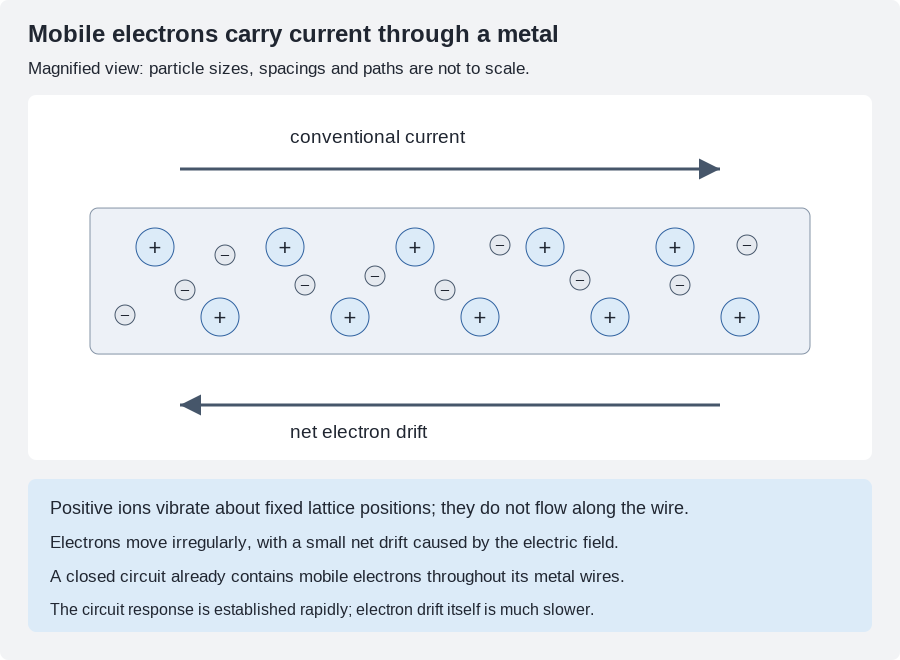
Two opposite direction conventions
conventional currentThe direction positive charge would flow, opposite to electron movement in a metal. is defined in the direction positive electric chargeA property of particles responsible for electrical interactions, measured in coulombs. would move. In the external circuit of a cell it runs from the positive terminal towards the negative terminal. electronA negatively charged subatomic particle found outside an atom’s nucleus. drift in the metal is opposite.
The figure shows equal positive and negative symbols to represent a neutral sample. A metal does not need to become strongly negative overall to carry a electric currentThe amount of electric charge passing a point per unit time, measured in amperes.. The drawing exaggerates particles and spacing and is not a literal track for one electron.
Why a lamp responds promptly
electronA negatively charged subatomic particle found outside an atom’s nucleus. are already present throughout the metal circuit. When the circuit is completed, the electric fieldA region where an electric charge experiences an electrical force. establishing the circuit response spreads rapidly. The lamp does not wait for one electron to travel all the way from the cell.
The electrons themselves drift much more slowly while also moving irregularly. Electrical energyA conserved quantity transferred between stores by working, heating, electrical processes or radiation, measured in joules. transfer and the drift speedThe distance travelled per unit time, without specifying direction. of individual carriers are different ideas.
Equations
Common misconceptions
- Electrons do not travel from the battery to the lamp at the speed of light; the electric field establishes the circuit response rapidly.